
Chord Melody Piano: The Barry Harris Method
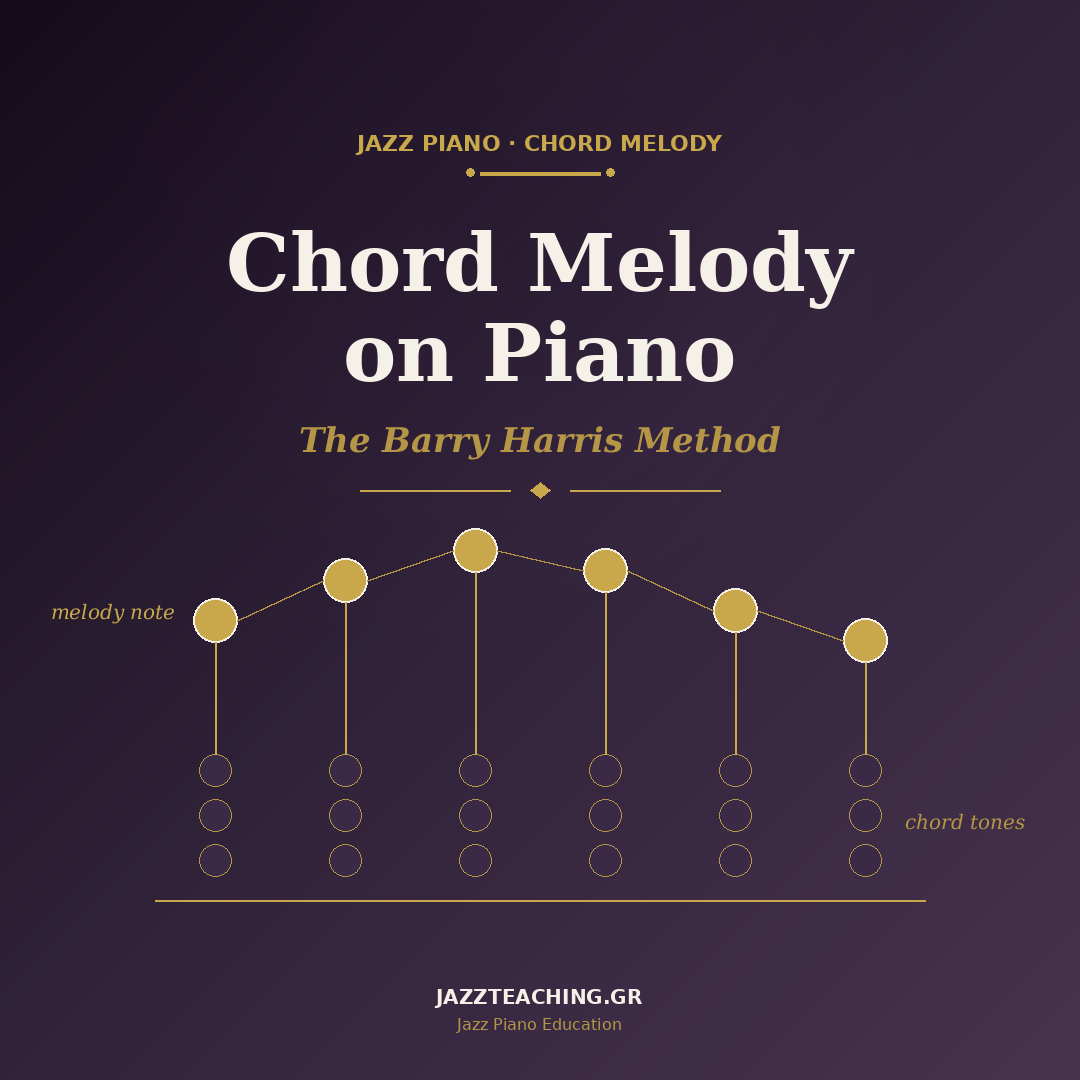
Melody Harmonization on the Piano — The Barry Harris Method for Chord Melody
We play chords with the melody in the right hand — the technique that gives jazz standards a rich, orchestral sound and forms the foundation of chord melody playing.
JazzTeaching.gr · Piano · Intermediate / Advanced
Melody harmonization on the piano is one of the most essential skills a jazz pianist can develop. Instead of just playing the melody with the right hand, you dress it with chords — bringing each melody note to the top of the corresponding inversion. The result: a rich, orchestral sound much closer to what you hear from the great jazz pianists.
This technique is mainly applied to jazz standards written up to 1958 — the classic Great American Songbook — and works beautifully on melodic lines without too many eighth notes. One of the greatest teachers who developed this philosophy systematically was Barry Harris — the legendary bebop pianist and educator who spent decades teaching that “music is motion” and that every note exists in relation to the harmony around it.
Why Learn It — The Advantages
- Rich sound: Every melody note has harmonic support — you sound like you’re playing with a whole ensemble.
- You play the melody where it’s written: No need to move it up an octave.
- Opening to reharmonization: Once you master the inversions, you have the foundation to combine motion, chromatic movement, and modern harmony later on.
- Self-sufficient sound: You can play a tune with no backing track and sound complete.
The Basic Principle — Melody Always on Top
The core principle is simple: find the inversion of the chord where the melody note sits at the top. That means you need to know all three inversions of every chord — it isn’t optional, it’s a prerequisite.
In the left hand we play the root and the top of the chord — an open shell voicing that gives a harmonic foundation without “drowning” the right hand. For the full mechanics of this two-hand approach, see the Barry Harris Voicing Map — the practical chart of “see → think → play”.
Barry Harris taught that there is no such thing as a “static” chord — every harmony is motion. The melody dictates the harmony, not the other way around.
The 4 Situations You’ll Encounter
Situation 1 — The melody note is NOT a chord tone
Look for the closest chord tone to the left on the keyboard. Play first the inversion with that note on top, then release that top note and play the melody note on top. Most of the time you return from the non-chord tone back to the chord tone. Occasionally, to avoid a large stretch, you go to the closest chord tone on the right.
Situation 2 — The melody comes after the chord (rest → note)
Play the root in the left hand first, and exactly on the melody note play everything else: the chord in the right hand and the top of the chord in the left hand. This small time delay gives rhythmic character and musicality.
Situation 3 — Large leaps in the melody
When the melody makes a large leap, play the other inversion with the new top note and continue. In short: every large leap is filled with an inversion. This keeps voice leading smooth and avoids awkward hand positions.
Situation 4 — The melody descends and clashes with the chord tones
Here, some chord tones are released gradually. Try to hold on to as many notes as can be held — a gradual release gives a much better sound than dropping the whole chord at once.
Barry Harris’s Contribution — The Sixth Diminished System
Barry Harris developed one of the most elegant systems for melody harmonization in jazz education: the sixth-diminished scale. Instead of using many different chords, he narrowed the harmonic palette to two alternating chords:
I6
Major chord with a sixth
C6 = C · E · G · A
IIdim7
Diminished on the 2nd degree
Ddim7 = D · F · A♭ · B
These two chords together form an 8-note scale that covers every note of the major key — allowing smooth voice leading on any melody note. The beauty of the system is its simplicity: two colours, infinite possibilities.
For Barry Harris, harmonization was never a static process. He used to say that “music is motion” — every chord leads to the next with logic and necessity, following the flow of the melody. The full theoretical background — how the chromatic scale gives birth to these two colours — is explained in Barry Harris Theory: Family Chords & the Genesis of Jazz Harmony.
Extra Tips for a Better Result
Practical Refinements
- Maj7 → 6: When the root is in the melody over a major chord with a major seventh, switch to major 6 — this avoids the clash between the root and the major seventh.
- Note early — chord early: When the chord tone arrives early in the melody, play the chord early too. Melody and harmony move together.
- Chord changes on beats 1 and 3: In most jazz standards the harmonic changes happen on the first and third beats of the bar.
- Use the pedal sparingly: Whatever can be held with the fingers and played legato doesn’t need the sustain pedal — otherwise the harmonies blur and you lose the clarity of the sound.
How to Start — A Practical Study Guide
Melody harmonization is a skill you build gradually. Here’s how to approach it:
Practice Guide
- Start without a backing track. The first phase is about listening to your own sound and paying attention to the chords and voicings — the backing track comes later, once you have flow.
- Slowly and cleanly. Every melody note must have the correct inversion underneath it — before you push the tempo.
- Learn all the inversions first. Without them you can’t bring the melody to the top — they are the foundation of the whole technique.
- Pick simple standards. Start with tunes whose melody moves mostly stepwise and doesn’t have many eighth notes — e.g. Autumn Leaves, All The Things You Are.
- Watch where the melody is going. Always look ahead — how many fingers you have available, which inversion you’ll need on the next beat.
Conclusion
Harmonizing the melody with chords in the right hand is one of the most transformative skills a jazz pianist can develop. It combines technique, harmonic awareness, and musicality in one. Barry Harris’s system reminds us that simplicity — two alternating harmonic colours — can produce infinite musical richness.
Take a jazz standard you love, find the inversions, bring the melody to the top — and hear how different you sound.
Continue the Barry Harris series
This article sits between two others in the Barry Harris method:
← Barry Harris Theory: Family Chords & the Genesis of Jazz Harmony
Jazz Piano Newsletter
Want to go deeper into jazz piano?
Free lessons, articles, and practice material straight to your inbox — from Barry Harris’s method to real jazz standards.
Subscribe to the NewsletterChristos Mastrogiannidis
Pianist & Educator · JazzTeaching.gr
Jazz pianist and educator, trained at Berklee College of Music and Kunstuniversität Graz. Teaches jazz piano online, based in Greece.




One Comment