Music Practice: Moving On or Going Deeper?
«Don’t think of progress as moving on. Think of it as going deeper down.»
— Kenny Werner, Becoming the Instrument
This idea from Kenny Werner describes something I see very often in my lessons, and something that occupies me more and more over the years, both as a musician and as a teacher.
Who is Kenny Werner
An American jazz pianist, composer and educator. In 1996 he wrote Effortless Mastery: Liberating the Master Musician Within, one of the most influential books on the mindset of practice, and since 2014 he has been artistic director of the Effortless Mastery Institute at Berklee College of Music. His book Becoming the Instrument: Lessons on Self-Mastery from Music to Life (2022) continues that line of thought.
A student learns a new voicing, a scale, a harmonic progression or a jazz standard and, as soon as they can play it, their first thought is: “Great, I’ve got it. What’s next?”
That’s completely natural. We’re used to thinking of progress as a road where we keep adding new things. More scales, more voicings, more tunes, more theory. But music doesn’t quite work that way.
Very often, what we really need isn’t to learn something new, but to discover how much we still haven’t understood about what we already know.
Knowing something is not the same as owning it
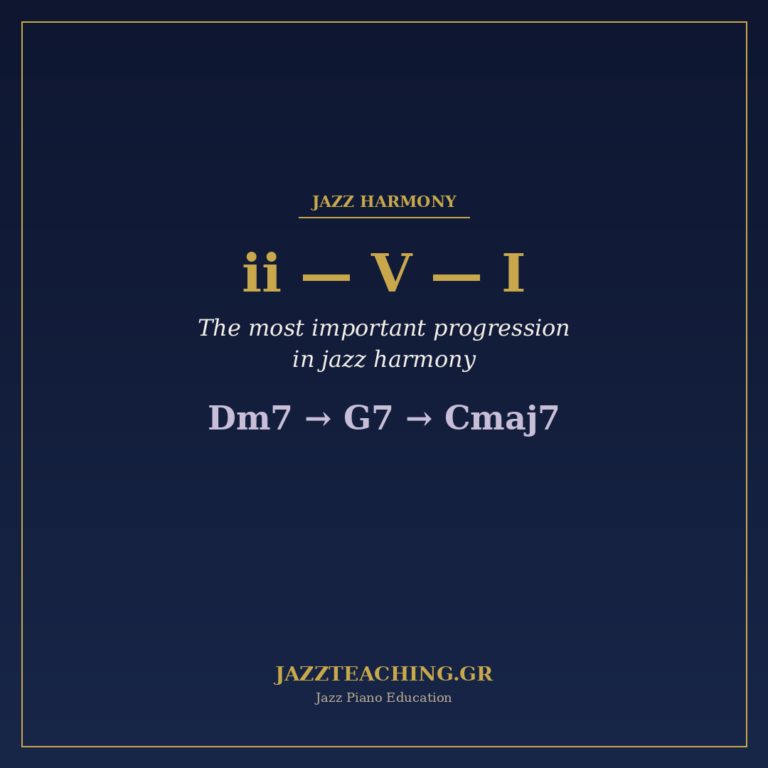
Let’s take a simple example. A student learns a II–V–I. They understand the chords, find the notes and can play the progression correctly.
So have they learned the II–V–I? It depends on what we mean by “learned.”
Can they play it in all twelve keys? Can they use it in different inversions on the piano? Can they create a melodic line through those chords? Can they play it at different tempos, with a different rhythmic feel? Can they recognize it by ear? And above all, can they use it spontaneously while playing music, without having to think about every note?
So there’s a huge distance between “I know something” and “I own it.” And that distance is covered through practice. Not necessarily with more material, but with more depth.
Kenny Werner points out that real progress isn’t just about playing something correctly. It’s about the ease we gain when something becomes truly familiar. And that ease doesn’t come from understanding something in theory. It takes time, repetition and patience.
We don’t practice exercises to play exercises
Another of Werner’s ideas that I find especially important is the distinction between what we practice and the effect practice has on our playing as a whole.
When we practice a scale, for example, the goal isn’t to run up and down it while we improvise. When we work on a rhythmic independence exercise, it doesn’t mean we’ll use that exact exercise in a tune. And when we study the harmonic movements and Barry Harris’s chord families, the goal isn’t simply to memorize a series of mechanical moves.
The goal is for all of this to gradually change the way we hear, think and play. To start seeing connections where we used to see isolated chords. To hear melodic possibilities where we used to see only a scale. To gain rhythmic freedom where we used to need constant control.
This is something I consider very important in teaching. An exercise doesn’t need a direct application in a tune to be useful.
A small rhythmic exercise can improve your overall sense of time. One specific harmonic progression can help you understand dozens of others. A hand-independence exercise can give you more freedom in musical situations completely different from the one you practiced.
In other words, the exercise isn’t necessarily the music we want to play. It’s a means of developing the skills that will let us play the music we want.
From playing it right to musical freedom
There’s a third point I find just as important. Many students stop working on an exercise the moment they manage to play it correctly.
But playing something correctly doesn’t necessarily mean you can play it with ease. You might hit every note without a mistake and still need all your concentration to pull it off.
So what happens when you also have to listen to the bass player, follow the drummer, respond to a phrase from the soloist or come up with your own musical idea? Suddenly, what you played correctly at home becomes difficult.
Why? Because playing correctly under the controlled conditions of practice is one thing, and actually using it in music is another.
Ease doesn’t just mean we can play something without mistakes. It means we’ve become familiar enough with it that we don’t have to give all our attention to executing it.
And that’s when something very interesting starts to happen. Our attention is freed up. We can listen better, react, make musical decisions, express ourselves. In other words, we start making music instead of just trying to execute correctly what we’ve practiced.
This doesn’t mean technique stops mattering. Quite the opposite. Technique is what allows us not to think about technique all the time.
Maybe we need to practice fewer things
In all my years of teaching, I’ve found that one of students’ biggest problems isn’t always that they practice too little. Often it’s that they practice too many different things, without giving any of them the time it needs to sink in.
A bit of a scale, a bit of a voicing, a bit of a new tune, an improvisation exercise, some interesting video we saw on YouTube. In the end we’ve touched on a lot, but how much of it has actually made its way into our playing?
And there’s a trap here. Because new information often gives us the feeling that we’re moving forward, we can neglect the process needed to turn that information into real knowledge.
Of course I’m not saying we should practice the same thing forever, or that we don’t need new knowledge. What I am saying is that we need to learn to tell the difference between collecting information and developing musical skills.
For example, we can spend a whole week working on just one simple melodic phrase. Take it through different keys. Change its rhythm. Use it over different harmonic settings. Transform it. Sing it. Hear it inside a tune.
From the outside it may look like we keep doing the same thing. In reality, we’re developing many different musical abilities. That’s what going deeper means.
In practice: one week, one phrase
- Take it through different keys.
- Change its rhythm.
- Use it over different harmonic settings.
- Transform it.
- Sing it.
- Hear it inside a tune.
Mistakes aren’t always something to avoid
There’s one more side of practice we often overlook: our relationship with mistakes.
We often practice trying constantly not to make a mistake, as if every wrong note were a small failure. But a mistake can show us exactly which spot we haven’t mastered yet.
Instead of getting frustrated or trying to skip past it, we can stop there, notice what’s happening and work on it with more attention.
We don’t need to prove at every moment that we can play correctly. Practice is exactly the space where we’re allowed not to know, to try things and to make mistakes. As long as we don’t turn repetition into a mechanical process where we simply replay the same mistake.
Meaningful repetition needs observation. And often we need to stop, take our hands off the piano for a moment and start again. Not with more force, but with more awareness.
So how do we measure our progress?
Maybe we should slightly change the questions we ask ourselves after a period of practice.
Instead of asking “How many new scales did I learn?”, ask “Can I use the ones I already know more musically?” Instead of counting how many new tunes we’ve added to our repertoire, think about how much better we understand and hear the ones we already play. And instead of assuming we’ve finished an exercise because we played it correctly, ask whether it really helped us become freer musically.
Because in the end, that’s what interests me most in music education. Not how much information a student has collected, but how much of it has become part of their musical thinking.
Knowledge is necessary. But on its own it isn’t enough. It takes time, repetition, experimentation, mistakes and, above all, real contact with the musical material.
At the end of his chapter, Kenny Werner sums up the goal of practice in one very simple phrase:
«Practice for freedom.»
I think this is the heart of the whole discussion. We don’t practice to fill our heads with more information, or to prove how much we know. We practice to gain the freedom to express what we hear and feel inside.
And maybe real progress in music isn’t always about getting somewhere new. Sometimes it’s about coming back to where we were and discovering that we now hear, understand and play it completely differently.
This article was inspired by the chapter “The Goals of Practice” from Kenny Werner’s book “Becoming the Instrument: Lessons on Self-Mastery from Music to Life” (2022), combined with my own observations and experiences from teaching jazz.
JazzTeaching.gr
Jazz isn’t information. It’s a way of thinking.
One-on-one jazz piano lessons, online
I teach private lessons on Zoom, starting from wherever you are right now. Your first lesson is a free 60-minute trial, so we can get to know each other and see if it’s a good fit.
About the lessonsJazz Piano Newsletter
The next article, in your inbox
About once a month: new articles, practice ideas and free material on jazz piano and the Barry Harris method. No spam, one-click unsubscribe.
SubscribeChristos Mastrogiannidis
Jazz Pianist & Educator · Berklee College of Music · Kunstuniversität Graz · Founder of JazzTeaching.gr