Ear training for jazz piano: 9 exercises from 6 great teachers
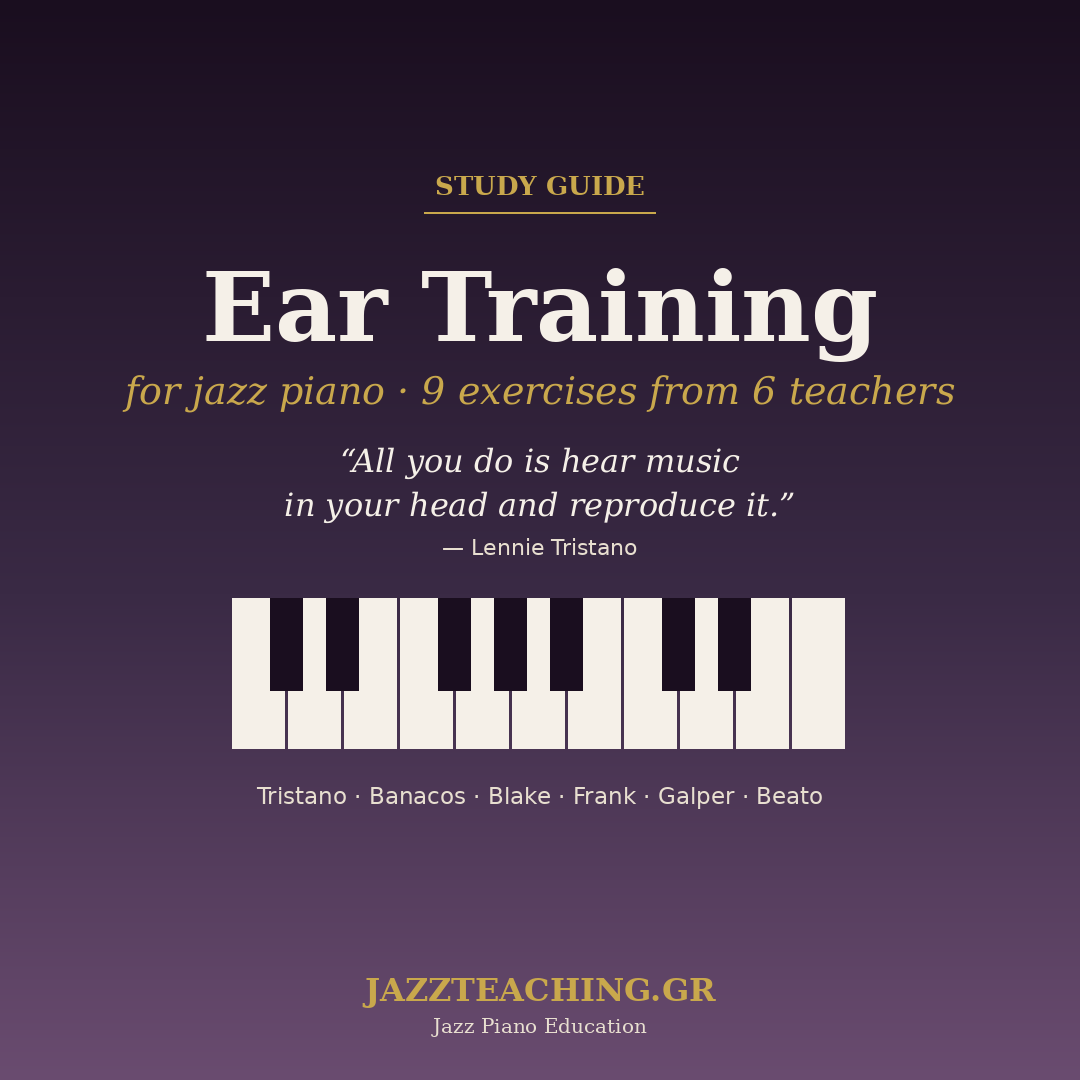
I have been teaching jazz piano for thirty years, and the question I hear most often isn’t about voicings or scales. It’s this: “How do I get an ear?” My answer: ear training for jazz piano isn’t a talent you either have or don’t. It’s daily, methodical work. You listen, you sing, you find it on the keys. No guessing. Much of what I do with my students I owe to six great teachers: Lennie Tristano, Charlie Banacos, Ran Blake, Dave Frank, Hal Galper and Rick Beato. In this article I show you how each of them thought, what I keep from them, and how I tied it all together into a study guide with nine exercises for beginners and intermediate players.
What ear training means for a jazz pianist
In classical music the source is the score. You read it, make it your own, and reproduce it. In jazz you do the same, but you add something: you create in the moment you play. Classical music gives you reproduction; jazz asks for reproduction and creation. They aren’t opposites. They complete each other.
To create, the music first has to sound inside you. That’s what I mean by ear training for jazz piano: not naming intervals in an app, but hearing a note, a chord or a phrase clearly in your head, and knowing where it is on the piano. You don’t need perfect pitch. What an improviser needs is relative pitch: hearing every note in relation to a key. And relative pitch can be built.
The six teachers below don’t agree on everything. Each puts the weight on something different: recognition, inner hearing, memory. That’s why it’s worth meeting them one by one before we get to the exercises.
Six teachers, six ways of listening
Lennie Tristano: hear it inside before you touch the key
Lennie Tristano (1919–1978) was a blind pianist from Chicago and one of the first to teach jazz improvisation systematically. Lee Konitz and Warne Marsh studied at his school in New York. For Tristano everything started with the inner ear. He had his students sing Lester Young and Charlie Parker solos along with the record before they played them on their instrument.
For ear training he worked with a fixed root, usually middle C, and one interval at a time, from the minor second up to the octave. The order was always the same: you play the interval while looking at the keys, you sing it up and down, you play it again and focus mentally on each note without using your voice, and finally you simply listen until it fades. Then you move on to triads, four-note chords and even denser chords.
What I keep: for me this is the strongest system of all, and it’s the one that makes the difference. It doesn’t just teach you to recognize a sound. It teaches you to hear it clearly inside you, note by note, before you play it. I see it with my students every time: when the ear hears clearly, the hand stops searching. And that last step, the silent listening, isn’t wasted time. It’s the moment the sound settles inside you.
Charlie Banacos: every note has its own color
Charlie Banacos (1946–2009) was a pianist and a legendary teacher in Boston. He taught mostly by correspondence, with more than 100 lessons, and his students included Mike Stern, Jerry Bergonzi and Mick Goodrick. He believed ear training has to be tailored to each musician, because every person hears in their own way.
His central exercise: you play a cadence, for example a ii-V-I in C, so the key “locks” into your ear. Then you play a random note and identify it in relation to the key. The goal isn’t to count half steps. “Don’t count,” he told his students: hear the whole. Each note takes on its own character above the tonic, like the minor third with its bluesier color. At first you can use familiar melodies as a bridge for each interval, but the destination is the color, not the song. Banacos also had his students make their own recordings of this exercise so they could practice every day.
What I keep: the cadence as a fixed point of reference, which you replay often so the key doesn’t fade. And tailoring the work to the student, which is the same principle behind my own teaching. Something you may not know: Banacos’s method was documented in the doctoral dissertation of the Athenian pianist Lefteris Kordis, his student and today a professor at Berklee.
Ran Blake: the ear first, the paper later
Ran Blake (b. 1935) is a pianist and teacher at the New England Conservatory, where his principles became the foundation of the Contemporary Improvisation department. He calls his approach the “primacy of the ear.” For Blake, “hearing” music inside you is essentially memory, and memory can be trained.
Instead of writing transcriptions on paper, his students listened to an excerpt, from Billie Holiday, Horace Silver or Ornette Coleman, again and again until they could sing it correctly from memory. Only then were they allowed to take it to their instrument. He also asked for something few teachers mention: not listening to music at certain hours of the day, so the ear can rest. The method is laid out in his book Primacy of the Ear, written with Jason Rogers.
What I keep: memory as part of hearing, and silence as part of practice. What you learn from memory stays. What you copy from paper usually leaves.
Dave Frank: jazz is learned like a language
Dave Frank studied with both Tristano and Banacos, and taught piano at Berklee from 1987 to 2004. He took the tools of his two teachers and added something of his own, which he calls the “Inner Ear Line Method” and presents in his book Joy of Improv. He doesn’t work with single notes but with whole lines, the way you learn phrases in a foreign language.
Three steps: first you learn to play the line, then you hum it while you play it, and finally you play only the chords in the left hand and sing the line. It doesn’t matter how nicely you sing. What matters is hitting the notes over the harmony.
What I keep: the bridge from the interval to the phrase. Many students hear intervals correctly but get lost when they have to sing a melody over changes. The Inner Ear Line closes that gap.
Hal Galper: the real instrument is between your ears
Hal Galper played with Phil Woods and the Brecker Brothers, and taught improvisation for many years. His position is simple: if you can hear it, you can play it. For him all practice is ear training, and every performance is playing by ear.
In one of his lessons he asks a student to imagine a phrase as if she were screaming it inside, and then to play it. The logic: the louder and clearer the signal inside you, the more surely your fingers reproduce it. A hesitant sound usually starts from a faint inner image.
What I keep: the intensity of inner hearing. Tristano teaches you to hear clearly; Galper teaches you to hear with conviction.
Rick Beato: a little, but every morning
Rick Beato is a musician and producer who taught ear training and theory at college level. His approach is the most accessible of all: intervals ascending and descending, always sung, short exercises every day. One of the most useful is “complete the chord”: you hear an incomplete chord and sing the missing note. He also insists that theory and ear training are studied together.
What I keep: consistency. Ten minutes every morning before practice are worth more than two hours once a week.
What remains when you put them side by side
When you study all six, you see that they are really working on three different abilities of the ear. An improviser needs all three:
| Ability | What it means | From whom |
|---|---|---|
| Recognition | You know where you are within the key | Banacos, Beato |
| Inner hearing | You hear clearly inside before you play | Tristano, Galper |
| Memory and language | You keep what you heard and make it your own | Blake, Frank |
To these I add something from my own path: the Barry Harris method. The six teachers show you how to listen. Barry Harris gives you the what: the major and minor 6th, the dominant 7th and the diminished. And he, like the others, had his students sing the melody. Once these sounds are in your ear, jazz harmony stops being a calculation.
All of this gives me the five principles on which I build the guide:
- Always sing. None of the six treats ear training as silent listening. The voice is the shortest road from the ear to the fingers.
- No guessing. If you don’t hear it, don’t throw out a random answer. Sing, go back to the tonic, play it again.
- Inside first, then on the piano. The sound is born in your ear and then goes to the keys. Not the other way around.
- A little, but every day. Fifteen consistent minutes do more than one long session that never gets repeated.
- And silence. The ear needs rest, just as music needs space.
The study guide: ear training exercises for beginners (Level 1)
In the first level we build the ear’s vocabulary: intervals, chord qualities, the four basic sounds of Barry Harris. Don’t rush to the next level. Whatever you build here, you’ll need in every standard.
Exercise 1 · Interval meditation
Influence: Lennie Tristano
- Play middle C and D♭ together (minor second). Look at the keys: you want to know where the sound is.
- While they ring, sing from the bottom up and from the top down.
- Strike it again and, without your voice, focus mentally first on the lower note and then on the upper one.
- Strike it one last time and listen silently until it fades.
One interval a day, up to the octave. You’ll notice that the note you focus on seems to “stand out” from the piano.
Next step: the same four steps with the diatonic triads of C major: C, Dm, Em, F, G, Am, B°. Play the chord together, not broken, and focus mentally on each of its notes.
Exercise 2 · Your own list of anchor melodies
Influence: Charlie Banacos, Rick Beato
For each interval, find a melody you know very well that starts with it. The major second opens Frère Jacques; the tritone opens Maria from West Side Story. Fill in the rest yourself, ideally from standards you’re working on.
- Write the list: one interval, one melody, ascending and descending.
- Play a random interval. If you don’t recognize it right away, sing the opening of each melody until one fits.
- Over time, try to hear the color of the interval without going through the song.
The melody is a bridge, not a destination. And it only works if the song is already inside you.
Exercise 3 · Complete the chord
Influence: Rick Beato
- Play only the root and the perfect fifth: C–G.
- Sing the major third (E), then the minor third (E♭). Feel the difference between major and minor.
- Check on the piano. Then change the root.
- Next step: play C–E–G and sing the seventh, major (B) or minor (B♭).
Sing first, check after. Not the other way around.
Exercise 4 · The four sounds of Barry Harris
Influence: Barry Harris, with Tristano’s sequence
Play the four chords with C as the root:
- C6: C–E–G–A
- Cm6: C–E♭–G–A
- C7: C–E–G–B♭
- C°: C–E♭–G♭–A
- Take each chord through the steps of Exercise 1: play, sing, focus mentally, listen.
- Then close your eyes, play them in random order and name each one.
Notice how similar Cm6 and C° are, and where they differ: only in the fifth.
If you haven’t worked on 6th chords yet, start with my article on Barry Harris voicings with 6th chords. You’ll hear them much more easily once they’re already in your hands.
Ear training exercises for intermediate players (Level 2)
In the second level the ear goes inside the music: key, changes, melodies, phrases. From here on, your hearing starts to show in your playing.
Exercise 5 · Cadence and random note
Influence: Charlie Banacos
- Play Dm7 – G7 – Cmaj7 and let the last chord ring.
- Close your eyes and press a random note in the octave above middle C.
- Sing it. Then sing your way stepwise down (or up) to the tonic.
- Name the degree: “minor third,” “fourth,” “major seventh.”
With a recording: record on your phone the cadence, a note, a few seconds of silence, and the answer in your own voice. Ten minutes of this kind of recording becomes practice material you can listen to anywhere.
When one note gets easy: two notes together, then distant octaves, then other keys and minor cadences. Replay the cadence often so the key doesn’t fade.
Exercise 6 · Sing the guide tones in the ii-V-I
Influence: Dave Frank, Rick Beato
The guide tones, the thirds and sevenths, are the backbone of the harmony. Play the roots D – G – C in the left hand and only thirds and sevenths in the right:
- Line A: C → B → B (♭7 of Dm7 → 3rd of G7 → 7th of Cmaj7)
- Line B: F → F → E (♭3 of Dm7 → ♭7 of G7 → 3rd of Cmaj7)
Sing one line while you play the other, then switch. You’ll hear how the seventh falls a half step to the third. That movement is the ii-V-I.
Exercise 7 · Sing the melody over the chords
Influence: Dave Frank
- Choose the melody of a standard you’re working on. Learn to play it.
- Play it again and hum it at the same time.
- Play only the chords in the left hand and sing the whole melody.
If you get lost, go back one step. Your voice doesn’t matter; hitting the notes over the harmony does.
Exercise 8 · From memory, then to the piano
Influence: Ran Blake, Lennie Tristano
- Choose a short excerpt from a recording: the melody of a standard or 4–8 bars of a solo.
- Listen to it many times during the week: first in the background of your day, then sitting down, with nothing else pulling your attention.
- Sing it along with the recording, then without it. Away from the piano.
- Only when you can sing it correctly from memory, sit at the piano and find it by ear.
It will take longer than a transcription on paper. But what you learn this way stays.
Exercise 9 · Hear it loud, play it once
Influence: Hal Galper
- Take a phrase you already sing correctly, from Exercise 7 or 8.
- Put your hands on the keys, close your eyes and hear the phrase inside you as loudly and clearly as you can.
- Right after, play it, without thinking about fingerings.
If it comes out hesitant, don’t fix it with your fingers. Go back and hear it again, louder.
Exercises 7 to 9 connect directly to working on the language. If you’re wondering why a phrase you sing belongs to you more than a lick you memorized, I explain it in Jazz vocabulary vs jazz licks.
A 15-minute daily ear training routine
A routine that works for most of my students. Do it before the rest of your practice, while your ear is fresh:
| Time | Level 1 | Level 2 |
|---|---|---|
| 0–4′ | Interval meditation (Ex. 1) | The four sounds of Barry Harris (Ex. 4) |
| 4–9′ | Anchor melodies (Ex. 2) | Cadence and random note (Ex. 5) |
| 9–12′ | Complete the chord (Ex. 3) | Guide tones in the ii-V-I (Ex. 6) |
| 12–15′ | The four sounds of Barry Harris (Ex. 4) | Melody or phrase (Ex. 7, 9) |
Exercise 8 doesn’t fit into fifteen minutes, and it doesn’t need to. The listening happens during the day, in the car, on a walk. You get to the piano only when the excerpt is already inside you. And leave hours of the day with no music at all.
Three mistakes I see often
- Guessing. If you don’t hear it, don’t throw out an answer at random. Sing, go back to the tonic, replay the cadence. Methodically, not hastily.
- Speed before clarity. As in playing, groove over speed. One interval you hear clearly is worth more than ten you recognize more or less.
- Ear training without the piano. Apps are useful on the bus. But for a pianist the exercise ends when what you heard is on the keys.
What comes next: advanced ear training for jazz piano
Once the first two levels become a habit, the same teachers open the road upward. Tristano went from three notes to four and many more. Banacos from one random note to clusters of notes. Blake and Frank from the melody to entire solos. In the next article in this series we’ll look at clusters, extensions (9ths, 11ths, 13ths) and how to sing a solo before you play it.
One last thing: ear training for jazz piano never ends, and it doesn’t need to. It needs humility. Every day you hear a little better than yesterday, and it shows first in the way you listen to other musicians, and then in the way you play.
Sources
- Dave Frank, Master Class #19: Ear Training – Theory and Practice, Dave Frank School of Jazz.
- Dave Frank & John Amaral, Joy of Improv, Hal Leonard.
- Ran Blake & Jason Rogers, Primacy of the Ear (2010).
- Lefteris Kordis, doctoral dissertation on the pedagogy of Charlie Banacos, New England Conservatory.
- Hal Galper, lesson “The Illusion of an Instrument.”
- Rick Beato, video series Ear Training Practice (Lessons 1–7), YouTube.
Jazz Piano Newsletter
The next article, in your inbox
About once a month: new articles, practice ideas and free material on jazz piano and the Barry Harris method. No spam, one-click unsubscribe.
SubscribeChristos Mastrogiannidis
Jazz pianist and educator · Berklee College of Music, Kunstuniversität Graz · Barry Harris Method · 30 years of teaching