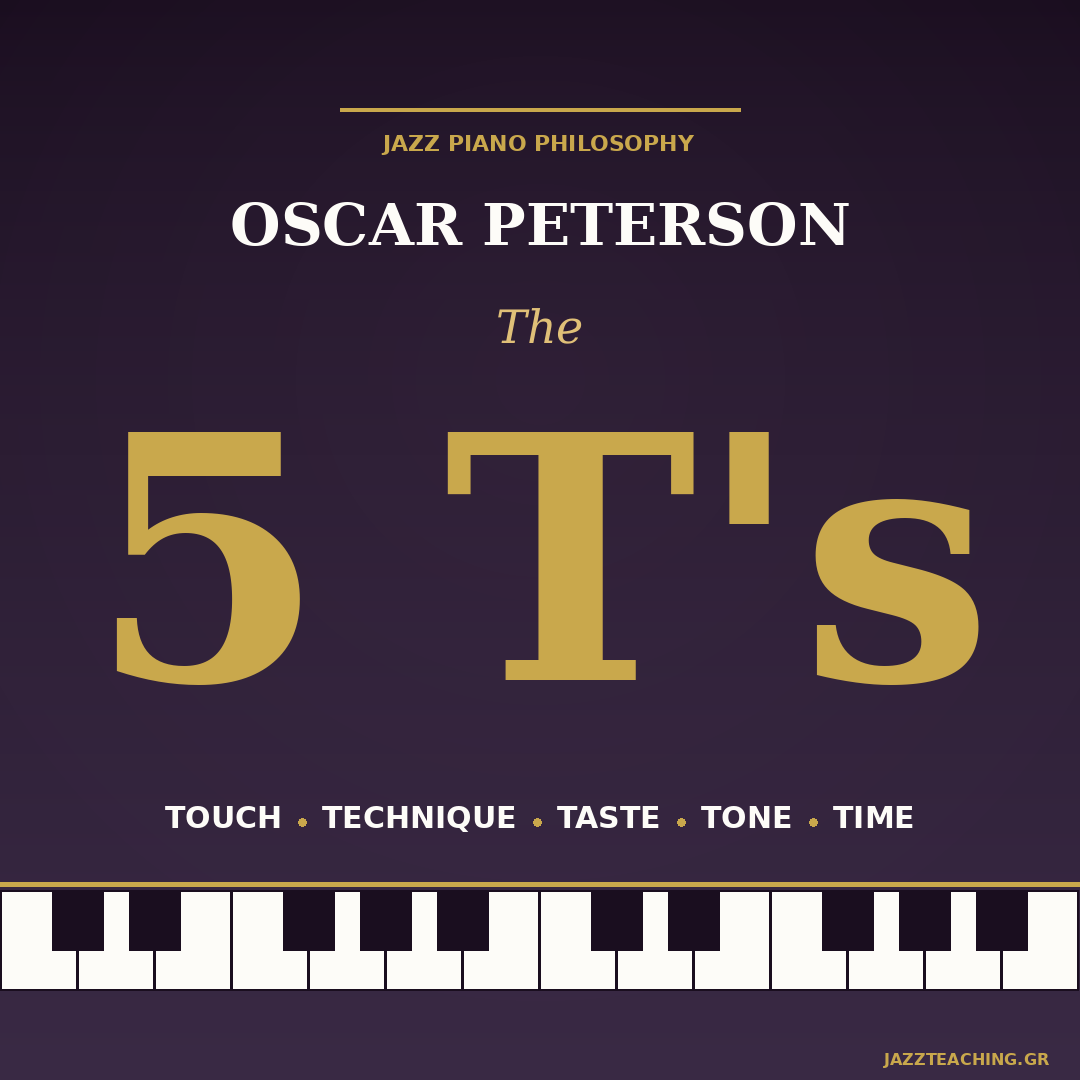
Oscar Peterson’s 5 T’s: A Jazz Piano Philosophy
“It’s not enough to play correctly. You have to play in a way that makes someone feel something — otherwise, you’re just pressing keys.”
— Oscar Peterson
I once asked a student to describe what moves him when he hears a great pianist play. He struggled to find the words. “It’s got… something,” he said. That “something” has a name — five, actually. Oscar Peterson, the “Maharaja of the Keyboard” as Duke Ellington called him, put it into words decades ago: Touch, Technique, Taste, Tone, Time. The 5 T’s. A philosophy, not a checklist.
PORTRAIT
Oscar Emmanuel Peterson (Montreal, August 15, 1925 – December 23, 2007). Canadian jazz pianist and composer. Winner of 8 Grammy Awards and the Lifetime Achievement Award from the Recording Academy. Founded the Advanced School of Contemporary Music in Toronto in the 1960s. Duke Ellington called him “Maharaja of the Keyboard.” His idols: Art Tatum, Nat King Cole, Teddy Wilson, Hank Jones.
Why the 5 T’s and Not Technical Exercises?
There are countless books, etudes, and method books for jazz piano. Peterson knew them well — he wrote his own influential collection of exercises, still in print through Hal Leonard. And yet he chose to articulate his philosophy in five words that all begin with the same letter, because he understood that technique without a philosophical frame is hollow.
He proposed a holistic view of musicianship: it isn’t the fingers that make a great pianist, but the unity between what you hear, what you feel, and what you express. Each of the 5 T’s addresses a different dimension of that unity. And the crucial part — you can’t truly have one without the others.
Touch — Feel as Language
Touch is the first meeting between the musician and the instrument. It isn’t simply how much force you put into the key — it’s how you put that force there. Peterson talked about touch the way a painter talks about a brushstroke: it can be gentle, sharp, legato, percussive, weighted or weightless. Each produces a different result.
At the keys of a piano, touch directly affects the sound. Two pianists striking the same note with the same volume can produce entirely different tones — because one is “dropping” onto the key from above and the other is “drawing” the same note from within. Peterson had a touch that could sound thick and round in a ballad and crystalline in an up-tempo. That wasn’t accident.
In 30 years of teaching I’ve seen the same pattern again and again: students focus on which notes to play long before they think about how those notes should feel. Once they start listening to touch instead of watching the keyboard, everything changes.
PRACTICAL APPLICATION — TOUCH
Take a simple ii-V-I (say, Dm7 – G7 – Cmaj7). Play it three times: once with legato touch, once percussive (nearly staccato), once “from deep inside” — as if you’re pulling the sound out. Listen to the difference. Same harmony, entirely different character. Touch decides the character.
Technique — Craft in the Service of Music
Peterson was one of the most technically complete pianists in jazz history. He’d practiced relentlessly from childhood — his classical training with Paul de Marky, a former student of Franz Liszt, gave him a foundation few jazz pianists shared. He talked about playing every line with both hands alternating, about “trading fours” with himself — the left hand answering the right.
But he insisted on something essential: technique is not the goal, it is the means. Speed for the sake of speed says nothing. Technique frees you to think musically — to stop tripping over the mechanics of execution. That’s the same principle I teach: groove over speed.
Peterson’s technique wasn’t opposed to classical training — it was the natural continuation of it. Just as I see jazz as a complement to classical education rather than a replacement for it, Peterson showed that classical technique provides the tools and jazz gives them a soul.
Taste — The Hardest of the Five
If technique is learned through hours of practice, taste is more complex. It’s the sense of what to play, when to play it, and — equally important — when not to play. Peterson saw taste as musical prudence: the ability to choose, from everything you know, whatever serves the moment.
In his famous 1979 Dick Cavett Show appearance, Peterson played live in the middle of a conversation and showed how one can completely change the character of a melody with different harmonic clothing — the same theme, an entirely different feeling. Taste is that choice.
Hank Jones — one of the pianists Peterson admired most — had perhaps the most refined taste in jazz history. “From Hank Jones I learned how to make the piano speak,” Peterson used to say. Economy, silence, the detail that makes the difference — these are dimensions I explore in the Hank Jones article, if you want to go deeper into this side.
PRACTICAL APPLICATION — TASTE
Take a 12-bar blues and play it twice. The first time, fill every space — play continuously, as if afraid of silence. The second time, play half the notes. Let it breathe. You’ll discover the second version speaks more, even with fewer notes. That experience is taste.
Tone — Sound as Identity
Close your eyes and listen to a great pianist for five seconds. Will you recognize them? If yes, that “I recognize you” is Tone. It’s personal color — a sound that belongs to one person and no other.
Peterson had a sound that was immediately recognizable: rich in the bass, crystalline in the treble, with a warm middle register that gave weight to both ballads and up-tempos. That sound was the result of years of conscious work — which piano he chose, how he sat, how his hand rested on the keys, what bench height he used.
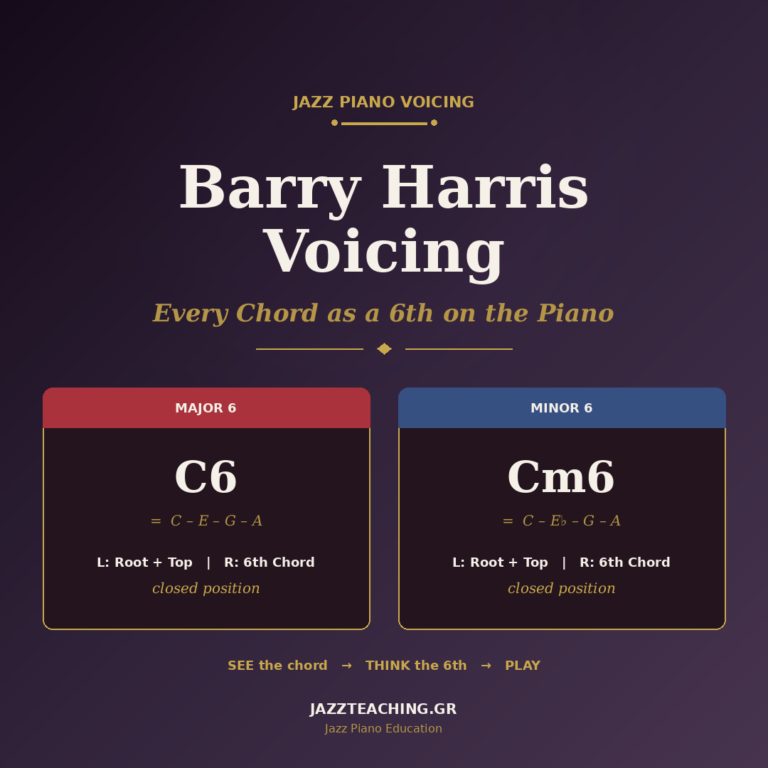
Tone isn’t something you “have” or “don’t have.” It’s something you cultivate with sensitivity and long observation. If you want to understand how different voicings shape the sound, working through Barry Harris voicings gives a very concrete picture of the relationship between harmony and sonic character.
Another great pianist with a unique Tone was Bill Evans — but for entirely opposite reasons to Peterson. Where Peterson was propulsive and full, Evans was ethereal and introspective. Both had absolutely conscious Tone. Their Tone was their musical identity — and listening to both is a superb exercise in understanding what personal sound means in jazz.
Time — The Foundation of Everything
If I had to choose only one of the 5 T’s as the foundation for the rest, I’d choose Time. Without an unshakable sense of time, the rest of the building shakes. Peterson thought the same.
In his interview with Studs Terkel, Peterson talked about how he could “stretch” or “compress” time deliberately — giving a melody a “lay back” feel or pushing it rhythmically, without changing the tempo. That’s not casual playing — that’s absolute control over Time.
This is the T where I see students struggle most in my own teaching. They practice with a metronome and mistake steadiness for time. Real time — Peterson’s time — is a felt inner pulse that survives without any external reference. The metronome is where you start, not where you finish.
For Peterson, Time wasn’t just rhythmic accuracy — it was communication with his bandmates. His trios were famous for astonishing cohesion: Ray Brown on bass, Herb Ellis on guitar, later Ed Thigpen on drums. That cohesion wasn’t accident — each of them had an internal Time that spoke to the others.
PRACTICAL APPLICATION — TIME
Set a metronome to 2 and 4 (not 1 and 3). Play a simple walking bass in the left hand and a line in the right. If you lose that 2-and-4 beat, stop — start again more slowly. Time isn’t the tempo. It’s your placement within the tempo.
The 5 T’s as a Self-Assessment System
What makes the 5 T’s so useful in teaching is that they work as a self-evaluation tool. After every recording — even a phone recording from your bedroom — you can run through these five categories:
How was my Touch? Did I have variety, or was I monotonous? Did Technique help me or drown me? Did I make good choices for the moment, or did I try to show more than needed (Taste)? Did I have a personal Tone, or did I “hide” behind the notes? And Time — did I feel confident, was I inside the groove, or was I chasing the beat?
This is exactly what I do with my own students when we study a jazz standard — the analysis doesn’t stop at the harmony. If you want to see this process applied to a full tune, read the 14-Step Jazz Standard Study Program — the 5 T’s fit naturally inside those 14 steps.
Thelonious Monk, who gave his own 25 rules to musicians, had a similar philosophy — though expressed in his own enigmatic way. The essence is the same: what matters most isn’t what you play, but how you play it and why.
What Each Student Level Can Take from the 5 T’s
If you’re a beginner: start with Time. A steady, internal sense of rhythm is the base on which everything else is built. Without Time, Touch has no meaning, Technique has nothing to stand on, Tone has no content, and Taste has no room.
If you’re intermediate: work on Taste. That’s where most pianists get stuck — they know enough notes, they have decent technique, but they don’t know when and what to choose. Listen back to your own recordings with a critical ear. Where did you fill in without reason? Where could you have left space?
If you’re advanced: focus on Tone. You have the tools — now you have to ask: who am I at the piano? What do I have to say that no one else says? Peterson wasn’t just technically better than most. He was sonically irreplaceable.
Peterson on Video: See the 5 T’s in Action
The best single-video documentation of Peterson’s philosophy is his iconic 1979 Dick Cavett Show appearance. In a few minutes, Peterson explains, plays, jokes and teaches — without ever giving a lecture. He never names the 5 T’s explicitly, but he lives them on camera.
Oscar Peterson on the Dick Cavett Show, 1979 — a rare glimpse into the mind of a great musician.
JAZZ PIANO NEWSLETTER
Weekly educational material, analyses, and practical exercises.
Sign up to receive exclusive jazz piano content — from theory to practical application.
SUBSCRIBE TO NEWSLETTER
One Comment