
Thelonious Monk: 25 Pieces of Advice for Musicians (1960)
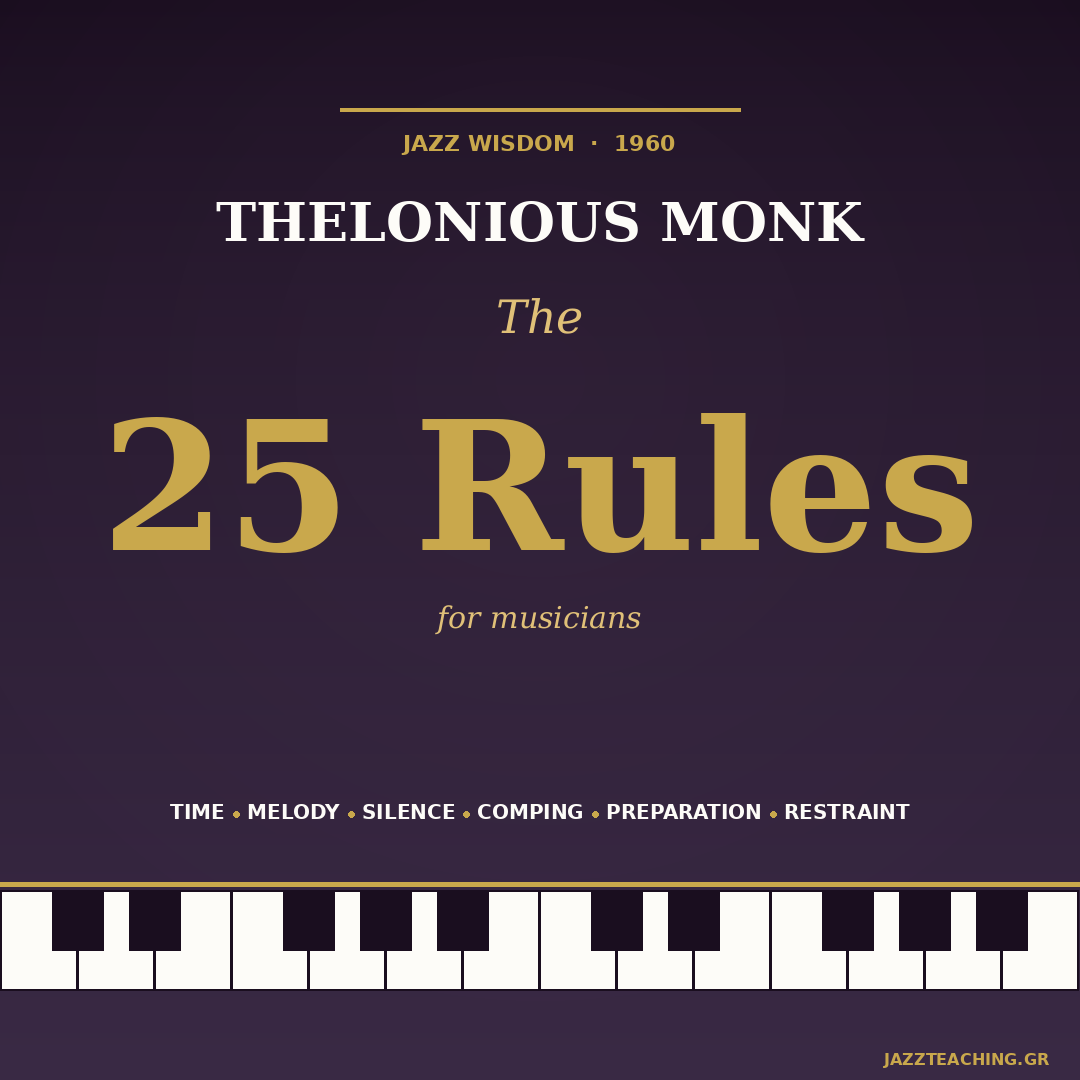
FROM STEVE LACY’S HANDWRITTEN LIST, 1960
“What you don’t play can be more important than what you play.”
— Thelonious Monk
In 1960, saxophonist Steve Lacy spent 16 weeks playing in Thelonious Monk’s band. Throughout that period, he kept a small notebook in which he wrote down the phrases, observations, and instructions Monk gave him — sometimes at rehearsal, sometimes on the bandstand, sometimes in moments that seemed like offhand remarks. From those notes emerged a list of 25 pieces of advice for musicians that has become one of the most famous documents in jazz history.
Read it, and you quickly realize that Monk wasn’t teaching technique. He was teaching stance. Many of the pieces of advice are laconic, almost a personal code (“Always know,” “All reet!”). Others are as blunt as a slap (“Stop playing all those weird notes — play the melody!”). Taken together, they form a picture of what it means to be a musician with identity.
In this article I won’t quote all 25 mechanically. I’ll group them into six themes and look at what each one means in practice — especially for those of us who play piano.
WHO WAS THELONIOUS MONK
Thelonious Sphere Monk (1917–1982) · Pianist and composer, one of the founders of bebop at Minton’s Playhouse in Harlem. Composed ‘Round Midnight, Blue Monk, Straight, No Chaser, and many other standards. Known for his abrupt, cutting phrasing, “strange” harmony, extensive use of silence, and unpredictable pauses.
1. Time Is Everyone’s Business
Two of Monk’s earliest pieces of advice concern time. He says that even if you’re not the drummer, you still have to keep time. And when you play, you have to tap your foot and sing the melody in your head.
That sounds obvious, but it isn’t. So many pianists — especially when they play complex harmonies or technical passages — forget the time. They hang on the notes, they lose the groove, they make the rhythm section drag them along. Monk says: no. Time is your responsibility as much as it is the drummer’s.
“Sing the melody in your head” is even deeper. It reminds you that everything you play has to connect to the song — not to exercises, scales, or “what my fingers happen to land on.” Your inner rhythm and your inner melody drive your playing, not the other way around.
This is one place where Monk and Oscar Peterson meet. In Peterson’s 5 T’s, Time is the foundation of everything else. Same principle, different vocabulary.
PRACTICAL APPLICATION
In your next practice session, play a standard without a metronome and without a backing track. Tap your foot on every beat and sing the melody (out loud or in your head) while you improvise. It’s much harder than it sounds.
2. Play the Melody — Not the “Strange Notes”
This is one of the funniest pieces of advice on the list, because it comes from the most famously dissonant musician in jazz history. But that’s exactly where the lesson lives.
Monk isn’t saying “never play dissonant notes.” He’s saying: don’t play them randomly, to sound “modern” or “out.” When he himself played a strange note, it was because the melody demanded it. It wasn’t decoration. It wasn’t there to impress. It mattered.
There’s a related piece of advice: “The bridge is what makes the A section sound good.” That’s an important observation. It isn’t enough to know the A sections — the bridge defines how the whole form sounds. A solo without a real feel for the bridge is a solo that’s lost its architecture.
3. Silence Is Structural Material
Perhaps the most important pieces of advice on the list: “Don’t play everything — let some things go by.” “What you don’t play can be more important than what you play.” “A note can be as small as a pin or as big as the world — it depends on your imagination.”
These three sentences are worth years of study. They’re the opposite of everything modern jazz education tends to teach. Today, the picture of a “good” pianist is someone who plays lots of notes, fast, with lots of harmonic substitutions. Monk reminds us that this is noise, not music.
Silence in Monk’s music isn’t a pause — it’s active material. When you let a note breathe, the note grows larger. When you play the next note after silence, that note has weight. When you play nothing while the rhythm section keeps going, you create tension. That tension is music.
In 30 years of teaching, silence is the last thing students learn to trust. They fill every gap because filling feels safer than being exposed. But the moment a student learns to leave a whole bar empty and mean it, their playing changes.
The same principle is what makes Hank Jones so distinctive — his economy, his taste, the complete absence of unnecessary notes. Monk and Jones sound entirely different, but they’re describing the same discipline.
SILENCE EXERCISE
Take a 12-bar blues. Play one chorus in which every other bar is silent. Then play a chorus in which you play in only 3 of the 12 bars. Notice how the few notes you do play take on entirely different weight.
4. Comping — Don’t Play My Part
One of Monk’s most characteristic instructions to his sidemen: “Don’t play the piano part — I’m playing that. Don’t listen to me, I’m supposed to be accompanying you!”
It sounds contradictory, but it isn’t. What he’s saying: when I’m comping, the soloist shouldn’t reproduce what I’m doing — the soloist should play their own line. If they start listening to me too intently, they lose their own musical voice and follow instead of leading.
The advice has huge implications for any pianist who comps (whether accompanying or being accompanied). It comes down to the balance between leading and supporting — a constant negotiation between the musicians.
There’s another piece of advice from Monk in the same family: “Make the drummer sound good.” It isn’t politeness — it’s practical. When you play in a way that reveals the drummer’s groove, the whole band sounds better. When you cover the drummer, everyone loses.
5. Preparation Is Dignity
Among the most practical items on the list: “Stay in shape! Sometimes a musician waits for a gig, and when it comes, he’s out of shape and can’t do it.”
That’s advice that doesn’t need philosophical unpacking. It means: practise systematically, not when inspiration hits. It means that as a professional musician you’re ready when the phone rings. It means condition doesn’t maintain itself.
Monk adds: “Dress as neatly as possible.” In our era this sounds superficial, but for Monk — a Black musician in 1960s America — it was political. You played like a professional. You showed up like a professional. That was dignity.
And one more: “Don’t beg for a gig. Just be on the scene.” In other words: show up, play wherever you can, become part of the scene, and the opportunities will come. You don’t chase them — you attract them with your presence.
The version of “stay in shape” I hear most often from students is different: they want to know the minimum daily practice that keeps them from losing ground. Monk’s answer is unsentimental. Losing ground is what happens when you’re not building. There is no maintenance mode.
6. Always Leave Them Wanting a Little More
The last lesson: “Always leave them wanting more.” When you’re swinging, swing a little more. When it’s going well, stop a step early. Don’t exhaust the audience, don’t exhaust the melody, don’t exhaust yourself.
In practice, this means many things at once. Stop your solo one chorus before you think you have to. When you play a good idea, don’t repeat it four times “to make sure” — let it go. When a set is going well, don’t add an encore just to milk the moment. When you’re teaching someone (a student, a child, a fellow musician), give one instruction at a time.
It’s a principle of economy. And it dovetails perfectly with the philosophy of silence above. Monk operated by the same logic both as a performer and as a person.
“A Genius Is the One Most Like Himself”
Of all 25 pieces of advice, this may be the most piercing. “A genius is the one most like himself.”
Jazz education often pushes you in the opposite direction: play like Tatum, copy Bird’s phrases, study Bill Evans‘s voicings, imitate Hank Jones’s articulation. All of that is useful — but it’s a means, not an end. The end is to become you. Not a good imitation of somebody else.
Monk was the clearest proof of this principle. He never tried to sound like Tatum (though he admired him). He didn’t follow the trends of cool jazz or fusion. He didn’t “modernize” himself. He stayed Monk. And that’s why he is Monk.
Hear Monk Apply His Own Advice
No amount of writing about Monk substitutes for hearing him play. Below, a solo performance of ‘Round Midnight from the album Monk Alone (1968). Watch the use of silence, the pauses, the harmonic simplicity at the right moments, the idiosyncratic phrasing, and his personal rhythmic language.
Thelonious Monk — ‘Round Midnight, solo (1968). Listen for what he leaves out.
Why Monk’s Advice for Musicians Still Matters
Monk’s 25 pieces of advice aren’t a method. You won’t find scales, exercises, or voicings in them. You’ll find something rarer and more important: an entire philosophy of what it means to be a musician.
Keep time. Play the melody. Respect silence. Listen properly. Stay in shape. Always leave them wanting a little more. And above all: be yourself.
What’s really extraordinary about this list is that, 65 years later, it remains current in a way most contemporary jazz-education techniques are not. Because Monk wasn’t talking about “how to sound modern” — he was talking about how to sound like yourself. And that never goes out of date.
JAZZ PIANO NEWSLETTER
Weekly educational material, analyses, and practical exercises.
Sign up to receive exclusive jazz piano content — from theory to practical application.
SUBSCRIBE TO NEWSLETTER
2 Comments