Herbie Hancock: 7 Lessons for Musicians from the Pianist

“Miles didn’t hear it as a mistake. He heard it as something that happened.”
— Herbie Hancock, on the night he played the “wrong” chord
Herbie Hancock (b. 1940) is one of the few pianists who changed jazz in almost every decade: from his Blue Note records and the Miles Davis Quintet in the 1960s to Head Hunters and the synthesizer era. In this article I won’t analyze his playing note by note. I want to focus on something that matters more to me: what he himself has said about how a musician thinks. I took these lessons from his interviews, his MasterClass and his Harvard lectures, and I tied each one to something you can do at the piano. In my lessons, these stories often teach more than a page of theory.
PORTRAIT — HERBIE HANCOCK
- Full name: Herbert Jeffrey Hancock
- Born: April 12, 1940, Chicago
- Classical start: February 5, 1952, age 11, he plays the first movement of Mozart’s Piano Concerto No. 26 (K. 537) with the Chicago Symphony Orchestra
- Jazz: no jazz teacher as a teenager; he learned from records (George Shearing, Erroll Garner, Oscar Peterson, Bill Evans). In 1960 he became a student of pianist Chris Anderson
- Miles Davis Quintet: from 1963, with Wayne Shorter, Ron Carter and Tony Williams
- Key albums: Takin’ Off (1962), Maiden Voyage (1965), Head Hunters (1973)
- Teacher: in 2014 he gave six Norton Lectures at Harvard, titled “The Ethics of Jazz”
1. Turn the mistake into material: the “wrong” chord and Miles
Herbie has told this story many times: in interviews, in his memoir Possibilities (2014) and in his first Harvard lecture. One night on tour in Europe with the Miles Davis Quintet (he places it in Stuttgart), the band was on fire. In the middle of a Miles solo on “So What,” Herbie hit a chord that was completely wrong. Miles paused for a moment, took a breath and played a few notes that made the chord sound right. Herbie froze; for almost a minute he couldn’t play.
Years later he understood what had happened. Miles didn’t hear a mistake. He heard an event, something that simply happened, and he saw it as his responsibility to find something that fit. Herbie connects this with the Buddhist practice he has followed for decades and with an idea he often repeats: turning “poison into medicine.”
I see this all the time in lessons. A student plays a note they didn’t expect, stops, apologizes and starts again from the top. But the music doesn’t stop. In jazz, the note that decides is the next one.
AT THE PIANO
When you improvise over a record or a backing track, never stop on a mistake. As an exercise, deliberately play a note outside the chord and resolve it chromatically, by a half step, to a chord tone. Your ear learns that every note has somewhere to go, and a “wrong” note becomes simply a note that hasn’t resolved yet.
2. Fewer notes, more space: the “butter notes”
At one point Herbie felt his playing had gone stale. Miles leaned over and said something Herbie heard as “don’t play the butter notes.” Butter is fat, he reasoned, so Miles must mean the obvious, the excess. He started leaving the most “obvious” notes out of his chords, the 3rd and the 7th. The sound opened up and left room for the band.
The twist came decades later, at Harvard. Someone in the audience told him that in Miles’ autobiography the phrase is “don’t play the bottom notes.” Herbie’s comment to WNYC: “Miles opened a doorway but I had to figure it out for myself.” For me that is the real lesson: the teacher points the way, the student walks it.
THE BARRY HARRIS VIEW
In the Barry Harris method, the 3rd and the 7th are the foundation. They are where Barry Harris voicings start, and all the voice leading rests on them. So I tell my students: you leave them out once you know them, not before. Herbie could drop them because he heard them anyway. It isn’t a contradiction. It’s a different tool for a different music.
3. Listen first, then respond
In his MasterClass, Herbie starts improvisation from the simplest idea: listen, then react. It sounds obvious. In practice, most students I see play what they prepared, whatever the band is doing. The Miles story is really about this: Miles listened, and that is why he could answer.
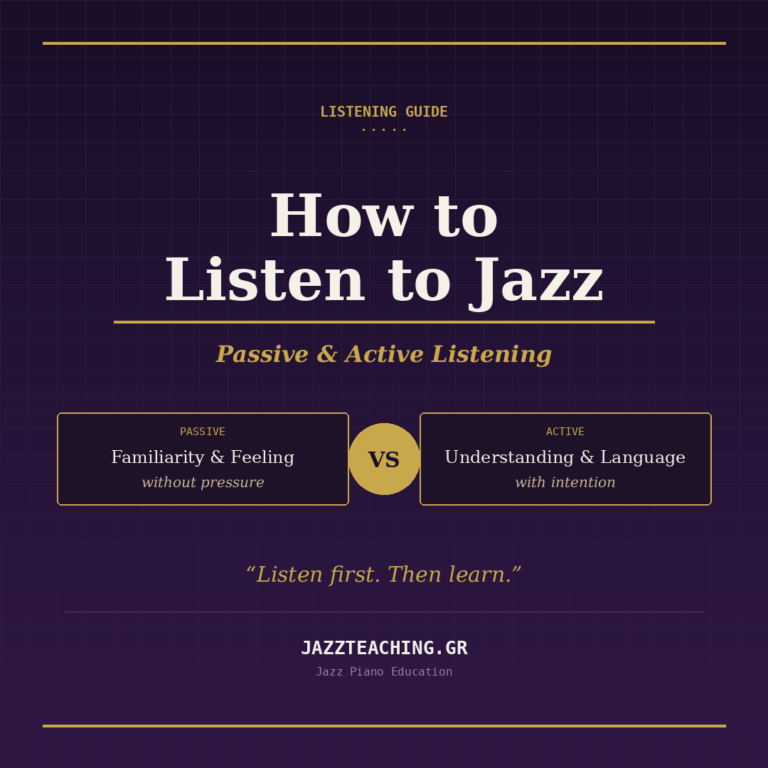
Listening isn’t only something you do when you put on a record at home. It is part of playing. I’ve written in detail about passive and active listening, and the same applies here.
AT THE PIANO
Put on a record or a backing track of a blues. Play for two bars, stay silent for two bars and listen. Your next phrase has to start from something you heard during the silence: a rhythmic figure from the drummer, a bass note, an answer to your own previous phrase.
4. The record is your first teacher
As a teenager Herbie had no jazz teacher. When he heard a young pianist improvise and asked how to learn it, he was told to check out George Shearing records. He eventually found them in his own home, in his mother’s collection. He learned by listening and playing along with records: Shearing, Erroll Garner, Oscar Peterson, Bill Evans.
In 1960 he heard Chicago pianist Chris Anderson play just once and begged him to take him as a student. He still calls Anderson his harmonic “guru.” The order matters: first the ear and copying from records, then a teacher who explains and organizes what you already hear.
If you want to work on this methodically, here is my guide on how to transcribe jazz piano, phrase by phrase rather than whole solos.
5. Outside the comfort zone
In a 2007 JamBase interview, Herbie said that if he isn’t being challenged, “maybe I’m working in an area where I’m too comfortable.” He added that he learned this from Miles, who told the band to work outside the comfort zone.
His career shows it: hard bop at Blue Note, modal jazz with Miles, Fender Rhodes and synthesizers, funk with the Headhunters, “Rockit” in 1983. You don’t have to do the same. But in practice, the comfort zone has a very specific shape: replaying every day what you already know, in the keys you already know.
AT THE PIANO
Each week, pick one thing you avoid: a key with many accidentals, a tempo slower than you like, or a groove that isn’t familiar. If you only play swing, “Watermelon Man” and “Cantaloupe Island” are ideal for working on a straight-eighths funk groove.
6. In jazz we don’t judge; we make everything work
Talking about his Harvard lectures, Herbie told The Jerusalem Post (2017) what the ethics of jazz mean to him: “In jazz, we don’t judge what each of us plays.” Instead, the musicians try to make everything work and become part of the music. They share ideas; they don’t compete.
This is the heart of comping. The accompanying pianist isn’t there to “correct” the soloist with their own harmony. They’re there to hear what the other player suggests and support it, even when it isn’t what they expected. Exactly what Miles did with Herbie’s chord.
7. A human being first, a musician second, and a student forever
When he took on the Harvard lectures in 2014, Herbie told The Harvard Crimson: “I am not fundamentally a musician, I am fundamentally a human being.” Music is what he does, not what he is. That’s why he approaches music from the standpoint of a person, not of a “musician.”
And one more thing, from the final chapter of his MasterClass: he listens to much younger musicians and opens himself to their ideas, because he learns a lot from them. And he asks: who wins from this? He does. He describes Miles the same way, as a leader who let the young players in his band influence him.
After 30 years of teaching, this feels very close to me. I learn from my students every week. A good teacher never stops being a student.
At the piano: the sus4 chords of “Maiden Voyage” through the Barry Harris lens
“Maiden Voyage” (1965) is one of the first jazz standards built almost entirely on sus4 chords. Herbie himself uses it in his MasterClass to teach the sus4 sound. With Barry Harris thinking, you don’t need a new “system” to play it:
STEP BY STEP
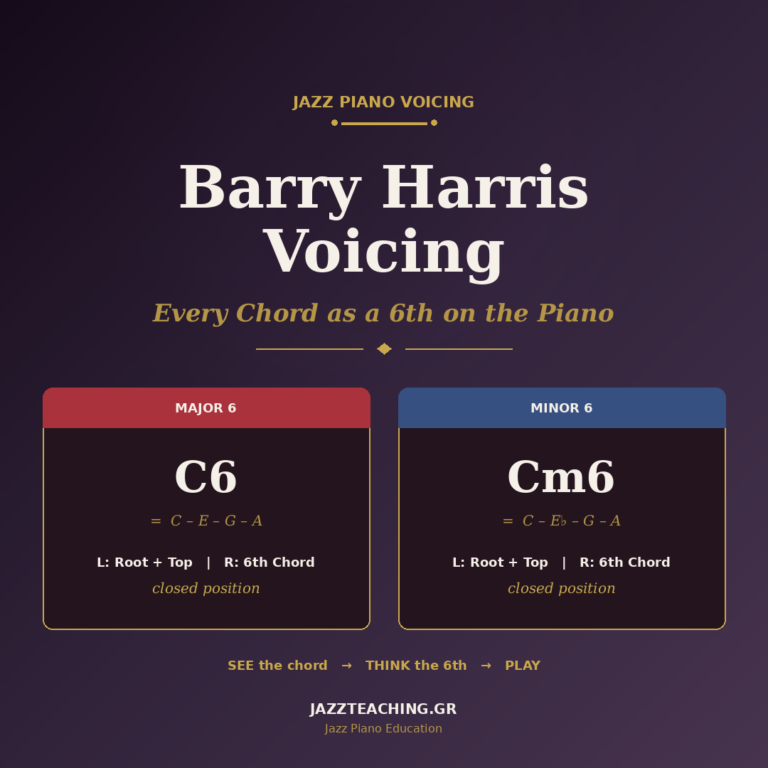
- D7sus4 = Am7 over D. And Am7 has the same notes as C6. So: left hand D in the bass, right hand a C6 voicing.
- Move the right hand through the C sixth diminished scale (C D E F G G# A B): C6 → diminished (D F G# B) → C6 in the next inversion, always over the D.
- F7sus4 = Cm7 over F, which is Eb6 over F. Do the same movement with the Eb sixth diminished scale.
- Play along with the record: few notes, lots of space (lesson 2), and listen to the band before you answer (lesson 3).
If you haven’t worked on sixth-chord voicings yet, start with the article on Barry Harris voicings. You’ll find that the “modern” sus4 sound is something your fingers already know.
Where to start: 6 recordings
- Takin’ Off (Blue Note, 1962): “Watermelon Man,” his debut as a leader
- Empyrean Isles (Blue Note, 1964): “Cantaloupe Island”
- Maiden Voyage (Blue Note, 1965): “Maiden Voyage” and “Dolphin Dance”
- Miles Davis, Miles Smiles (Columbia, 1966): the Second Great Quintet at full strength
- Speak Like a Child (Blue Note, 1968): Herbie as an arranger
- Head Hunters (Columbia, 1973): “Chameleon” and the turn to funk
Watch Herbie tell the story
Nothing compares to hearing it from the man himself. Notice how he describes freezing after the chord, and how it took him years to understand what Miles had done.
What we keep from Herbie Hancock
- The next note decides whether the last one was a mistake.
- Fewer notes leave space. But first you learn the ones you’ll leave out.
- Listen first, answer second.
- The record is your first teacher.
- Practice needs challenge, not repetition of the familiar.
- In a band we don’t judge; we make everything work.
- You are a human being before you are a musician, and a student forever.
You don’t learn these from a video or a list. You learn them slowly, at the piano, at your own pace. That’s why in my online lessons we work with a method tailored to each student, from beginner to advanced.
Sources
- Open Culture: Herbie Hancock Explains the Big Lesson He Learned From Miles Davis (2018)
- WNYC Soundcheck: Herbie Hancock Reflects On Buddhism, Beating Addiction, And Butter Notes (2014)
- MasterClass: Herbie Hancock Teaches Jazz (Learning by Listening, Improvisation, A Musical Life)
- JamBase: Herbie Hancock, Outside The Comfort Zone (2007)
- The Jerusalem Post: Herbie goes… beyond jazz (2017)
- The Harvard Crimson: Herbie Hancock Will Deliver 2014 Norton Lectures
- Chicago Symphony Orchestra: 125 Moments, Herbie Hancock
- Wikipedia: Herbie Hancock
Jazz Piano Newsletter
The next article, in your inbox
About once a month: new articles, practice ideas and free material on jazz piano and the Barry Harris method. No spam, one-click unsubscribe.
SubscribeChristos Mastrogiannidis
Jazz Pianist & Educator · Berklee College of Music · Kunst Universität Graz · 30 years of teaching the Barry Harris method