
Jazz Piano Comping: The Art of Accompaniment in Jazz
What is comping in jazz
In the language of jazz, the term comping comes from the words accompanying or complementing.
Jazz piano comping is the art of accompaniment — the way the pianist supports the soloist or the band through rhythm, harmony and the right placement of chords within the groove.
Comping doesn’t just mean playing chords.
It means creating a harmonic and rhythmic framework that helps the music move naturally and breathe.
The pianist:
- creates rhythmic motion
- highlights harmonic tension
- leaves room for improvisation
- interacts musically with the band
In fact, good comping is the kind that doesn’t draw attention to itself — but makes all the music work better.
The pianist’s role in jazz comping
In a jazz ensemble, the pianist isn’t just an accompanist.
Their role is to shape the harmonic environment the music moves in.
Through comping, the pianist supports the soloist and at the same time interacts with the rhythm section — mainly the bass and drums. The chords they play aren’t static; they’re placed rhythmically, they answer the soloist’s phrases and they help drive the whole tune forward.
In practice, comping involves:
- supporting the harmony of the tune
- creating rhythmic motion within the groove
- bringing out the soloist’s phrases
- managing intensity and space in the music
A good jazz pianist doesn’t play all the time.
Real comping is based on listening, timing and economy of chords.
Often, what makes the difference isn’t how much you play, but when you play — and when you choose to leave space in the music.
The basic elements of jazz piano comping
1. Voice Leading
Voice leading is the logical connection between chords.
In jazz we avoid big leaps and aim for:
- small movements between notes
- smooth chord transitions
- economy of motion
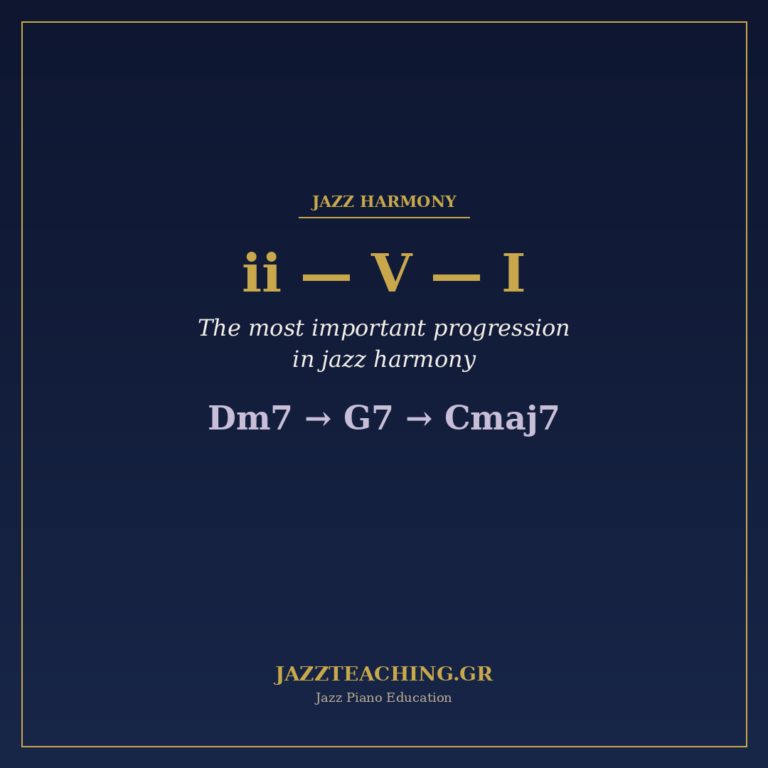
For example, in a ii–V–I progression:
Dm7 → G7 → Cmaj7
the pianist will use voicings that move as little as possible from one to the next.
This creates a coherent, professional sound.
2. Rhythm & Interaction
Comping is above all a rhythmic art.
Chords aren’t simply played on every beat.
Instead, the pianist uses:
- syncopation
- off-beat accents
- rhythmic displacement
The goal is to create a dialogue with the soloist and the drummer.
Accents and phrasing in jazz comping
One of the most important things in jazz piano comping is how we place accents and the length of the chords. Not all chords are played the same way. Some are short and clipped, others are held longer, some are strongly accented and others have almost no emphasis at all.
In practice, the pianist uses different kinds of phrasing, such as:
- long chords (held chords)
- short chords (short, staccato hits)
- accented chords (accented chords)
- unaccented chords (light chords without a strong accent)
This variety creates rhythmic life and musical motion in the comping.
Many jazz pianists think of comping as imitating the articulation of the horns in a big band. Just as saxophones or trumpets use different lengths and accents in their phrases, the pianist tries to give their chords a phrasing logic that recalls a horn section.
That way, comping stops being just chords on the piano and starts working as part of a bigger orchestral phrase within the ensemble.
Comping styles in jazz
Comping changes with the style of jazz.
Swing
Characterized by:
- light chordal accompaniment
- rhythmic punctuation
- interaction with the soloist
Classic example:
Wynton Kelly
Bebop
In bebop, comping becomes:
- more active
- more rhythmic
- harmonically more intense
Influenced by pianists such as
Bud Powell
Modern Jazz
In modern jazz you’ll find:
- quartal voicings
- clusters
- more open harmony
A style you’ll hear in pianists such as
Herbie Hancock
How to practice jazz piano comping
Practicing comping takes a different approach from practicing improvisation.
Here are a few basic practices:
1. Study ii–V–I progressions
Most jazz tunes are built on ii–V–Is.
Practicing them in all keys is fundamental.
2. Study rhythmic patterns
Work on different rhythmic placements of chords.
Comping shouldn’t be mechanical.
3. Transcribe pianists
The best training is listening and analysis.
Study pianists such as:
- Bill Evans
- McCoy Tyner
- Herbie Hancock
4. Interact with real musicians
You only really learn comping through ensemble playing.
Interacting with:
- bass
- drums
- soloists
is essential.
5 common mistakes in jazz piano comping
- We play far too many chords, constantly filling up the space in the music.
- We always place chords in the same spots in the bar, with no rhythmic variety.
- We use voicings that are too dense or too low, so the sound becomes heavy and muddy.
- We don’t listen to the soloist, and play without regard for the ensemble’s phrasing.
- We always use the same articulation and accents, with no difference between long, short and accented chords.
Conclusion
Jazz piano comping isn’t just playing chords. It’s a form of musical interaction that combines harmony, rhythm and phrasing within the ensemble.
The pianist has to listen closely to the band, place their chords precisely in the groove and use different accents and voicings to support the improvisation without covering it.
In essence, good comping is what makes the whole band sound more coherent, more alive and more musical.
See jazz piano comping in action
In the video below you can see live examples of jazz piano comping — how accompaniment on the piano works in practice:
Jazz Piano Newsletter
The next article, in your inbox
About once a month: new articles, practice ideas and free material on jazz piano and the Barry Harris method. No spam, one-click unsubscribe.
SubscribeChristos Mastrogiannidis
Pianist & Educator · JazzTeaching.gr
This article was written by Christos Mastrogiannidis. If you’d like to learn more, visit JazzTeaching.gr.
Want to learn more about jazz piano?
On JazzTeaching.gr you’ll find more articles, videos and learning material for every level.
Explore JazzTeaching.gr
6 Comments