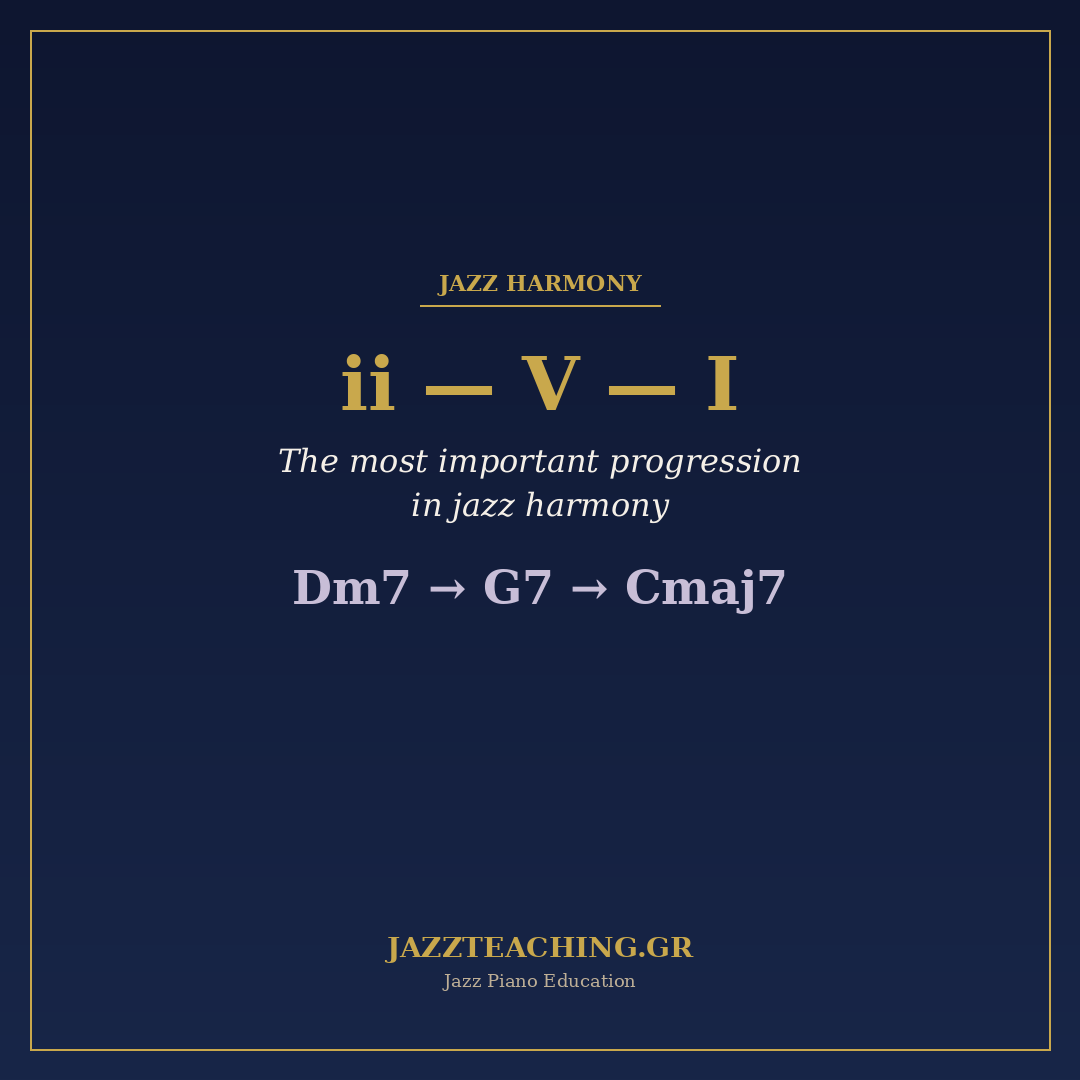
The ii-V-I: the most important progression in jazz
Jazz Harmony Handbook
If you wanted to sum up all of jazz harmony in a single phrase, it would be: ii — V — I. Every standard you love, every blues you play, every reharmonization you hear comes back here. In this article you’ll understand why, and you’ll learn how to play it, from your first shell voicings all the way to the Barry Harris approach.
This article is built on two levels. If you’re a beginner, you’ll find all the theory here, plus shell voicings for the left hand: simple, clear and useful from day one. If you already have a foundation, we’ll move on to the Barry Harris approach, with 6th chord voicings, diminished color and altered resolutions that give your sound that bebop color.
What is the ii-V-I?
The ii-V-I is a sequence of three chords that come from the same scale. The numeral shows the scale degree each chord is built on. In the key of C major:
| Degree | Chord | Type | Character |
|---|---|---|---|
| ii | Dm7 | Minor 7th | Departure: creates movement, we leave stability |
| V | G7 | Dominant 7th | Tension: the strongest harmonic pull, it “asks” for resolution |
| I | Cmaj7 | Major 7th | Resolution: back “home,” the breath after the tension |
The logic is narrative: the ii leaves, the V creates tension, the I returns. This cycle of departure, tension and resolution is the basic “sentence” jazz thinks in.
Why exactly these three chords?
The key is the tritone hidden in V7 (G7): the note B (the 3rd of G7) and the note F (the ♭7 of G7) are exactly three whole tones apart, and the tritone is the most unstable interval in Western harmony. That instability creates a natural pull toward the I. The ii (Dm7) comes first because it shares two notes with G7 (D and F), so the move is completely smooth.
How to recognize a ii-V-I in a standard
Once you know what to look for, the ii-V-I shows up everywhere. That’s no exaggeration: it’s the most important harmonic structure in jazz. Here’s how to recognize it:
The secret to spotting it:
Look for two chords a perfect fourth (or fifth) apart, where the first is a minor 7 and the second a dominant 7. Those are always ii and V.
Dm7 → G7: D and G are a perfect fourth apart. Dm7 = ii, G7 = V. The I that follows is Cmaj7.
| Standard | ii — V — I | Key |
|---|---|---|
| Autumn Leaves | Cm7 — F7 — Bbmaj7 | Bb major |
| All The Things You Are | Fm7 — B♭7 — E♭maj7 | E♭ major |
| Misty | Gm7 — C7 — Fmaj7 | F major |
| Summertime | Bm7♭5 — E7 — Am6 (minor!) | A minor |
Major and minor ii-V-I: the difference
There are two versions: the major one (which we’ve seen) and the minor one, which shows up just as often in standards in minor keys. The difference is in the ii, which becomes half-diminished (m7♭5), and in the V, which is often played with a ♭9 or altered for more tension:
| Version | ii | V | I / i | Character |
|---|---|---|---|---|
| Major | Dm7 | G7 | Cmaj7 | Open, bright |
| Minor | Dm7♭5 | G7(♭9/alt) | Cm6 | Dark, dramatic |
Important
The minor version isn’t a “hard variation”; it’s just as common. In Autumn Leaves, for example, you have both in the same tune: a major ii-V-I in B♭ major and a minor ii-V-i in G minor.
PART A — Shell voicings: the foundation for beginners
The shell voicing is the clearest way to play the ii-V-I with the left hand. Just two notes, the root and a guide tone (3rd or 7th), and you have all the harmonic information you need. This is the voicing Bud Powell, Wynton Kelly and Horace Silver used: the bebop left hand.
What a shell voicing is
It consists of two notes in the left hand:
Shell voicing structure:
Bottom note: always the root of the chord
Top note: either the 3rd or the 7th. These are the guide tones, the notes that define the chord’s character
The 5th is left out: it adds no harmonic information and makes the sound “heavier” for no reason.
The big secret of the shell voicing is the alternation of 3rd and 7th (voice leading). As you move from chord to chord, the top note moves very little, usually a half step or a whole step. That small movement gives the characteristic bebop sound.
Shell voicing — Position A (root + 7th)
In Position A you have the root below + the 7th above. This is the more open, “darker” position, typical of bebop comping.
| Chord | Root (bottom) | 7th (top) | Function in the ii-V-I |
|---|---|---|---|
| Dm7 | D | C | ii — departure |
| G7 | G | F | V — tension |
| Cmaj7 | C | B | I — resolution |
Shell voicing — Position B (root + 3rd)
In Position B you have the root below + the 3rd above. A “brighter,” more compact position. Note: on the I, the Barry Harris system often uses C6 instead of Cmaj7. The 6th chord is the natural resolution in bebop thinking.
| Chord | Root (bottom) | 3rd (top) | Function |
|---|---|---|---|
| Dm7 | D | F | ii — departure |
| G7 | G | B | V — tension |
| C6 | C | E | I — resolution (6th chord) |
Voice leading: alternating A ↔ B
The most important step: learn to alternate Positions A and B depending on which gives the smoother connection. There’s no “right” one, only the choice that moves the least.
The voice leading rule
The 3rd of one chord resolves to the 7th of the next, and vice versa. This 3↔7 alternation is the heart of bebop voice leading. Every time you change chords, the top note moves as little as possible.
Dm7 (7th = C) → G7 (3rd = B) → Cmaj7 (7th = B) → C6 (6th = A)
The top note: C → B → B → A. Minimal movement, maximum flow.
Shell voicings in all keys
The goal is to play the ii-V-I in all 12 keys. The cycle of fourths is the natural path: C → F → B♭ → E♭ → A♭ → D♭ → G♭ → B → E → A → D → G. Practice slowly, one key at a time, until the movement becomes automatic.
| Key | ii (m7) | V (7) | I (maj7 / 6) | Shell A — ii | Shell A — V | Shell A — I |
|---|---|---|---|---|---|---|
| C | Dm7 | G7 | Cmaj7 | D + C | G + F | C + B |
| F | Gm7 | C7 | Fmaj7 | G + F | C + B♭ | F + E |
| B♭ | Cm7 | F7 | B♭maj7 | C + B♭ | F + E♭ | B♭ + A |
| E♭ | Fm7 | B♭7 | E♭maj7 | F + E♭ | B♭ + A♭ | E♭ + D |
| A♭ | B♭m7 | E♭7 | A♭maj7 | B♭ + A♭ | E♭ + D♭ | A♭ + G |
| D♭ | E♭m7 | A♭7 | D♭maj7 | E♭ + D♭ | A♭ + G♭ | D♭ + C |
| G♭ | A♭m7 | D♭7 | G♭maj7 | A♭ + G♭ | D♭ + C♭ | G♭ + F |
| B | C♯m7 | F♯7 | Bmaj7 | C♯ + B | F♯ + E | B + A♯ |
| E | F♯m7 | B7 | Emaj7 | F♯ + E | B + A | E + D♯ |
| A | Bm7 | E7 | Amaj7 | B + A | E + D | A + G♯ |
| D | Em7 | A7 | Dmaj7 | E + D | A + G | D + C♯ |
| G | Am7 | D7 | Gmaj7 | A + G | D + C | G + F♯ |
For the theory behind inversions and positions, see my article on Barry Harris inversions: major 6 & minor 6.
PART B — Barry Harris voicings: for intermediate pianists
The shell voicing gives you the foundation. The Barry Harris voicing gives you the sound. The difference is that in the right hand you don’t just play the melody; you play a complete 6th chord that corresponds to the chord symbol, following Barry Harris’s chart.
If you haven’t yet read the full logic behind this system, start with Barry Harris theory: family chords and Barry Harris voicing: every chord on jazz piano.
Table 1 — Major ii-V-I: the basic voicing
The basic Barry Harris ii-V-I in C major. Left hand: shell (root + guide tone). Right hand: the matching 6th chord from the voicing chart.
| Function | Chord | Left hand (shell) | Right hand (6th chord) | Barry Harris rule |
|---|---|---|---|---|
| ii | Dm7 | D + C | F6 F · A · C · D |
minor 7 → a major 6 from the ♭3 |
| V | G7 | G + F | Dm6 D · F · A · B |
dominant → a minor 6 from the 5th |
| I | Cmaj7 | C + B | G6 G · B · D · E |
maj7 → a major 6 from the 5th |
Table 2 — Major ii-V-I with ♭9: bebop color
The most characteristic bebop move: the V7 is played with a ♭9. In the right hand, instead of Dm6, you play A♭dim7, the diminished chord that starts a half step above the root of the V. That automatically gives you the ♭9, 3rd, 5th and ♭7 of G7, all the tension without having to think about alterations.
The rule for the ♭9 diminished:
Find the root of V7 → go a half step up → play a dim7 from there.
G7 → a half step above G = A♭ → A♭dim7 = A♭ · B · D · F
| Function | Chord | Left hand (shell) | Right hand (Barry Harris) | Note |
|---|---|---|---|---|
| ii | Dm7 | D + C | F6 F · A · C · D |
Same as before |
| V(♭9) | G7(♭9) | G + F | A♭dim7 A♭ · B · D · F |
A half step above G = A♭dim7 |
| I | Cmaj7 / C6 | C + B / C + A | G6 / C6 G·B·D·E / C·E·G·A |
Two resolution options |
Table 3 — Minor ii-V-i with an altered V: a dark sound
The minor version with an altered dominant. The ii becomes half-diminished (m7♭5) and the V is played with A♭m6 in the right hand, the minor 6 chord that starts a half step above the root of the V. This choice automatically gives you the ♭9, ♭13 and #9 (C♭ = B), the full altered sound.
The rule for the altered minor 6:
Find the root of V7 → go a half step up → play a minor 6 from there.
G7alt → a half step above G = A♭ → A♭m6 = A♭ · C♭ · E♭ · F
| Function | Chord | Left hand (shell) | Right hand (Barry Harris) | Barry Harris rule |
|---|---|---|---|---|
| ii° | Dm7♭5 | D + C | Fm6 F · A♭ · C · D |
m7♭5 → a minor 6 from the ♭3 |
| V (alt) | G7alt | G + F | A♭m6 A♭ · C♭ · E♭ · F |
A half step above G = A♭m6 |
| i | Cm6 | C + A | Cm6 C · E♭ · G · A |
Resolves to minor 6 |
The rule that connects Tables 2 & 3
For both the ♭9 major and the altered minor, the rule is the same: go a half step above the root of the V and play from there. For a major context → dim7. For a minor context → minor 6. That small half-step move gives the maximum harmonic tension.
How to practice the ii-V-I
The most common trap is learning the ii-V-I only in C and stopping there. But jazz speaks in all 12 keys, and standards change key constantly, often within the same chorus. Here’s the right order of study:
| Step | What you do | Goal |
|---|---|---|
| 1 | Shell voicing in C — Position A | Automatic, without thinking |
| 2 | Shell voicing in C — Position B + alternating A↔B | Voice leading, smooth movement |
| 3 | Shells through the cycle of fourths (C → F → B♭ → …) | Covering all 12 keys |
| 4 | Barry Harris — Table 1 (basic) in C | Shell in the left hand + 6th chord in the right |
| 5 | Barry Harris — Table 2 (♭9 dim) in C | Bebop color on the V |
| 6 | Barry Harris — Table 3 (minor altered) in C | Resolving to minor, altered sound |
| 7 | Everything through the cycle of fourths | Full freedom on any standard |
For how to put these voicings to work in rhythm, see my article on jazz piano comping, and for systematic practice with the metronome, the metronome in jazz piano practice.
Conclusion
The ii-V-I isn’t “theory for exams.” It’s the language jazz thinks in: the narrative structure of every standard, every improvisation, every reharmonization. Once you start recognizing it everywhere, the way you hear music changes for good.
Start with shell voicings: two notes in the left hand, simple and clear. Learn the 3↔7 rule. Then move on to the Barry Harris approach: shell in the left hand, 6th chord in the right. And when you want color, remember the half-step rule: a half step above the root of the V, dim7 or m6 depending on which chord you’re resolving to.
One-on-one jazz piano lessons, online
I teach private lessons on Zoom, starting from wherever you are right now. Your first lesson is a free 60-minute trial, so we can get to know each other and see if it’s a good fit.
About the lessonsJazz Piano Newsletter
The next article, in your inbox
About once a month: new articles, practice ideas and free material on jazz piano and the Barry Harris method. No spam, one-click unsubscribe.
SubscribeChristos Mastrogiannidis
Jazz Pianist & Educator · Berklee College of Music, Kunstuniversität Graz · Founder of JazzTeaching.gr