
Bill Evans: How to Approach a Jazz Standard
THE UNIVERSAL MIND OF BILL EVANS — 1966
“People tend to approach the whole problem approximately, instead of taking a small piece of it and being real and precise about that.”
— Bill Evans, The Universal Mind of Bill Evans, 1966
In 1966, Bill Evans sat in front of a camera for an unusual 45-minute documentary. It wasn’t an interview about a record or a tour — it was a deep conversation with his brother Harry, a music teacher, about the nature of creativity, self-teaching, and how one really studies jazz.
The Universal Mind of Bill Evans: The Creative Process and Self-Teaching was directed by Louis Cavrell and aired on the Steve Allen show. Today it circulates freely on YouTube and stands as one of the most valuable documents we have of the philosophy of a great jazz musician.
In this article we’ll walk through the documentary’s key ideas — particularly those that concern how Evans approached a jazz standard and how he studied one.
The “Problem” of Jazz
If there’s a central idea running through the whole documentary, it’s what Evans calls “the problem” — the challenge of playing jazz in a way that’s real and self-owned.
Evans doesn’t see jazz as a style or genre. He sees it as a process — a way of approaching music with spontaneity and honesty. For him, any music created spontaneously is jazz, regardless of surface style.
The problem with most students, he says, is that they don’t grasp the size of the challenge. They either give up early, thinking they lack talent, or they’re in such a hurry that they never complete the journey.
“The person who succeeds at anything has the realistic attitude at the beginning: the problem is big, it has to be tackled step by step, and the step-by-step learning process has to be enjoyed.”
— Bill Evans
This has direct practical implications: studying a jazz standard isn’t something that “gets done.” It’s a continuous, ever-deeper exploration — and something to enjoy, not rush.
In 30 years of teaching, the pattern is almost unfailing: students who accept that a standard will take months (and stay with it) get somewhere real. Students who abandon it after two weeks because “I’ve got it” never do.
Approaching a Standard: Melody First, Harmony Second
In the most revealing section of the documentary, Evans sits at the piano and analyzes the standard “Star Eyes” on the spot. That sequence alone is worth watching for every jazz pianist.
He begins by playing only the melody — one note at a time, with no harmony. The message is clear: you have to know the melody well enough to play it alone, cleanly, as if you were speaking it.
Then he adds the basic harmony — the chords as written. Here his brother Harry makes a wry observation: he asks Evans to add “basic” harmony, and Evans plays something already fairly sophisticated. (That moment at 5:25 in the video is a piece of jazz history by itself.)
Then comes the crucial step: Evans plays the tune again, but this time with his own harmony underneath the melody. And then once more — new melody, new harmony, different rhythm. The tune changes completely, but it remains recognizable.
This is the essence of jazz improvisation: you don’t change things randomly — you change with reference to a strict original form. As Evans puts it: “There’s no freedom without reference to something.”
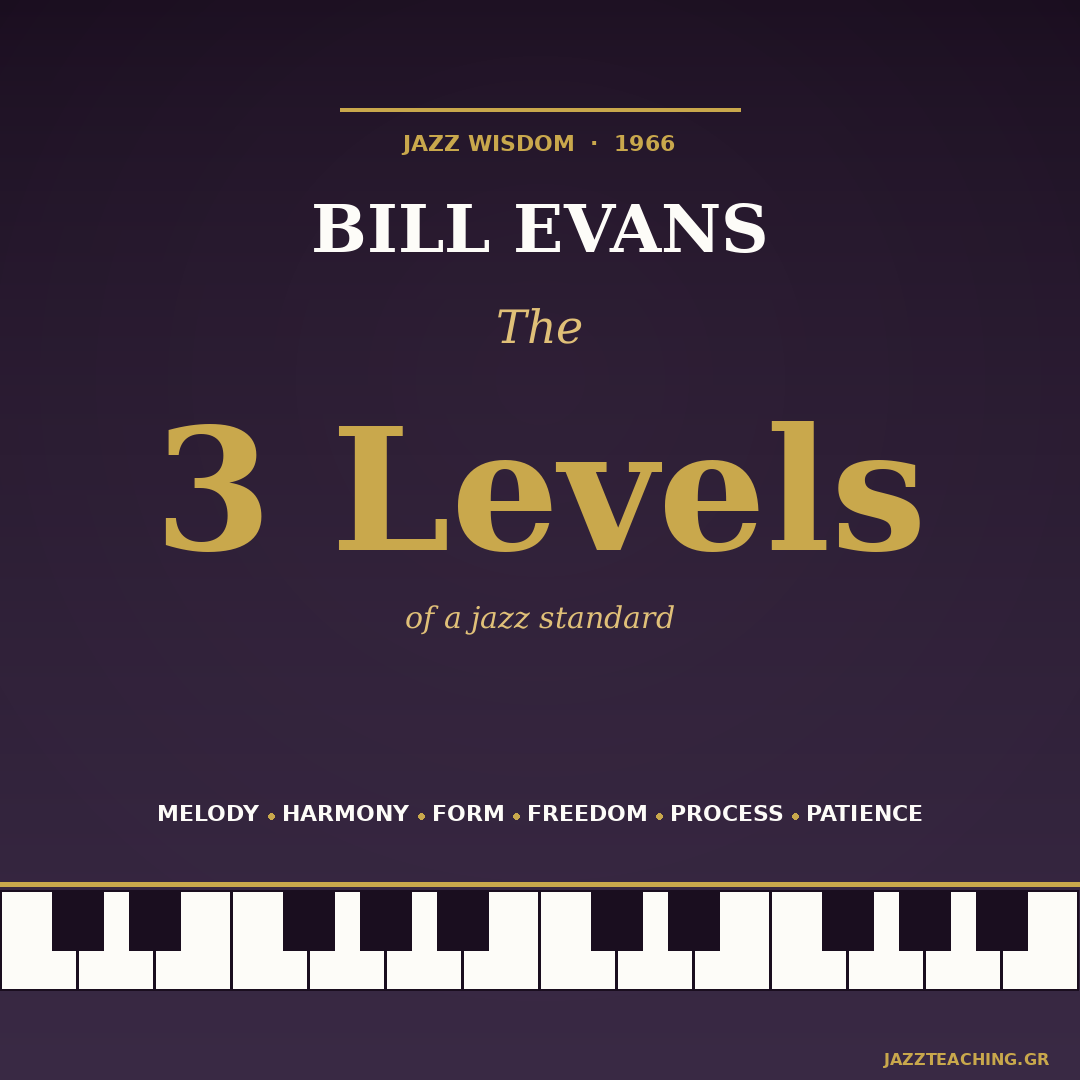
The 3 Levels of a Standard — A Framework for Any Tune
| Level | What You Play | Goal |
|---|---|---|
| 1. Melody only | Single notes, no harmony | “Speak” the melody — know it by heart |
| 2. Melody + basic harmony | Chord-melody as in the Real Book | Understand the tune’s structure |
| 3. Free harmony | Your own chords, reharmonization | Express something that’s really yours |
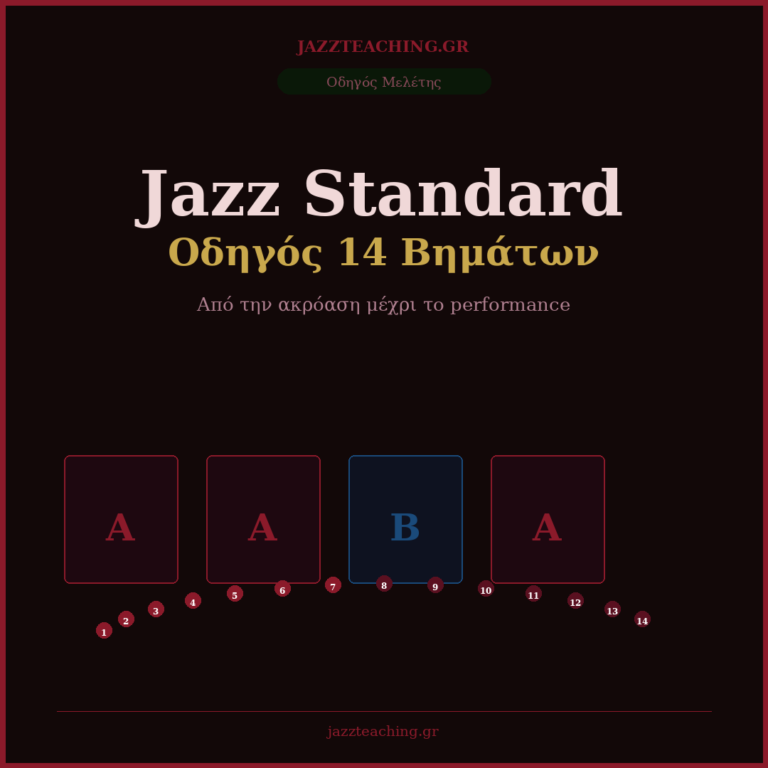
This is the foundation of the 14-Step Jazz Standard Study Program: understanding of harmonic structure is the base on which everything else is built.
Where Evans emphasises melody first, Thelonious Monk says the same thing more bluntly — “Stop playing all those weird notes, play the melody!” Two very different musicians, one identical instruction.
The “Approximation” Trap
One of the most powerful moments in the documentary is when Evans talks about the trap of approximate study. Many students try to imitate someone else’s result — the sound, the voicings, the licks — without ever understanding the process that led there.
The consequence? They build on a foundation made of fog. It may sound something like jazz, but they can’t move forward — because they don’t know why they’re playing what they’re playing.
The alternative Evans proposes: take a very small piece of the problem and make it completely real. However elementary — it has to be precise, honest, and yours. Only then can you build on it.
This is the discipline that made Hank Jones the pianist he was: not enormous vocabulary, but every note precise, honest, and his. Different musicians, same principle.
Self-Teaching and the Role of the Teacher
One of the most interesting exchanges in the documentary is the disagreement between Bill and Harry Evans about whether jazz can be taught.
Harry, as a teacher, argues that the student needs examples — patterns, chord progressions, specific solutions. Bill counters: “Or how to find one!” — instead of handing over twelve ready-made solutions.
Evans’s position is that every serious jazz musician is, in the end, self-taught. The teacher can point to principles — but the student has to decide on their own what to keep and what to reject. Nobody can do that work for you.
This is where I often find myself disagreeing gently with new students. They want the map. What Evans is saying — and what I’ve come to trust after 30 years — is that the map has to be redrawn by each musician. The teacher hands you the compass, not the route.
That doesn’t make teaching useless — it means that teaching style (patterns, licks, “so-and-so’s voicings”) is dangerous when it isn’t accompanied by an understanding of the underlying principles.
Freedom Within Form
Perhaps the deepest idea in the documentary concerns freedom in jazz. Many people think jazz freedom means “I play whatever I want.” Evans has an entirely different view.
Freedom isn’t the absence of constraints — it’s the ability to express yourself authentically within a set of constraints. The notes available, the harmonic structure, your technical ability — those are the constraints. And precisely because there are constraints, freedom means something.
“There is no freedom without reference to something… You take this strict form and you find a way to move away from it — and that’s what gives it meaning.”
— Bill Evans
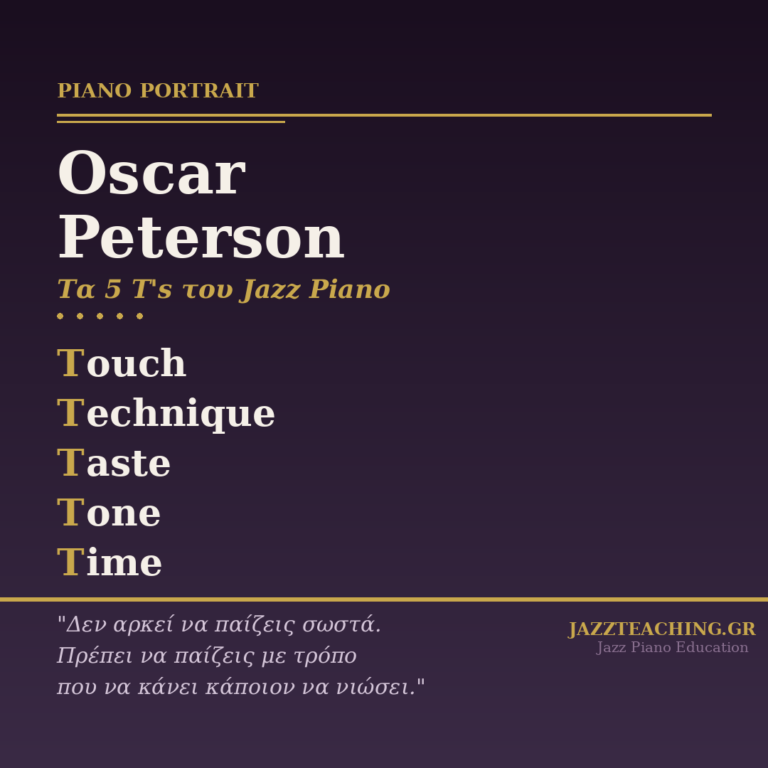
This is very close to what Oscar Peterson meant by Taste: not the freedom to do anything, but the wisdom to choose within the frame what actually serves the music.
Internalization: From Conscious to Automatic
Evans describes with real clarity how a musician develops their ability. It isn’t magic — it’s a specific path:
Every problem has to be met first with intense conscious concentration. You have to know exactly what you’re doing and why. Then, with repetition and time, that knowledge becomes secondary and unconscious — automatic. Once it’s automatic, you can turn your attention to the next problem.
This is the study model that makes real growth possible: first conscious practice of the voicings, then their gradual automation, so that you can listen and react in the moment.
Peterson called this Technique in service of music. Evans calls it internalization. Same insight, different vocabulary — and worth noticing that the whole cluster of masters here converges on it.
Evans on Classical Music — An Interesting Observation
Something Evans says that isn’t often quoted: he observes that classical music in the era of Bach and Mozart was more “jazz-like” — it had large open sections for improvisation, something that was lost later as composers began writing every note. Jazz, then, isn’t a divergence from the classical tradition — it’s a return to its spirit.
Watch the Documentary
If you haven’t seen The Universal Mind of Bill Evans, the video below is one of the most important 45 minutes a jazz pianist can spend. Take notes.
What to Take Into Your Daily Practice
The essence of Evans’s approach in practical terms:
- Learn the melody alone first — no harmony, no voicings.
- Understand the tune’s structure, not just its chords.
- Don’t try to imitate the result — explore the process.
- Every new piece of knowledge has to become automatic before you move on.
- Enjoy every step — the “problem” is big, but each step has value.
- Jazz freedom lives inside form, not outside it.
Evans didn’t say jazz was easy. He said that if you understand the scale of the challenge and enjoy every step, the journey is worth it. And that, at the end of the day, is true of every art form.
JAZZ PIANO NEWSLETTER
Weekly educational material, analyses, and practical exercises.
Sign up to receive exclusive jazz piano content — from theory to practical application.
SUBSCRIBE TO NEWSLETTER
One Comment