Bud Powell: the philosophy of bebop piano in 6 lessons
“If I had to choose one musician for his artistic integrity, for the incomparable originality of his creation and the grandeur of his work, it would be Bud Powell. He was in a class by himself.”
— Bill Evans, 1979
Bud Powell (1924–1966) is the pianist who took the language of bebop from Charlie Parker’s saxophone and brought it to the piano. Practically all of modern jazz piano starts with him: the right hand that “sings” like a horn, the left hand that says only what’s necessary, the piano trio as we know it today. In this article I won’t dwell so much on his biography as on Bud Powell’s philosophy of playing. What he was thinking when he played, what we can keep from it today, and how it translates into everyday practice at the piano. In all my years of teaching, every student who wants to really understand bebop has to go through Bud at some point. There’s no way around him.
PORTRAIT — BUD POWELL
- Full name: Earl Rudolph “Bud” Powell
- Born: September 27, 1924, Harlem, New York
- Died: July 31, 1966, New York (only 41 years old)
- Family: His father was a stride pianist. Bud himself started on classical piano as a child
- Mentor: Thelonious Monk, who dedicated “In Walked Bud” to him
- Key recordings: Blue Note 1949 (“Bouncing with Bud”, “Dance of the Infidels”), The Amazing Bud Powell 1951 (“Un Poco Loco”)
- Europe: Paris 1959–1964 with Pierre Michelot and Kenny Clarke · Copenhagen 1962
1. Why is Bud Powell considered the founder of bebop piano?
Before Bud, jazz piano was mostly an “orchestral” instrument. The stride pianist handled bass, harmony and rhythm alone with the left hand, and decorated the melody with the right. It was music of self-sufficiency: the pianist had to do everything.
Bud did something radical. In essence he said: “I don’t need to do everything myself. There’s a bass player, there’s a drummer. I’m going to tell a story.” From that moment on, the piano could speak with the same freedom as Parker’s saxophone and Dizzy Gillespie’s trumpet.
Herbie Hancock described it in a way that says it all: Bud was the foundation on which the whole structure of modern jazz piano was built. Every pianist after him has either passed through his language or is consciously trying to get away from it.
And Monk himself, who rarely handed out praise, used to say that nobody could play like Bud.
2. The right hand as a horn: the philosophy of the line
Bud Powell’s first and most important idea is simple: the right hand is a voice, not a finger running up and down. Bud listened to Charlie Parker and thought like a saxophonist. His lines have a beginning, a middle and an end. They breathe.
If you listen carefully, you’ll notice that Bud doesn’t play “endless eighth notes.” He plays short, clearly shaped phrases, like sentences in a speech. Each phrase says something and then stops, to let the next one come.
Breath as a structural element
A saxophonist has to breathe. A pianist doesn’t have that limitation, and that’s exactly why pianists often play without ever stopping. Bud played as if he had lungs. That “artificial” breath is what makes his lines sound like music and not like an exercise.
Articulation is directly connected to this: where you accent, where you play legato, where you cut a note short. If you want to work on it systematically, I’ve written in detail about jazz phrasing and articulation on piano.
🎹 Put it into practice
- Choose a short Bud improvisation (4–8 bars) from “Bouncing with Bud” or “Anthropology.”
- Sing it first, without the piano, until you know it by heart.
- Play it with the right hand only, at a slow tempo. Notice where the phrase “breathes.”
- Now improvise your own phrases over the same harmony, with one rule: each phrase has to end before the next one begins.
3. The left hand: economy instead of filling
If Bud’s right hand is the horn, his left hand is a lesson in economy. Bud kept only the absolute essentials in the left hand: usually two notes. The root and the seventh, or the root and the third (often opened up into a tenth).
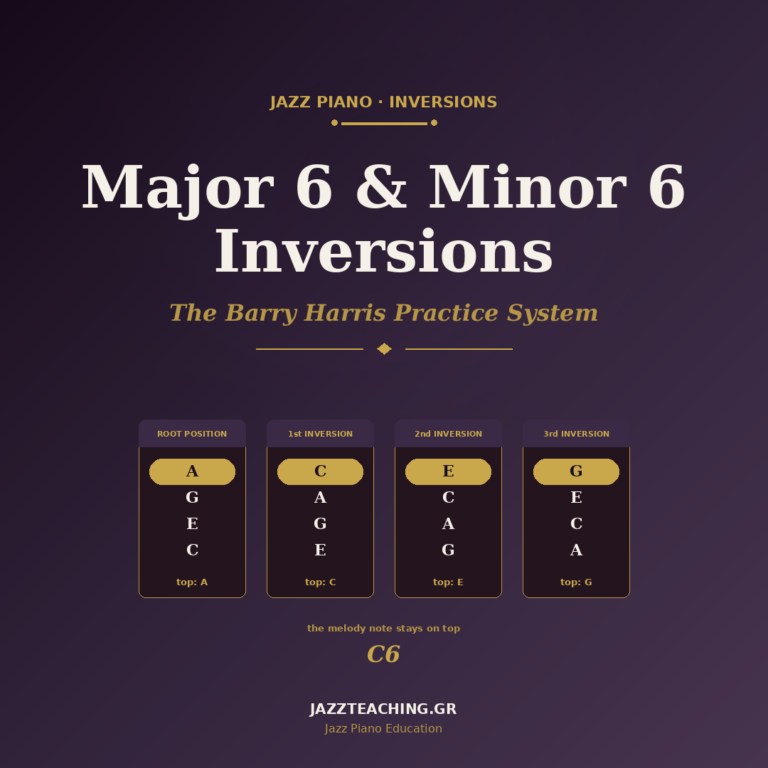
These are the so-called “Bud Powell shells.” A note for our students here: they aren’t the same as the shell voicing we use in the Barry Harris method (root below, top of the 6th chord above). They’re related ideas, but with a different logic and a different sound.
| Shell | Notes (on C7) | When to use it |
|---|---|---|
| 1 – ♭7 | C – B♭ | Dominant and minor 7 chords |
| 1 – 3 | C – E | Major and major 6 chords, and also on dominants for variety |
| 1 – 10 | C – E (an octave higher) | When you want a more open, “fuller” sound without getting heavy |
Why so few notes?
Because Bud trusted the people he played with. The bass player gave the root, the drummer gave the time, and the left hand could simply “push” the harmony along and underline the rhythm with short, crisp hits. Less leaves room. And room, as I often tell my students, is music too.
This logic of economy is also the basis of good jazz piano comping: fewer notes, clearer intention.
🎹 Put it into practice
- Take a blues in F. Play only the left hand, with 1–♭7 shells (F–E♭, B♭–A♭, C–B♭).
- Play the shell short, on 2 and 4 or syncopated, with the metronome on 2 and 4.
- Once it feels steady, alternate 1–♭7 and 1–3 at each chord change, so the top of the left hand moves smoothly.
- Only then add a simple melody in the right hand.
4. Groove before speed: time as a way of life
Bud Powell went down in history for his fast tempos. But that’s a trap for the student listening to him. What’s impressive isn’t the speed. What’s impressive is that even at the fastest tempos, Bud swings. Every note sits in the right place in the beat.
Speed without groove is showing off. Groove without speed is already music. I always say this, and the more I listen to Bud, the more I believe it.
Bud sang while he played
On many of his live recordings you can hear him humming his lines. It wasn’t an eccentricity. It was a sign that the music started inside him, from the ear and the voice, and then passed into his fingers. This is also the basis of the methodical ear training I recommend: first you listen and sing, then you play. No guessing.
🎹 Put it into practice
- Set the metronome to 80 bpm on 2 and 4.
- Play a simple bebop line in eighth notes and sing it at the same time.
- Go up 4 bpm only when the line sounds relaxed and swinging. If it “tightens up,” go back.
5. Classical foundation and jazz voice: complementary, not opposites
Bud grew up with classical piano. His technique, his hand independence, his ability to control dynamics and sound all have their roots in that training. He didn’t “forget” classical music in order to play jazz. He put it at jazz’s service.
This is something I often tell students who come from conservatories: your classical training isn’t an obstacle, it’s a tool. Classical training teaches you to reproduce with precision. Jazz asks for something more: to reproduce and to create. Bud is the proof that the two can live together.
The composer behind the pianist
Bud wasn’t only an improviser. He was also a great composer. Pieces like “Un Poco Loco” (1951), “Tempus Fugit,” “Celia,” “Parisian Thoroughfare” and “Glass Enclosure” show a musician who thought in terms of form and architecture, not only in terms of the solo.
“Un Poco Loco” in particular, with Curley Russell on bass and Max Roach on drums, is a lesson in how a steady rhythmic figure can hold up an entire composition. Repetition as intensity, not as monotony.
6. Monk, listening and humility: Bud Powell’s legacy
Bud’s relationship with Thelonious Monk is one of the most moving friendships in jazz history. Monk guided him when he was young, defended him when others didn’t understand him, and dedicated “In Walked Bud” to him. Bud, in turn, was one of the first to record Monk’s music, and in 1961 he released a whole album dedicated to him, A Portrait of Thelonious. If you’re interested in Monk’s thinking, I’ve put together Thelonious Monk’s 25 pieces of advice for musicians.
A story from Copenhagen
In February 1962, Bud played at the Café Montmartre in Copenhagen. On bass was a 15-year-old Dane: Niels-Henning Ørsted Pedersen, who would later become one of the leading bass players in jazz. The young man kept asking Bud about the form and the harmony of the tunes. Bud didn’t answer him. He just nodded.
So NHØP learned the only way that was left: by listening. For me, this story is the whole lesson. Jazz isn’t learned only through explanations. It’s learned with open ears and with the humility to accept that the music is leading you.
From Bud to Barry Harris
For us at JazzTeaching.gr, Bud has a special significance. Barry Harris, whose method we follow, considered Bud and Charlie Parker the central models of the bebop language. Much of what we teach about 6th chords and Barry Harris voicings is, in essence, a systematic way of understanding what Bud did spontaneously.
His life wasn’t easy. A brutal beating by a police officer in 1945 and the many hospitalizations that followed marked his health and his career. And yet, even in his last years, as in the Copenhagen performances, his music keeps its warmth and grace. That may be his strongest lesson: music as a place of dignity.
Where to start: 5 Bud Powell recordings
| Track | Year | What to listen for |
|---|---|---|
| Bouncing with Bud | 1949 | The right hand as a horn, next to Fats Navarro and Sonny Rollins |
| Un Poco Loco | 1951 | Repetition as intensity, the dialogue with Max Roach |
| Tempus Fugit | 1949 | A fast tempo without losing the swing |
| Glass Enclosure | 1953 | Bud as a composer of form, his classical foundation |
| Anthropology (live) | 1962 | The mature Bud in a trio, the left hand in absolute economy |
Watch Bud Powell live: Copenhagen, 1962
Very little footage of Bud has survived, and none from the 1940s. This performance at the Café Montmartre, with Niels-Henning Ørsted Pedersen on bass and Jørn Elniff on drums, is one of the most valuable documents we have. Watch his left hand: how little it plays and how much it says.
The original 1962 Copenhagen films are kept today in the Francis Paudras collection at the Institute of Jazz Studies (Rutgers University).
What we keep from Bud Powell’s philosophy
- The right hand is a voice. Phrases that breathe, not endless eighth notes.
- The left hand is economy. Two notes, clear intention, room for the others.
- Groove comes before speed. Fast is only worth it if it swings.
- First you listen and sing, then you play.
- Your classical foundation is an ally. Reproducing and creating, together.
- Humility is a musical prerequisite. The music leads you, not the other way around.
One-on-one jazz piano lessons, online
I teach private lessons on Zoom, starting from wherever you are right now. Your first lesson is a free 60-minute trial, so we can get to know each other and see if it’s a good fit.
About the lessonsJazz Piano Newsletter
The next article, in your inbox
About once a month: new articles, practice ideas and free material on jazz piano and the Barry Harris method. No spam, one-click unsubscribe.
SubscribeChristos Mastrogiannidis
Jazz Pianist & Educator · Berklee College of Music, Kunstuniversität Graz · Founder of JazzTeaching.gr