The Detroit School of Bebop: 4 pianists who changed jazz
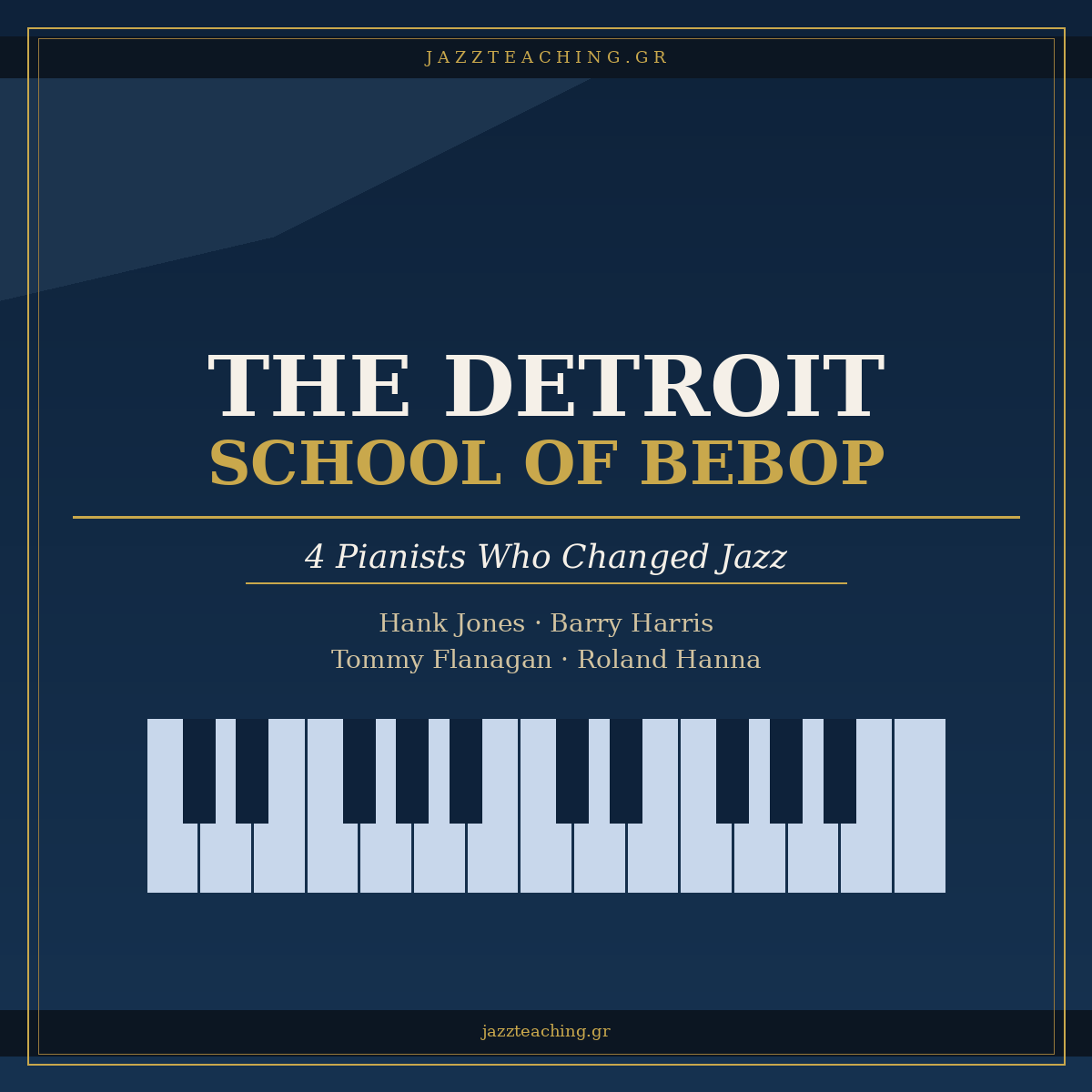
There are times in jazz when a whole city works like an academy. Detroit in the 1940s and ’50s was one of those times, and the four pianists who came out of it form one of the most cohesive, recognizable and deeply developed circles in the history of jazz piano.
The roots: Bud Powell and Thelonious Monk
To understand the Detroit School, you first have to understand who influenced all of them. Two names dominate: Bud Powell and Thelonious Monk. They weren’t Detroiters, but they were the common language, the common reference, the common definition of what it means to play bebop piano.
Bud Powell (1924–1966)
Powell did on the piano what Charlie Parker did on the saxophone: he freed the right hand. Before him, jazz piano was a two-handed balance, stride bass on the left, melody on the right. Powell changed that completely: the right hand plays fast, independent bebop lines as if it were a trumpet or a saxophone, while the left keeps the comping minimal, two or three notes (a shell voicing), at the right moment, and nothing more. That was a revolution. Barry Harris put it simply: for him, Powell’s playing was “the revelation.” And he wasn’t the only one. The whole generation of Detroit pianists started from there.
📀 Listen: The Amazing Bud Powell Vol. 1 (1949–51, Blue Note). Start with “Un Poco Loco” and “Tempus Fugit,” and you’ll understand right away why everyone talks about this man.
Thelonious Monk (1917–1982)
Monk was different from Powell in every way, but just as essential. Where Powell was fluid and fast, Monk was angular, deliberately “clumsy,” full of pauses and dissonances that didn’t “resolve” the way you’d expect. He played as if he were thinking out loud, and that’s exactly what made him unsurpassed as a composer and as a performer. The Detroit pianists learned something from Monk that can’t be learned from Powell: how to leave space, how to make silence speak, how to build a solo like architecture rather than a sprint. Barry Harris was so close to Monk that late in Monk’s life they lived in the same house: the home of the “Jazz Baroness,” Pannonica de Koenigswarter, in Weehawken, New Jersey.
📀 Listen: Alone in San Francisco (1959, Riverside). Monk alone at the piano: the most direct, most revealing way into his world.
The Detroit School of Bebop
Postwar America was a country on the move, and Detroit was its industrial heart. But beneath the noise of the factories there was a lively jazz scene, with strong public school music programs, dozens of clubs and one legendary landmark: the Blue Bird Inn on Michigan Avenue. That’s where local musicians played with the greats passing through town: Miles Davis, Coleman Hawkins, Sonny Rollins, Lester Young. And that’s where a shared aesthetic DNA took shape, what we now call the Detroit sound: swing that breathes, a clean bop vocabulary, a lyrical touch. What Charlie Parker famously called “playing the pretty notes.”
In 1957, at a John Coltrane session with Kenny Burrell, the entire rhythm section was from Detroit: Tommy Flanagan on piano, Doug Watkins on bass, Louis Hayes on drums. That wasn’t a coincidence. It was a community. The Detroiters stuck together, played together and learned from one another.
Hank Jones (1918–2010)
Hank was the eldest of the three famous Jones brothers; Thad (trumpet) and Elvin (drums) were the other two. He grew up in Pontiac, Michigan, listening to Art Tatum, Fats Waller and Teddy Wilson, but as soon as he arrived in New York in 1944, invited by saxophonist Lucky Thompson, he fully absorbed the language of bebop. Within a few months he was already playing with Charlie Parker.
What made Hank Jones unique wasn’t speed or technical display. It was absolute economy and elegance. Every note in the right place, nothing superfluous, never anything showy. Ray Charles, who didn’t hand out compliments easily, said he preferred Hank Jones to Bud Powell because of his touch and the feeling in his playing, which reminded him of Nat Cole. Hank played with Ella Fitzgerald (five years as her accompanist), Charlie Parker and Cannonball Adderley, and on May 19, 1962, he was at the piano when Marilyn Monroe sang “Happy Birthday, Mr. President” to JFK. He kept recording and performing until he was 91, with the same precision and grace to the very end.
He once said that every note should have its own identity and its own soul, and that he wanted the listener to understand what he was doing. That philosophy, music as communication rather than display, is something every jazz pianist should take to heart.
📀 Listen: Have You Met Hank Jones? (1956, Savoy), solo piano. The best introduction to his world: 40 minutes of pure jazz elegance with nothing extra.
Barry Harris (1929–2021)
If Hank Jones was the first to leave Detroit, Barry Harris was the one who made Detroit. House pianist at the Blue Bird Inn for years, he was the teacher everyone went to see at his home, from Donald Byrd to Joe Henderson, from Paul Chambers to John Coltrane. The story says it all: when Coltrane played in Detroit, he would stop by Harris’s house to see “what new things he was exploring.”
Harris was, in the words of his colleagues, “a bebopper down to his socks”: bop down to the last cell of his body. He never followed free jazz, never fusion, never the fashions. He stayed faithful to the language of Powell and Monk, but made it his own, with a rhythmic depth and harmonic intelligence that set him apart immediately. Alongside his playing, he developed a complete theoretical method for bebop, the one we now know as Barry Harris theory, which has influenced thousands of musicians around the world.
Late in his life he taught weekly workshops in New York, and he kept doing it until a few weeks before he died in 2021, at the age of 91. His last public appearance was at a concert for the NEA Jazz Masters, where he played two Monk tunes and sang the blues with his old friend Sheila Jordan.
On JazzTeaching.gr you already know him from Family Chords theory, the 6th chord voicings and melody harmonization. But before any theory, Harris was simply one of the greatest bebop pianists who ever lived.
📀 Listen: Magnificent! (1969, Prestige), a trio with Ron Carter and Billy Higgins. Bop in its purest, most alive form, and the album title simply describes the reality.
Tommy Flanagan (1930–2001)
Flanagan grew up in Detroit listening to Hank Jones, whom he considered “a great solo pianist and a great accompanist,” and learning the bop language next to Barry Harris. He played clarinet as a child, and that left its mark on his piano playing: legato phrases with no breaks, a sense that every line sings rather than being spelled out. Critic Richard Cook described him with a phrase that has stuck: “a bebopper of gentlemanly distinction.”
Flanagan’s discography as a sideman may be the most impressive in the history of jazz piano. Within a few years of moving to New York in 1956, he had already played on Sonny Rollins’s Saxophone Colossus, one of the greatest tenor albums ever made, and on Coltrane’s Giant Steps (1959), where he handled Trane’s unprecedented harmonic changes with a composure and taste that still impress today. Then came years as musical director and accompanist for Ella Fitzgerald, a job that demands complete control of your ears, an enormous knowledge of the repertoire and zero ego. Kenny Barron, one of the most important jazz pianists of our time, says Flanagan was his hero from the moment he heard him as a high school student, and that he remained an influence until the day he died, and still is.
📀 Listen: Eclypso (1977, Enja), a trio with George Mraz on bass and Elvin Jones on drums. Here Flanagan is free as a leader, and the result is the most complete expression of his maturity.
Roland Hanna (1932–2002)
Roland Hanna is the least known of the four, and that’s an injustice worth correcting. He grew up in Detroit, a friend and schoolmate of Flanagan’s from his teens: Flanagan showed him jazz, and Hanna gave him back classical technique and theoretical rigor. He studied at the Eastman School of Music and at Juilliard, and that classical training shows in every solo: architectural construction, full use of the instrument, polyphonic thinking that recalls composition, but with a jazz groove and a bop vocabulary that leave no doubt about where he belongs.
In 1970, the President of Liberia awarded him the title of Sir, in recognition of a series of concerts for Liberian children, and that’s how he became known: Sir Roland Hanna. He played with Charles Mingus, was musical director for Sarah Vaughan, and for eight years (1966–1974) was the pianist of the Thad Jones/Mel Lewis Jazz Orchestra, perhaps the most important big band of its time. His own composition “Oasis,” for piano and orchestra, was performed by the Detroit Symphony Orchestra in 1993, closing a circle that had started decades earlier in the same city.
He believed that anyone who plays music should play it first and foremost for the love of the art, and that the music has to come first. That aesthetic integrity, not following the fashions and staying true to the art, is something he shares with all the Detroit pianists.
📀 Listen: Après un Rêve (2004), solo piano. Here you hear, without distractions, what it means to combine classical technique with a bop soul at full maturity.
What makes them the Detroit School, and why it matters to you
It was no accident that these four came out of the same city. Detroit had something New York didn’t: time and space to develop before you left. They grew up listening to each other, learning from the same teachers, playing in the same clubs. Their shared DNA, the thing every analyst recognizes right away, can be summed up in four elements:
- Swing that breathes: never heavy, always with “air” between the notes. Even at fast tempos, the groove never gets choked.
- A clean bop vocabulary: no ornaments, no unnecessary notes. Every phrase has a beginning, a middle and an end.
- A lyrical touch: the melody is always recognizable, even inside the most complex chord substitution. “Playing the pretty notes,” as Parker said.
- Harmonic sensitivity: smart choices without showing off. The harmony serves the melody, not the other way around.
If you’re studying jazz phrasing or jazz comping, these four are the best way to hear where the ideas come from. And if you want to understand why Barry Harris theory carries so much weight, you first need to hear him play, because the theory came out of the playing, not the other way around.
One-on-one jazz piano lessons, online
I teach private lessons on Zoom, starting from wherever you are right now. Your first lesson is a free 60-minute trial, so we can get to know each other and see if it’s a good fit.
About the lessonsJazz Piano Newsletter
The next article, in your inbox
About once a month: new articles, practice ideas and free material on jazz piano and the Barry Harris method. No spam, one-click unsubscribe.
Subscribe- Barry Harris Theory: Family Chords & Jazz Harmony
- Barry Harris Voicing: Every Chord on Jazz Piano
- Barry Harris Reharmonization: The 4 Brothers of V7
- Hank Jones: 5 Jazz Piano Lessons from a Master
- Mark Stryker — Jazz From Detroit (University of Michigan Press, 2019)
- Richard Cook & Brian Morton — The Penguin Guide to Jazz on CD
- Ted Panken — Today Is The Question (interviews with Barry Harris & Tommy Flanagan)
- Jazz at Lincoln Center — jazz.org · SFJAZZ — sfjazz.org
One Comment