How to listen to jazz: passive and active listening
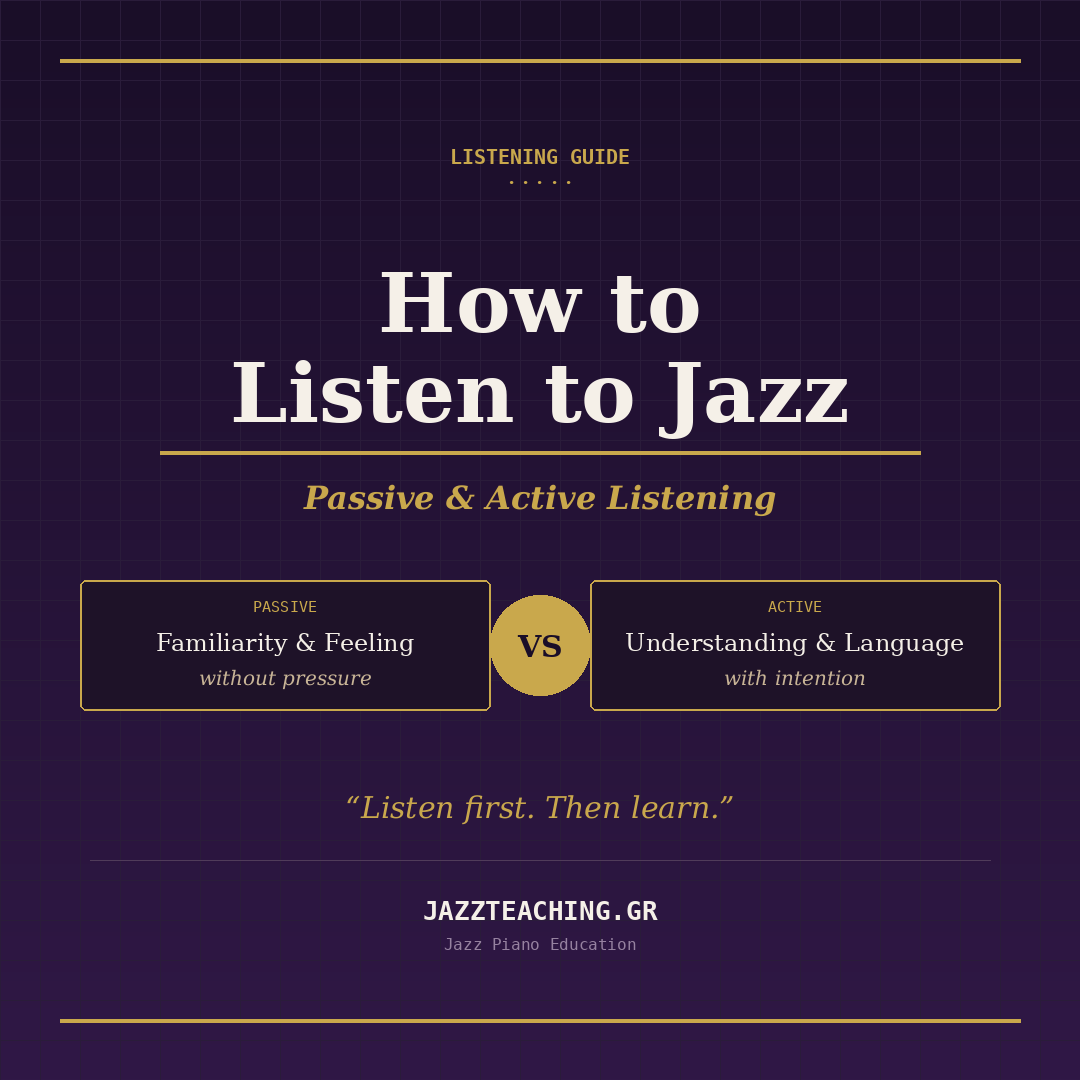
“Listen first. Then learn. If you reverse the order, you’ll be playing notes, not music.”
— Christos MastrogiannidisPeople often ask me: “Christos, why don’t I ‘get’ jazz? I listen, but it all sounds the same to me.” And my answer is always the same: it isn’t a question of your ear, it’s a question of attention. Jazz isn’t music that just plays in the background. It asks something of you. It asks you to be present.
What you’ll find in this article
Two ways of listening, passive and active, and how to use each one depending on what you want to get from the music. Separate advice for the everyday listener and for the musician. Practical exercises you can apply from your very next listen.
Two kinds of listening: which one do you use?
There’s a difference few people point out when they’re learning jazz: the difference between hearing and paying attention. And that difference has a name: passive and active listening.
Passive listening is what we all do every day. Music plays in the background while we drive, eat, work or relax. There’s nothing wrong with that; it’s a human, necessary experience. Active listening, on the other hand, is a conscious act: you sit down, you focus, you let the music become the center of your attention.
Passive listening
- Music as background
- Requires no concentration
- Builds familiarity with the style
- Ideal for everyday life
- Builds taste without pressure
Active listening
- Music as something to study
- Requires focus and intention
- Builds understanding of the language
- Ideal for learning and improving
- Builds vocabulary and a voice
You don’t have to choose one of the two. You need both, just at different moments and for different purposes.
Passive listening: the quiet power of familiarity
Don’t underestimate simple, carefree listening. When jazz is playing in the background while you make coffee or go for a walk, something happens in your mind without you noticing: you get used to the sound. You start to recognize swing, the atmosphere of bebop, the weight of the blues. This quiet familiarity is the first and most valuable gift of passive listening.
Think about how you learned your own language. Before you started saying words, you had heard them thousands of times. Jazz works the same way. You need hours of passive listening for the language to “get inside you” before you can analyze it.
What music to put on, and where to start?
If you don’t know where to start, don’t dive straight into free jazz or avant-garde recordings. Start with something that has melodic clarity. Miles Davis on Kind of Blue (1959), Bill Evans on Waltz for Debby, Oscar Peterson in any trio: these are introductions that don’t hit you over the head. They welcome you in.
For a listener who grew up with classical, pop or folk music, jazz can seem “messy” at first. It isn’t. It has structure; it’s just hidden behind the freedom. Passive listening will help you start to pick it up without pressure.
Active listening: how to listen with intention
Active listening is like going to the cinema instead of having the TV on in the background. You sit down, turn off the lights, let yourself go. The music stops being wallpaper and becomes an event.
Set aside 20–30 minutes with no phone, no notifications, nothing else going on. Just you and the music. That’s a luxury these days, and that’s exactly why it’s so valuable.
What to do while you listen
Start with a single track. Listen to it once all the way through without analyzing it; just take in the overall impression. On the second listen, choose one of the following points of focus:
🎯 Points of focus for active listening
- The melody (head): What’s the main theme? Where does it start, where does it end? Can you sing it?
- The rhythmic feel: Do you feel the swing? Is your foot tapping? Where do the beats fall?
- The dialogue: How do the instruments talk to each other? Who “answers” whom?
- The silence: Where does the music stop? What does it leave hanging in the air?
- The intensity: Where does it build? Where does it relax? Where does it lift you up?
You don’t have to do all of them at once. One listen, one point of focus. That’s the art of active listening: selective attention.
For the everyday listener: how to approach jazz
Jazz has a reputation that puts new listeners off: “It’s difficult music.” And yes, some forms of it really are complex. But enjoying jazz doesn’t require a music degree.
Step 1: Follow the melody
Every jazz standard starts with the head, the main melody of the song. Listen to it and hold it in your mind. Then, as the musicians start to improvise, ask yourself: “Is the melody still here? Can I hear it peeking through the lines?” That’s enough to start “following” the story.
Step 2: Pick out the instruments
In a jazz quartet or quintet, every musician has a role. On the first listen, focus only on the bass. On the next listen, follow the drums. Then the piano or the guitar. This technique of isolation trains your ear to take apart layered music without getting lost.
Step 3: Let yourself feel it
Jazz isn’t only music for the mind; it’s music for the body and the soul. If a solo moves you and you don’t know why, that’s enough. Understanding comes later. Feeling comes first.
Step 4: Build a relationship with one artist
Instead of jumping from recording to recording, choose one musician and “stay” with them. Listen to five or six albums. Let their sound, their phrasing, their character become familiar. Over time you’ll recognize Miles from the first few notes. You’ll feel when Monk is “playing” with your expectations. That familiarity is the closest a listener can get to a musical language.
For the musician: active listening as practice
If you play piano or any other instrument, active listening isn’t just a pleasant pastime; it’s the main source of your musical language. What you listen to becomes what you play. That isn’t abstract philosophy; it’s how the brain works.
In jazz, unlike classical music, you don’t have sheet music guiding you note by note. Your vocabulary comes from your ears, not your eyes. That’s why great jazz musicians always name listening as their main way of learning, long before they talk about scales or harmony.
Transcription: the deepest form of listening
Transcribing a solo is the most complete form of active listening there is for a musician. It isn’t enough to listen to Charlie Parker: you need to choose a phrase, reproduce it by ear, find it on the piano, play it in other keys, and understand why it works. Then that phrase becomes yours. Not copying, but absorbing.
If you’re not sure how to approach a jazz standard from scratch, from learning the melody all the way to improvising, you may find my article How to study a jazz standard on piano: 14 steps useful. I go through the process step by step.
Do you hear the rhythmic feel, or just the notes?
A mistake many jazz musicians make when they listen: they focus only on the notes and ignore the rhythm. But in jazz, when you play a note is just as important as which note you play. Listen to how Oscar Peterson builds intensity through rhythmic compression. Listen to how Monk leaves gaps where others would add more notes. The groove, the feel: all of this is taught only through the ears.
🎹 An active listening exercise for musicians
- Choose a track you love, 4–5 minutes at most.
- Listen 1: The whole thing, no analysis. Just feel it.
- Listen 2: Follow only the melody / the main theme.
- Listen 3: Focus only on the bass and drums, on the rhythmic setting.
- Listen 4: Choose a phrase that “hits” you. Sing it. Find it on the piano.
- Listen 5: Listen to the silence. Where does the musician stop? How long does the rest last?
Do you hear the conversation?
Jazz is a musical conversation. The soloist doesn’t play alone: they respond to the drummer, the drummer reacts to the pianist, the bass player holds the harmony that everyone follows. When you listen actively, ask yourself: “Who’s talking now? Who’s listening? Who’s ‘commenting’?” That conversation is the heart of jazz.
If you’re interested in how this connection with melody and rhythm works in your own playing, take a look at my article on jazz phrasing & articulation. The way you phrase completely changes what you hear and what you play.
Silence as part of listening
There’s something listening guides almost never mention: the value of silence inside the music. Miles Davis was famous for it. He didn’t play more notes; he played fewer, and let the space between them speak.
When you listen actively, learn to listen to the silence as much as to the sound. Where does the music stop? How long does the gap last? What do you feel in there? This sensitivity to space is what sets the deep listener apart from someone who just “hears.”
Where to listen: recordings and live
There’s a huge difference between listening to jazz on a recording and at a live performance. Both are valuable, but they’re not the same thing.
Recordings
A recording lets you come back. You can listen to the same phrase ten times. You can slow it down. You can isolate sections. That repeatability is invaluable for a musician. For the everyday listener, the recording is the way in: the way to build a relationship with an album, a musician, an era.
Live performance
If you get the chance to see jazz live, take it, even just once. Then you’ll understand something no recording fully captures: the real-time interaction. You’ll see a drummer look the pianist in the eye before changing the feel. You’ll feel the space the soloist leaves. You’ll experience jazz as what it really is: a conversation that never repeats itself in exactly the same way.
A few recordings to get you started
There’s no “right” list, but if you’re looking for starting points, these are my suggestions for each kind of listener:
| For the new listener | For the musician |
|---|---|
| Miles Davis – Kind of Blue (1959) | Bill Evans – Village Vanguard Sessions (1961) |
| Dave Brubeck – Time Out (1959) | Oscar Peterson – Night Train (1962) |
| Chet Baker – Chet Baker Sings (1954) | Thelonious Monk – Monk’s Music (1957) |
| Norah Jones – Come Away with Me (2002) | Hank Jones – Arigato (1976) |
| Diana Krall – Look of Love (2001) | Barry Harris – Preminado (1960) |
I’ve written in detail about Hank Jones, one of the richest jazz pianists to listen to, in my article on his jazz piano lessons, if you’re looking for a deeper look at his style.
How to build a listening habit
The best practice isn’t the most intense one; it’s the one that lasts. A 20-minute active listening session a day is worth more than five hours of background music.
📅 A weekly listening plan (beginners & intermediate)
- Monday–Wednesday–Friday: 20 minutes of active listening (one track, several listens)
- Tuesday–Thursday: Passive listening during the day (cooking, walking)
- Weekend: Free exploration: a new artist or album
- Bonus: One live jazz night a month, if you get the chance
The secret is consistency. The ear isn’t trained in a week; it’s trained over months and years. But every listening session leaves a trace. And over time, those traces become a language.
One-on-one jazz piano lessons, online
I teach private lessons on Zoom, starting from wherever you are right now. Your first lesson is a free 60-minute trial, so we can get to know each other and see if it’s a good fit.
About the lessonsJazz Piano Newsletter
The next article, in your inbox
About once a month: new articles, practice ideas and free material on jazz piano and the Barry Harris method. No spam, one-click unsubscribe.
SubscribeChristos Mastrogiannidis
Jazz Pianist & Educator · Berklee College of Music, Kunstuniversität Graz · Founder of JazzTeaching.gr