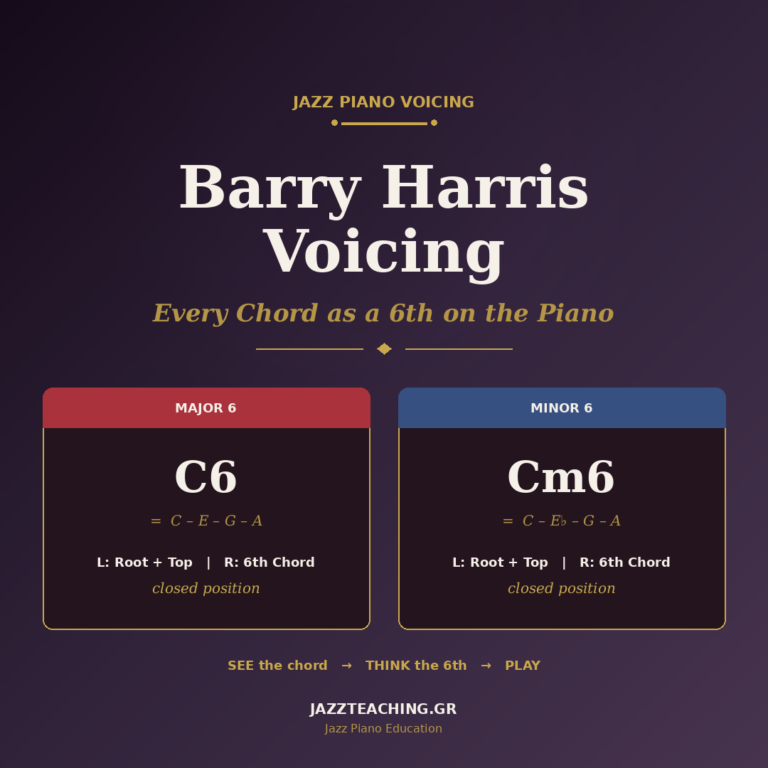
Barry Harris’s teaching: lessons from the master
Barry Harris · NEA Jazz Master 1989
“I should really be teaching the teachers, not the students.”
— Barry Harris, Smithsonian NEA Jazz Masters Oral History Program, 2010
The first time I read the full interview Barry Harris gave to the Smithsonian in 2010, I felt like I was sitting next to him. He doesn’t talk like an academic. He talks like someone who has spent a whole life at a piano, with students around him, and has learned things no school teaches. This article is my attempt to pass on some of his most important ideas about Barry Harris’s teaching — not as technique, but as an attitude toward music.
Who Barry Harris was
Pianist and teacher, born in Detroit in 1929. He lived at the heart of the bebop scene and played with Max Roach, Cannonball Adderley, Coleman Hawkins and Lester Young. He taught Charles McPherson, Joe Henderson, Yusef Lateef and dozens more. He was named an NEA Jazz Master in 1989. He passed away in December 2021, leaving behind a method that is still taught all over the world.
The teacher of teachers — the house in Detroit
Before his name became synonymous with jazz education, Barry Harris was simply a kid who sat at the piano at home all day. His friends — kids who later became Tommy Flanagan, Paul Chambers, Roland Hanna, Donald Byrd, Sonny Red — knew that if you wanted to learn chords, you climbed the stairs to Barry’s house.
In the interview he remembers Roland Hanna telling him, shortly before he died, that he and Sonny Red used to climb those stairs to learn how to play chords. Paul Chambers, Miles Davis’s legendary bassist, learned to play at his house. Yusef Lateef, Motown’s James Jamerson, Joe Henderson — they all came through there.
What Barry describes isn’t a school. It’s a home for learning. Students come to your house because they know they’ll find someone at the piano. And you, as the teacher, never stop studying. It’s a philosophy that has deeply shaped the way I think about my own online jazz piano lessons: the relationship between teacher and student isn’t a one-way transfer of information. It’s a shared space for study.
“Did you do your homework?” — the story of Charles McPherson
Charles McPherson, one of the most important alto players in the bebop tradition, came to Barry when he was fifteen. Barry didn’t only teach him music. He taught him how to be a student.
In the interview he remembers one particular scene. Charles would call: “There’s a jam session, can I go?” And Barry would ask: “Did you do your schoolwork?” If the answer was no, Barry’s answer was no as well — not until the homework was done. Charles McPherson finished high school with top grades in every subject, because Barry insisted that this was how it had to be.
In practice
Music isn’t separate from the rest of a student’s life. A teacher who only cares about what the student does at the piano, and not about how they organize their life, is missing half the job. I keep this lesson in my own teaching: discipline at the piano means discipline everywhere.
“We are the continuation of the classical musicians”
This may be the most important idea in the whole interview. And it’s an idea I have passed on to my students again and again.
Barry says, with his own simplicity, that jazz musicians aren’t a separate breed. They are the continuation of the classical tradition of improvisation. Bach, Beethoven, Chopin and Liszt all improvised. Improvisation was a core part of a classical musician’s training until, as Barry puts it, it “stopped in Europe and started in America.” He got this idea from a Dutch theorist, Badweyn.
If Chopin, Bach and Beethoven were alive today, Barry asks rhetorically, where would they play? In concert halls? No. Concert halls play the music of dead people. They’d be playing at the corner bar. Just like him.
This isn’t just a figure of speech. It’s a deep teaching position. Jazz isn’t against the classical tradition — it’s its living continuation. In the theory of Family Chords we see exactly this logic: harmonic organization rooted in the functional harmony Bach and Mozart knew, but with everything left open for the improviser.
Why he never needed the modes
One of the sharpest moments in the interview is Barry’s criticism of how jazz was turned into a school subject. When it was decided that jazz should go into the universities, he says, there had to be something to teach. And the thing they chose was the modes — Dorian, Phrygian, Mixolydian and the rest.
Barry’s reaction is clear. He never learned a single mode in his life, and he learned to play jazz. So something is wrong with that way of teaching. The same goes, he says, for the way the diminished scale is taught as “half step – whole step.” It’s a mechanical description that doesn’t explain where the scale comes from or why.
His own approach starts from structure, not from names. He mentions Schoenberg: if you take a diminished chord and lower one note at a time, you end up with four dominants. The roots of those four dominants form a second diminished chord. The two diminished chords together are the diminished scale. Suddenly you don’t have a rule to remember. You have a relationship to understand.
This is central to Barry’s whole approach: understanding instead of memorizing. A student doesn’t need more scale names. They need fewer, with a deeper connection between them. In my article on Barry Harris theory I’ve tried to give exactly this perspective.
The night with Charlie Parker — a feeling that starts in the feet
In the interview Barry describes a night at the Forest Club in Detroit, when he was still a teenager. His brother sang jazz, and Charlie Parker was appearing with strings. The musicians gathered up front, everyone else in the back to dance. Parker tuned his saxophone and began to play.
The experience, Barry says, started in his feet and rose through his whole body. That isn’t rhetoric. It’s a literal description of what it means to be touched by music.
The interesting part comes next. Barry says that this experience “spoiled” him as a listener. Ever since, when he goes to hear someone, he expects the same feeling. And he rarely finds it. That’s why, he says, he doesn’t go to clubs anymore — he knows they won’t give him that feeling.
And here he asks the most powerful self-critical question: Do I give that feeling? And before I answer that, shouldn’t I first give it to myself? Be on the other side, listen to myself, and only then be able to pass it on to someone else?
That question is, I think, the heart of his teaching. You don’t teach something you haven’t first found inside yourself.
The “soul part” above technique
Barry has hard words for modern jazz education and for many contemporary musicians. He says they think far too much about technique and far too little about the soul part of the music. They don’t care, he says, about playing a melody beautifully.
He mentions Nat King Cole. He was a brilliant pianist. But the whole world fell in love with the singer, not the pianist. And while nobody complains about the singing, Barry says he wishes he could have heard more of the piano. The melody, the movement of the voices, the singing inside the playing — that’s what it’s all about.
It’s the same reason I insist so much on phrasing and articulation in my teaching. Without melodic thinking, improvisation becomes a mental exercise. And the listener notices right away.
There’s a second dimension here too, and that’s humility. In one of the most moving moments of the interview, Barry says he only plays piano when he’s working. In other words, he doesn’t sit down to show off. He plays when there’s a reason to play. And when he plays, he does it with full attention on the song, not on himself.
What we keep for our own teaching
The interview runs to 36 pages and has dozens more stories — about Monk staying at his place for ten years, about concerts with five hundred kids in Toronto, about how he learned to write for strings while flying to Detroit. They don’t fit here. But the central teaching lessons of Barry Harris’s teaching are, I think, five:
Five things we keep
- The home, not the classroom. Jazz teaching works best as a community of study, not as a one-way transfer.
- Discipline everywhere. A student isn’t split into “musician” and “person.” Discipline in life is discipline in music.
- Continuity, not rupture. Jazz is the modern form of the tradition of improvisation. Classical music isn’t the enemy — it’s family.
- Structure, not names. Fewer scales, more understanding of how they relate to each other.
- Feeling before technique. If you don’t feel it, the listener won’t feel it either.
In the video below, Barry explains some of the basic principles of his harmonic thinking. You don’t need to understand him completely. Watch the way he talks, the way he plays, and above all the way he listens to his students.
One-on-one jazz piano lessons, online
I teach private lessons on Zoom, starting from wherever you are right now. Your first lesson is a free 60-minute trial, so we can get to know each other and see if it’s a good fit.
About the lessonsJazz Piano Newsletter
The next article, in your inbox
About once a month: new articles, practice ideas and free material on jazz piano and the Barry Harris method. No spam, one-click unsubscribe.
SubscribeChristos Mastrogiannidis
Jazz Pianist & Educator · Berklee College of Music, Kunstuniversität Graz · Founder of JazzTeaching.gr