Private Jazz Piano Lessons vs Online Platforms: What Actually Helps You Improve
On learning jazz piano
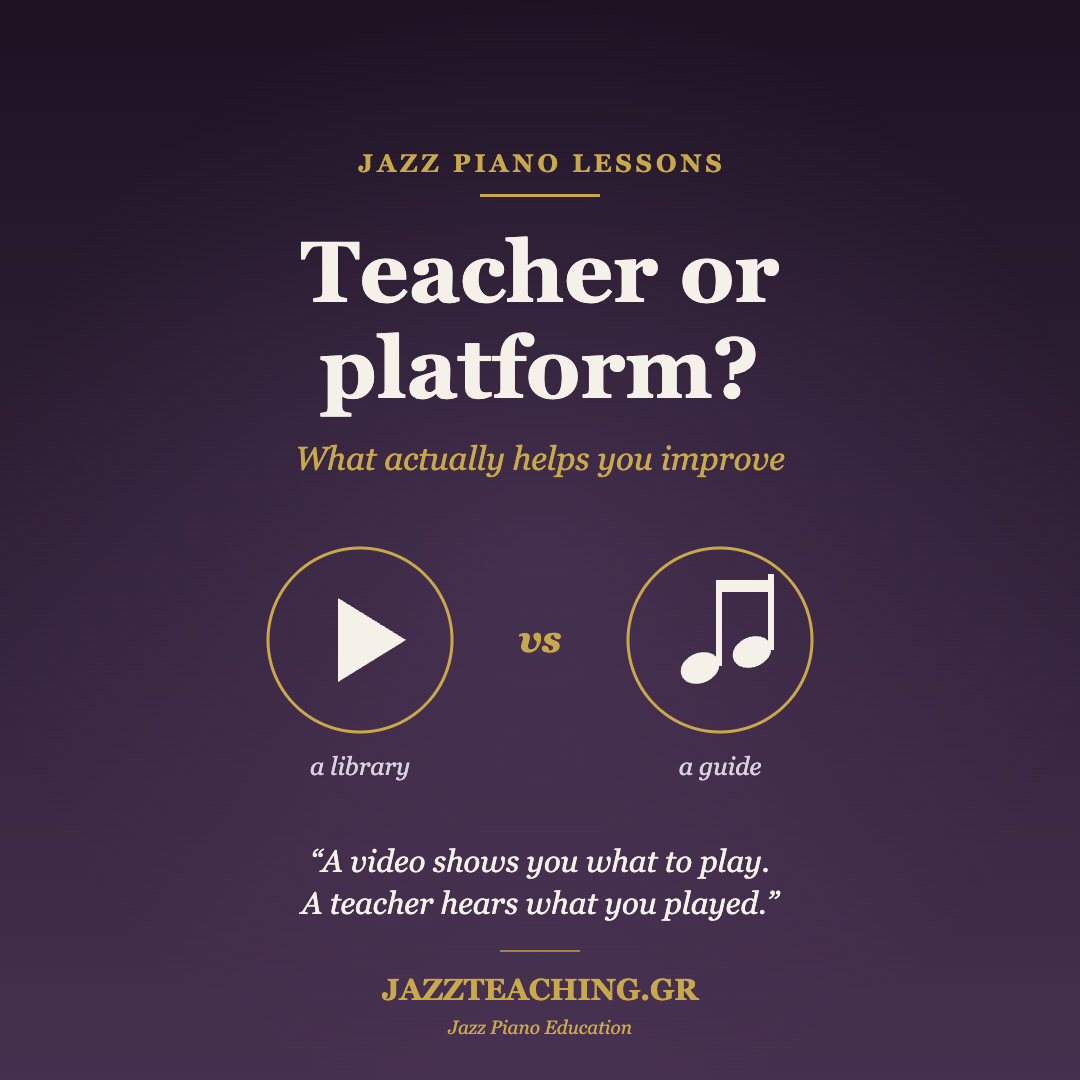
“A video shows you what to play. A teacher hears what you actually played.”
— Christos Mastrogiannidis
There are many people who have taken jazz lessons — on a platform, on YouTube, from books — but have never discovered the system of Barry Harris: a way of thinking that puts harmony directly into your hands, with a simple approach and endless creative possibilities. This article is my honest take on what platforms do well, where a private teacher makes the difference, and how to choose what fits you.
The short answer
- Online platforms are a great library: lots of material, low cost, available any time.
- A private teacher is a guide: someone who hears you, finds what’s really holding you back and gives you the next step.
- If you’re disciplined and know what to work on, a platform can be enough. If you feel stuck, you probably need feedback, not more content.
- Many students do best with both: the teacher sets the direction, the platform fills in material.
What online jazz piano platforms do well
I want to be fair here. Platforms like PianoGroove, JazzSkills, Open Studio or Jazzedge have made a huge amount of good material available to anyone with an internet connection. Twenty years ago you had to find a teacher, a book or a record and work it out yourself. Today you can watch a great player break down a tune on a Sunday morning, in your pajamas, for the price of a few coffees a month.
Their strengths are real: a large library of lessons, play-alongs and transcriptions, the freedom to learn at your own pace and at any hour, and a low monthly cost. For exposure — hearing many ideas, many tunes, many approaches — they’re excellent.
Where they fall short: nobody hears you
The limit of a video is simple: it can’t listen back. It doesn’t know that your left hand rushes on beat 4, that your voicings are in the wrong register, or that you’re playing the right notes with no swing at all. So you can practice the same mistake for months, with total dedication, and never know it.
The second problem is the path. A library gives you everything at once. But a student doesn’t need everything — they need the one next thing that unlocks their playing. That might be time feel, not another scale. It might be listening, not another lick. Choosing that next step is exactly the hardest part, and it’s what a teacher is for.
And the third is simply human: accountability. Knowing that someone will hear you next week changes how you practice this week.
What research says about feedback
In their well-known study on expert performance (Psychological Review, 1993), K. Anders Ericsson and his colleagues described “deliberate practice” as practice designed to improve specific weaknesses, usually with a teacher’s guidance and immediate feedback. John Hattie’s large review of educational research, Visible Learning (2009), also places feedback among the strongest influences on learning. Watching more lessons isn’t the same thing.
Private teacher vs online platform: a side-by-side comparison
| Online platform | Private teacher | |
|---|---|---|
| Feedback on your playing | Little or none | Every lesson, on what you actually played |
| Learning path | The same for everyone; you choose | Built around you and adjusted as you go |
| Amount of material | Very large | Focused: what you need now |
| Schedule | Any time | A fixed lesson time |
| Cost | Low monthly subscription | Higher, per lesson |
| Accountability | Up to you | Someone hears you next week |
| Best for | Exposure, self-directed players, extra material | Getting unstuck, building solid foundations, real progress |
How to know which one you need
A platform is probably enough if you already play jazz with some confidence, you know what you want to work on, and you mainly need new material and ideas.
A teacher will probably help you more if any of these sounds familiar:
- You’ve watched a lot of lessons but can’t play a tune from start to finish with confidence.
- You know the theory, but your playing doesn’t swing.
- You come from classical piano and feel lost without a score.
- You jump from course to course and never finish anything.
- You don’t know what to practice tomorrow.
The best of both: use a platform as a library, a teacher as a guide
You don’t have to choose one forever. You can keep your platform subscription and add lessons with a teacher. In the lessons you decide together what to work on, and between lessons you use the platform for extra tunes and play-alongs. The difference is that now you know why you’re watching a lesson and what to take from it.
Whatever you choose, one thing doesn’t change: jazz is learned with the ears. Record yourself, listen back, and compare it with the players you love. A good place to start is my guide on how to study a jazz standard on piano.
How my lessons work
I teach one-on-one jazz piano lessons online, on Zoom, and I’ve been teaching for 30 years. I studied at Berklee College of Music and the Kunstuniversität Graz, and much of my teaching is based on the method of Barry Harris: harmony built on 6th chords and diminished chords, bebop language, and a lot of listening. If you want a taste of it, read my article on Barry Harris theory and Family Chords.
We start from wherever you are right now, whether you’re a beginner, a classical pianist moving to jazz, or a player who has been stuck for a while. Every lesson ends with a clear plan for your practice until the next one. And the first lesson is a free 60-minute trial, so we can see if it’s a good fit.
Μιλάς ελληνικά; Lessons are available in Greek as well as in English. Greek-speaking students anywhere in the world can find everything in Greek on the Greek lessons page.
One-on-one jazz piano lessons, online
I teach private lessons on Zoom, starting from wherever you are right now. Your first lesson is a free 60-minute trial, so we can get to know each other and see if it’s a good fit.
About the lessonsJazz Piano Newsletter
The next article, in your inbox
About once a month: new articles, practice ideas and free material on jazz piano and the Barry Harris method. No spam, one-click unsubscribe.
SubscribeChristos Mastrogiannidis
Jazz Pianist & Educator · Berklee College of Music, Kunstuniversität Graz · Founder of JazzTeaching.gr