Jazz piano technique: why we start with simple exercises
In jazz piano, technique isn’t measured by how fast you can play. It’s measured by how freely you can say what you hear inside. Your fingers have to be ready to follow your thinking in the moment of improvisation, without getting in the way.
Why technique is different in jazz piano
That’s why, for years now, I’ve called all technical exercises (scales, arpeggios, repeated patterns) preparation exercises. They prepare the mind and the body for the music. They aren’t the music.
The problem I often see in students: they practice technique the classical way, with straight eighths, perfectly even, no pulse. Then they sit down to play a standard and the swing just isn’t there. Their fingers learned how to move, but not how to swing.
How you approach an exercise matters more than the exercise itself
A simple five-finger exercise can be mechanical repetition or a small musical phrase. The difference isn’t in the notes. It’s in how you play them.
That’s why I care more about the approach than about the number of exercises. I treat every technical exercise as a short phrase with a beginning, a peak and an ending. That way, phrasing doesn’t come “later,” once we have the technique. It’s built together with it, from day one.
This means that even when warming up:
- we play swing eighths, not straight ones,
- we listen to our sound on every note,
- we know where the chord tones fall in the bar.
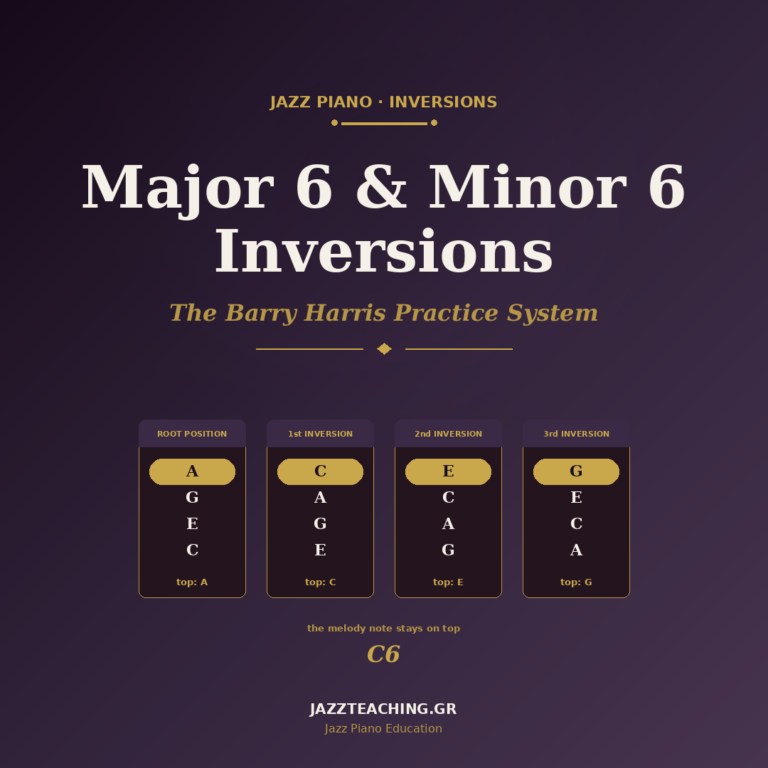
The third point comes straight from the Barry Harris method: chord tones fall on the beat. Even a simple 1-2-3-4-5 on C6 turns into a little bebop line this way.
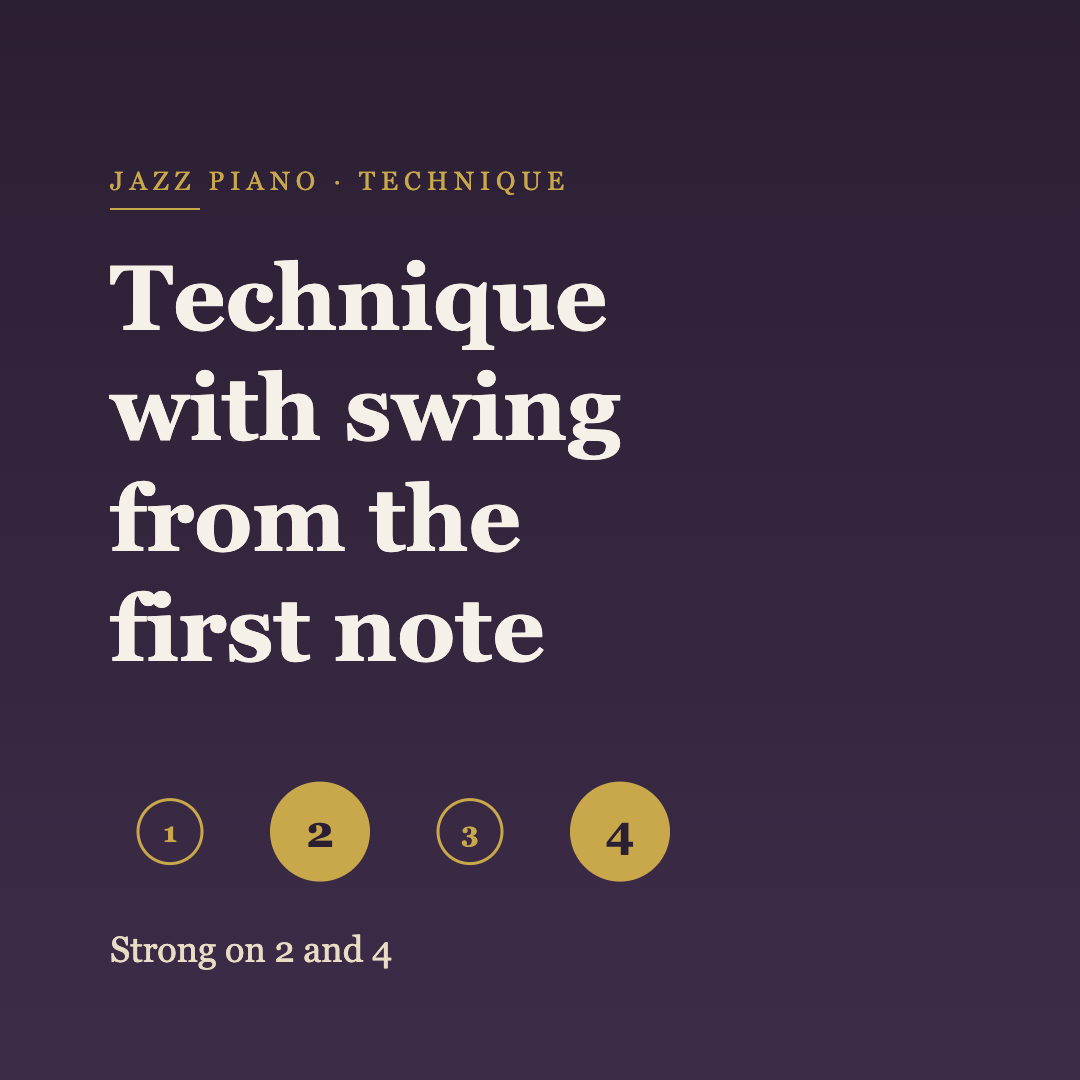
Strong on 2 and 4
If you keep only one idea from this article, let it be this: swing lives on 2 and 4.
In classical music we learn to feel 1 and 3 as the strong beats. In jazz the weight moves to 2 and 4, where the hi-hat closes and the audience claps. If you don’t feel it in your body, it won’t come out in your fingers either.
That’s why I bring it in from the very simplest exercises. The metronome clicks only on 2 and 4, and we play the five notes over it. The exercise stays the same, but the feel changes completely: instead of “technique,” it sounds like music.
This doesn’t mean hitting the notes on 2 and 4 harder. It means your body and your ear hear them as the center of the bar, and the phrase sits on them. You’ll find more on this in my article on swing feel on piano.
Four tips for getting started
- Slow and steady. Speed doesn’t matter. Start around 60 and only go up once the exercise has settled.
- Metronome on 2 and 4. Or a simple drum loop. If it feels hard at first, that’s exactly the point.
- Posture first. Body, wrist and fingers relaxed. Don’t let your posture change as you get tired. A video from your phone will show you a lot.
- Set a time limit. Preparation shouldn’t take more than a quarter of your practice. In a two-hour session, half an hour is enough. The rest belongs to the music.
Variations, accents, ghost notes, triplets and the order to work through them are all covered in detail in the book.
The new JazzTeaching exercise book
These ideas are the foundation of a new exercise book I’m working on: Jazz Five-Finger Warm-ups. They’re short five-finger exercises in the spirit of the classic Czerny books, but written for jazz.
Each exercise comes from real jazz patterns: chord tones on the beat (Barry Harris), cells like 1-2-3-5 (Coltrane), neighbor notes and enclosures from bebop. The series starts with hands separately and moves on to contrary and parallel motion, with 20 exercises in each section.
It isn’t an improvisation book. It’s the warm-up before improvising: agility, evenness between the fingers, and swing from the very first note.
If you’d like to hear when it’s ready, send me a message.
One-on-one jazz piano lessons, online
I teach private lessons on Zoom, starting from wherever you are right now. Your first lesson is a free 60-minute trial, so we can get to know each other and see if it’s a good fit.
About the lessonsJazz Piano Newsletter
The next article, in your inbox
About once a month: new articles, practice ideas and free material on jazz piano and the Barry Harris method. No spam, one-click unsubscribe.
SubscribeChristos Mastrogiannidis
Jazz Pianist & Educator · Berklee College of Music, Kunstuniversität Graz · Founder of JazzTeaching.gr

One Comment