Music teacher: who are they really there for?
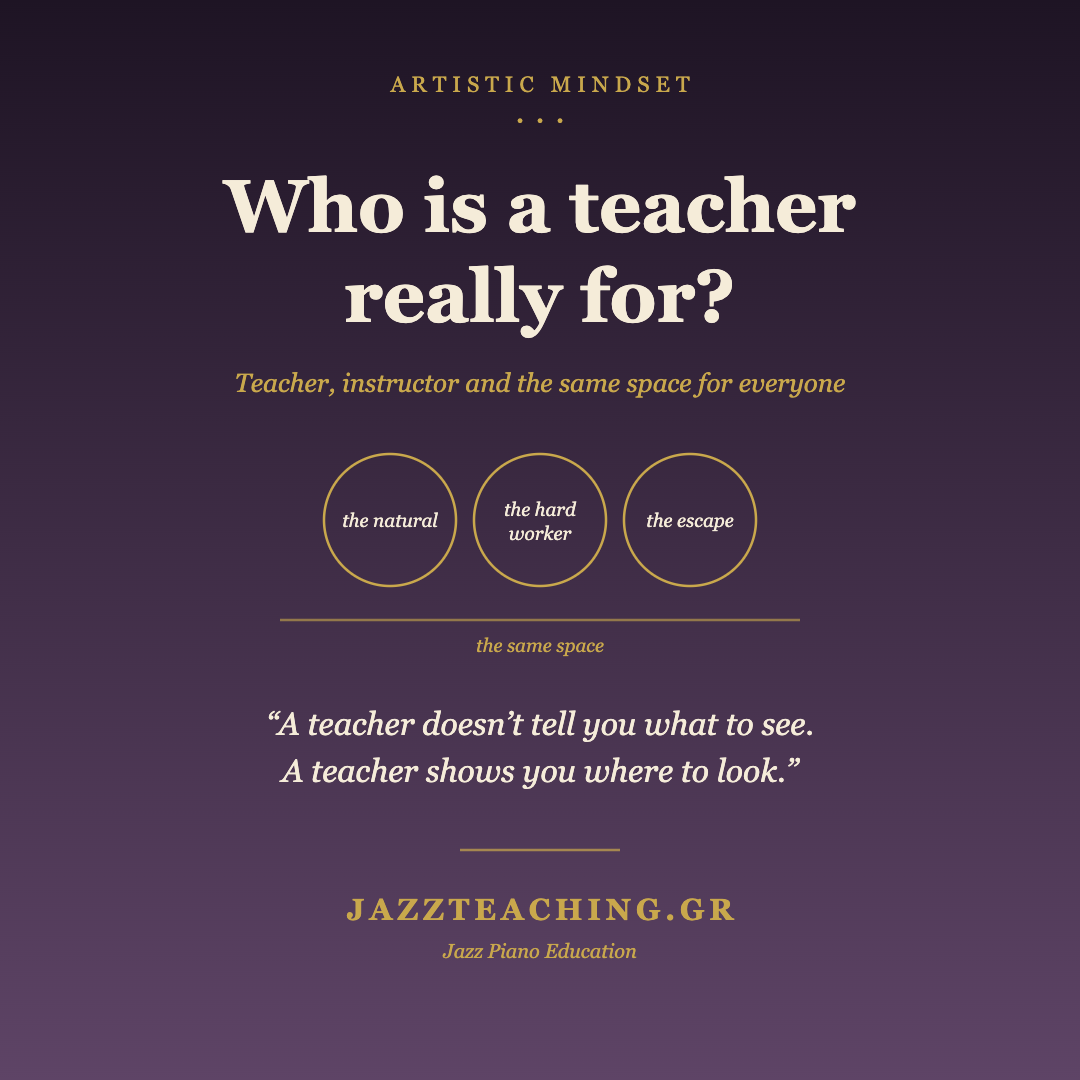
“A teacher doesn’t tell you what to see. A teacher shows you where to look.”
— Christos Mastrogiannidis
There’s a question that has followed me since my first years of teaching, and it has never really let go of me. Who is a teacher actually for? The student who already has jazz inside them? The one who practices every day and wants to go professional? Or also the person who comes to the piano once a week to get away from their day? This isn’t a lesson. It’s my own answer.
A music teacher is there for everyone. Not just for the talented, not just for the hard-working. They’re also there for the person who doesn’t know yet whether they’ll love music, but came to give it a try. And if you ask me where a teacher stands closest, I’ll tell you: next to the one who needs them most. That’s rarely the most talented person in the room. It’s usually the one who came from furthest away.
The core idea at a glance
- An instructor holds a position. A teacher has a relationship.
- A teacher gives everyone the same space: the natural, the hard worker, and the one who came to escape.
- They stand closest to whoever needs them most.
- Every student brings to the lesson time they stole from somewhere else. That deserves respect.
- Passion isn’t a requirement for getting started. Often it’s the result.
Who is a music teacher for?
Let’s be honest. It’s easy to teach someone who has a gift for it. You show them an idea and they get it. You suggest a record and the next week they come back with ten questions. It’s also a pleasure to teach the hard worker, the one who does everything you ask, practices every day, and whose progress you can hear from one lesson to the next.
But there’s a third person too. Someone with no real connection to jazz, maybe not even to the piano. They work all day, they have a family, they have responsibilities. They’re not going to practice two hours a day. They came because they wanted something of their own. A good habit. An outlet. One hour a week that belongs to nobody else.
My answer is simple: a teacher is there for all of them. And the way a teacher treats that third person says a lot about what kind of teacher they are.
Teacher and instructor: what’s the difference?
In Greek we have two words for this, and we often use them as if they meant the same thing. They don’t. Kathigitis, the word for an instructor or professor, comes from kathigoumai, which means to lead, to go on ahead. The instructor walks in front and shows you the way. Daskalos, the teacher, comes from didasko, to teach. The daskalos is the one who walks the road with you.
I want to be clear here, because this is easy to misread. I’m not putting anyone down. Plenty of instructors are teachers to the bone, and someone who is called a teacher may not be one at all. It isn’t about the title. An instructor holds a position. A teacher has a relationship.
| The instructor | The teacher |
|---|---|
| Holds a position, a title | Has a relationship with the student |
| Goes on ahead and shows the way | Walks beside you on the road |
| Passes on knowledge | Opens paths through knowledge |
| Grades the result | Sees the effort and the person |
| Has one program for everyone | Adapts the program to each person |
| Tells you what to see | Shows you where to look |
For me, that last line matters most. A teacher is there for you at every moment, but doesn’t do the seeing for you. They don’t just say, “This is a ii–V–I, play this scale.” They say, “Listen to the bass. Where is it going?” And then they let you find out. What you discover on your own stays with you. What you’re told, you forget.
Three people at the same piano
Every student is unique, we know that. But when I look back over all my years of teaching, I see three attitudes towards music. And each of them asks something different of the teacher.
The natural: the one who already has jazz inside them
They’ve listened a lot. They have ears, curiosity, a feel for it. On the surface, they’re the easiest student. But the danger here isn’t for the student. It’s for the teacher. It feels good to teach someone who “gets it,” and our ego can easily start taking pride through them. This student doesn’t need someone to admire them. They need someone to show them where they haven’t looked yet.
The hard worker: the one who wants to go professional
They practice every day. They have a goal: maybe music school, maybe the stage. They need method, structure, honesty. They need to hear the truth about their playing, even when it isn’t pleasant. The danger here is that the lesson turns into an exam. That we measure only the result and forget there’s a person sitting across from us, anxious, carrying the weight of their goal. Even the hardest worker needs to remember why they started.
The one who came to escape
They’re not especially diligent. They practice when they can. Some weeks they turn up without having opened the piano. But they turn up. And that “but they turn up” is the most important thing a teacher needs to see. For this person, the lesson isn’t a step towards a career. It’s a breath of air. The danger here is the most subtle one: that we quietly see them as less “serious.” And that, without even noticing, we give them less.
Why a music teacher stands closest to the one who isn’t “meant to be”
Here’s something that may sound strange. The natural and the hard worker will find their way, one way or another. They’ll listen to records, find books, go to jam sessions. A teacher helps them get there faster and more soundly, but the road is already in front of them.
The third person doesn’t have a road yet. They have a door that’s half open. If the teacher doesn’t push it open with them, gently and patiently, it may close. And for me, that’s where the greatest joy of this work lies: opening paths where there weren’t any. Watching someone who came “just for a lesson” begin, month by month, to listen differently. Ask you for a record. Tell you they caught themselves humming a standard in the car.
Because passion isn’t always where you start. Often it’s where you end up. You don’t need to love jazz to begin. You need someone who’ll give you the space to grow to love it over time.
Research in education says something similar. Self-Determination Theory, developed by Edward Deci and Richard Ryan and one of the best-supported theories of motivation, describes three needs that make a person love something from the inside: autonomy, a sense of competence, and connection with others. That third one is exactly where the teacher comes in. Intrinsic motivation isn’t born from pressure. It’s born inside a relationship.
Barry Harris understood this before any of us. For decades he kept his weekly workshops in New York open to everyone. Professional musicians sat side by side with people who had only just started. Everyone sang together, everyone played, nobody was in the way. I’ve written more about this in my article on Barry Harris’s teaching and the lessons we learned from him.
Everyone’s time, and what it costs them
Everyone who sits across from me in a lesson has left something behind to be there. The parent who finds half an hour to practice after the kids are asleep. The person who gets home from work tired and, instead of lying down, opens the piano. The young musician who says no to a night out because they have practice. The retiree who always wanted to play and has finally found the time.
Those hours aren’t equal in number. But they are equal in value. Half an hour of practice for someone who works ten hours a day can cost more than three hours for someone who has the whole day free. A teacher who only counts hours doesn’t see the person. A teacher who sees the sacrifice, sees.
That’s why I believe we should give everyone the same space. Not the same program. The same space. The same attention, the same respect, the same joy when something works. Whether that “something” is a solo over rhythm changes, or the first time someone played a melody they love with both hands.
Putting it into practice: five questions before every lesson
If you teach, these are the questions I ask myself before the door opens:
- Who’s coming today, and what did they leave behind to be here?
- What does this person want from music? Not what I want for them.
- What’s the next single step? Not the next ten.
- Where will I show them to look, instead of telling them what to see?
- Will they leave today a little closer to music than when they came in?
If you’re a student, hold on to one simple thing: the value of your practice isn’t measured in hours. It’s measured in how present you are when you sit at the piano. Fifteen focused minutes are worth more than an hour with your mind somewhere else.
Why it’s hard for a teacher to hold on to this
All of this sounds nice on paper. In practice, it’s one of the hardest parts of the job, and it would be dishonest not to say so.
- Fatigue. The seventh lesson of the day rarely has the same energy as the first. But the person who comes for the seventh deserves just as much.
- Ego. Every teacher is happy when a student shines. That’s human. The danger is when we start measuring our own worth only through the ones who “made it.”
- Patience. With the natural, you see results right away. With the one who came to escape, progress is slow and often invisible. You have to believe in something you can’t see yet.
- Easy labels. It’s very easy to put people in boxes: “this one’s serious,” “this one’s a hobby.” Labels spare us the effort of seeing each person fresh.
- Our own music. A musician who teaches also has their own path and their own needs. It takes a conscious choice to leave your own music outside the door and step into your student’s.
That’s why I often say that humility isn’t a moral luxury, for the musician or for the teacher. It’s a precondition. I’ve written about the same thing on stage, in my article on who we really play for: just as a musician plays for the person listening and not for their own ego, a teacher teaches for the student and not to prove what they know.
The American historian Henry Adams wrote in The Education of Henry Adams (1907) that a teacher affects eternity, because he can never tell where his influence stops. You never know which of your students will still be carrying music with them twenty years from now. Often it isn’t the one you expected.
A teacher doesn’t tell you what to see, but shows you where to look
If a teacher tells you what to see, you’ll see what they see. At best, you’ll become a good copy. If they show you where to look, you’ll see something of your own. That’s the nature of jazz, too. Classical music teaches us to reproduce with respect and precision, and that’s valuable. Jazz adds one more thing: we reproduce and we create. They aren’t opposites. Each completes the other. And to create, at some point you have to look with your own eyes.
In practice, this comes down to very simple things. I don’t tell you which chord you’re hearing. I show you how to listen for the voice that moves. I don’t hand you a ready-made solo. I show you how to find the melody inside the changes. I don’t tell you how many hours to practice. I help you find your own pace, because your own pace is the one that lasts. If you want to see what this looks like step by step, my guide on how to study a jazz standard on piano is exactly this way of thinking, in fourteen steps.
A teacher is there for you at every moment. When you practice a lot and when you don’t practice at all. When you want to go professional and when you just want one hour a week to hear yourself play. All of these people love something, or maybe they will. And they all deserve the same space.
One-on-one jazz piano lessons, online
I teach private lessons on Zoom, starting from wherever you are right now. Your first lesson is a free 60-minute trial, so we can get to know each other and see if it’s a good fit.
About the lessonsChristos Mastrogiannidis
Jazz Pianist & Educator · Berklee College of Music, Kunstuniversität Graz · Founder of JazzTeaching.gr