Barry Harris Reharmonization: The 4 Brothers of V7
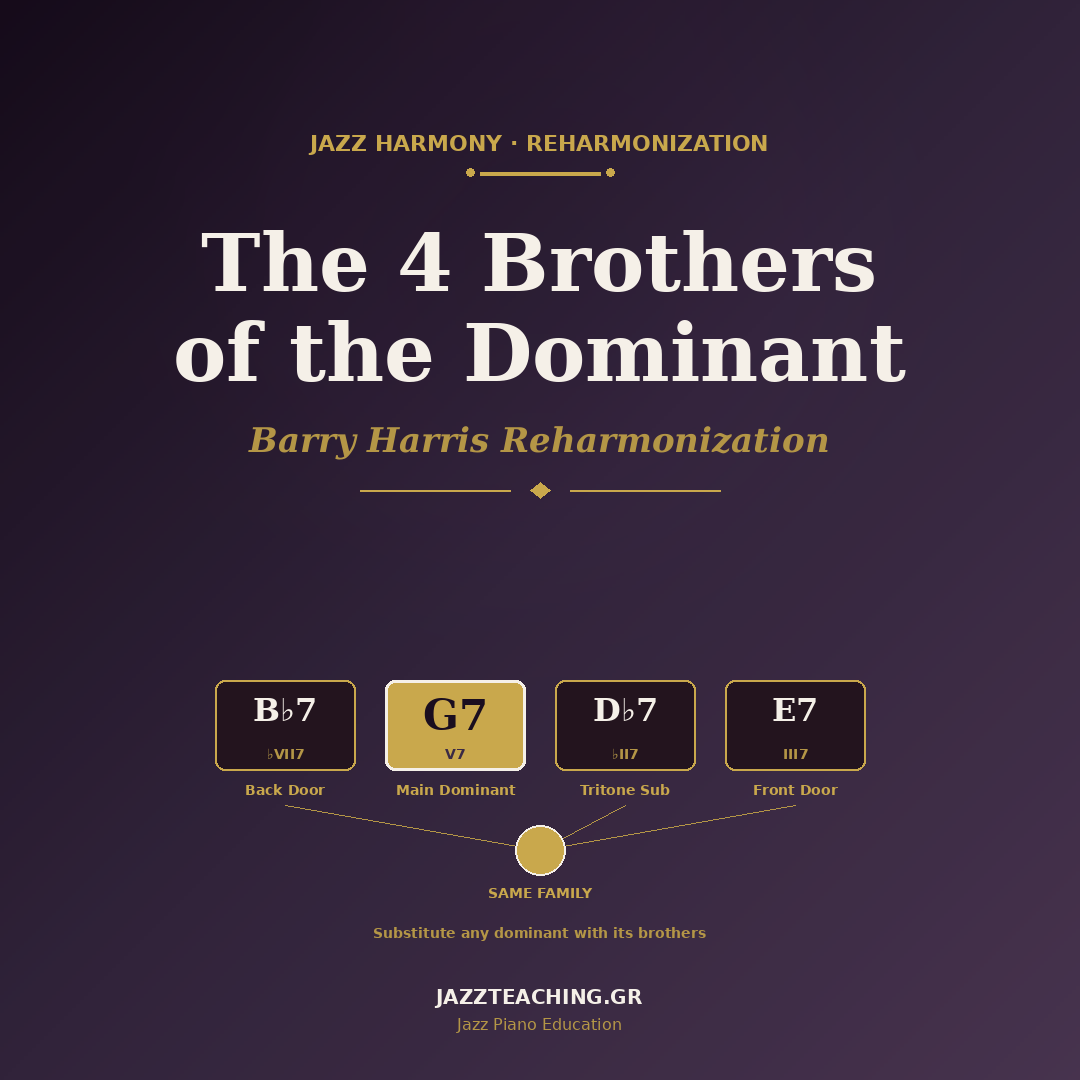
Reharmonization: The “Brothers” of the Dominant
Every dominant chord has three brothers — dominant chords that can substitute for it. This is the secret behind some of the most beautiful harmonic moves in jazz.
JazzTeaching.gr · Piano · Intermediate / Advanced
In the previous article on the Theory of Evolution we saw how the chromatic scale gave birth to the whole tone scales, the diminished chords, and finally the 12 dominant chords. Today we take a step further — we learn how to use these relationships to reharmonize jazz standards.
Barry Harris used to say: “Who do you play first? Your brothers.” And that’s exactly what the Brothers are — the dominant chords that belong to the same family and can be exchanged with one another. If you haven’t yet studied how to play these dominant chords with the 6th chord method, read first the Barry Harris Voicing article.
The Starting Point — From Diminished to Brothers
Remember the basic principle: every diminished chord gives birth to 4 dominant chords — by lowering each of its notes by a semitone. Let’s see it for G7, the dominant of C major:
G7 and its Family
G7 comes from A♭°7 (= A♭ · B · D · F)
↓ Lower A♭ by ½ → G = G7 ← the main dominant
↓ Lower B by ½ → B♭ = B♭7 ← “back door”
↓ Lower D by ½ → D♭ = D♭7 ← “tritone sub”
↓ Lower F by ½ → E = E7 ← “front door”
All four are brothers — born from the same diminished.
Notice something remarkable: the roots of the 4 brothers (G, B♭, D♭, E) themselves form a diminished chord! Careful — it’s not the same A♭°7 they came from. But from this diminished, formed by their roots, you can find the brothers of any dominant chord instantly — just build a diminished on the root of the dominant. The same underlying logic applies in chord melody, where I6 and IIdim7 alternate to “dress” every melody note.
💡 The secret tool
Want the brothers of G7? Play G°7 = G · B♭ · D♭ · E. Those 4 notes are the roots of the 4 brothers.
The 4 Brothers — Names and Character
Each brother has its own harmonic character and its own analytical logic. Let’s meet them one by one in the key of C major — so the main dominant is G7:
1. G7 — The Main Dominant (V7)
The classic dominant. Sitting a perfect fifth above the tonic (C). Creates the strongest sense of “coming home”.
Example: … Dm7 → G7 → Cmaj7 ← the classic ii-V-I
2. D♭7 — Tritone Substitution (♭II7)
The most famous brother. It sits a tritone away from G7 (6 semitones). Their relationship is magical: G7 has 3rd B and 7th F — D♭7 has 3rd F and 7th B. Exactly swapped! That’s why it sounds so natural as a substitute.
Example: … Dm7 → D♭7 → Cmaj7 ← chromatic bass line D♭ → C
3. B♭7 — Back Door Dominant (♭VII7)
Comes “through the back door” — from below instead of above. It sits a whole tone below the tonic (or a minor seventh above). The move B♭7 → C has something bluesy and warm about it — like walking into the house through the back door. Often appears in a IV minor context (Fm7 → B♭7 → C).
Example: … Fm7 → B♭7 → Cmaj7 ← the back door ii-V
4. E7 — Front Door Dominant (III7)
Comes through the front door but from above — sitting a major third above the tonic. The move E7 → C is bolder, with a clear altered color. Sounds more exotic and creates a stronger harmonic tension.
Example: … Bm7 → E7 → Cmaj7 ← front door ii-V
Why They Work — The Logic Behind the Brothers
Every dominant chord has two “critical notes” — the third and the seventh. These form the tritone that “pulls” toward the tonic. The brothers share notes from this tritone — which is why they sound similar to the ear.
The 4 Brothers of G7 (key of C major)
G7 = G · B · D · F ← V7 “Main Dominant”
D♭7 = D♭ · F · A♭ · B ← ♭II7 “Tritone Sub”
B♭7 = B♭ · D · F · A♭ ← ♭VII7 “Back Door”
E7 = E · G# · B · D ← III7 “Front Door”
Examples in Jazz Standards
Autumn Leaves in Em — Opening ii-V-I in G major
The basic sequence: Am7 → D7 → Gmaj7
Tritone Sub (A♭7)
Am7 → A♭7 → Gmaj7
Chromatic bass line: A → A♭ → G
Back Door (F7)
Cm7 → F7 → Gmaj7
Warm, bluesy color
Front Door (B7)
F#m7 → B7 → Gmaj7
Altered, exotic color
Combination
Am7 → A♭7 → F7 → Gmaj7
Double substitution!
All The Things You Are — Final ii-V-I in A♭ major
Basic: B♭m7 → E♭7 → A♭maj7. The brothers of E♭7 in the key of A♭:
- E♭7 → A♭maj7 ← the classic
- A7 → A♭maj7 ← tritone sub (chromatic A → A♭)
- G♭7 → A♭maj7 ← back door
- C7 → A♭maj7 ← front door
There Will Never Be Another You — The Turnaround
One of Barry Harris’s favourites. The last 2 bars usually contain a turnaround in E♭ major: Gm7 → C7 → Fm7 → B♭7 → E♭maj7.
With brothers, Barry Harris often played it as: Gm7 → G♭7 → Fm7 → E7 → E♭maj7 — using tritone subs for both C7 and B♭7. The result: a chromatic descending line G → G♭ → F → E → E♭ that sounds remarkable.
How to Find the Brothers of Any Dominant, Fast
The fastest method — the way Barry Harris taught it:
The 4-Step Method
- Take the root of the dominant — e.g. for G7, take G.
- Build a diminished on it — G°7 = G · B♭ · D♭ · E.
- These 4 notes are the roots of the 4 brothers — G7, B♭7, D♭7, E7.
- Give them names — the original is V7, the one across the tritone is the tritone sub, the one below (♭VII) is the back door, the one above (III) is the front door.
Quick Reference — Brothers in Common Keys
| Key | V7 (main) | ♭II7 (tritone) | ♭VII7 (back door) | III7 (front door) |
|---|---|---|---|---|
| C | G7 | D♭7 | B♭7 | E7 |
| F | C7 | G♭7 | E♭7 | A7 |
| B♭ | F7 | B7 | A♭7 | D7 |
| E♭ | B♭7 | E7 | D♭7 | G7 |
| G | D7 | A♭7 | F7 | B7 |
Practical Guide — How to Start
Practical Application
- Start with the Tritone Sub. It’s the easiest to hear and to apply. Take a ii-V-I and replace the dominant with the tritone sub — listen to the chromatic bass line.
- Then try the Back Door. Take any V7 → I and replace it with ♭VII7 → I. Fm7 → B♭7 → Cmaj7 is a classic example that sounds immediate.
- Practise on a standard you know well. Only one ii-V-I at a time — don’t change everything at once.
- Listen to how the masters do it. Bill Evans on “Alice in Wonderland”, Oscar Peterson on “Autumn Leaves” — full of back doors and tritone substitutions.
- Learn the brothers by heart. The table above is your starting point — in a few weeks you’ll be finding them automatically.
Conclusion
The Brothers of the dominant are one of the most powerful reharmonization tools in jazz — and at the same time one of the most elegant, because they are not arbitrary: they follow with mathematical necessity from the structure of the diminished chord.
This is what made Harris a unique teacher: he didn’t teach rules, he taught relationships. And once you understand the relationships, reharmonization stops feeling like “tricks” and becomes natural expression.
“Who do you play first? Your brothers.”
— Barry Harris
The Barry Harris Series
If you haven’t read them yet:
← Barry Harris Theory: Family Chords & the Genesis of Jazz Harmony
Jazz Piano Newsletter
Want to go deeper into jazz piano?
Free lessons, articles, and practice material straight to your inbox — from Barry Harris’s method to real jazz standards.
Subscribe to the NewsletterChristos Mastrogiannidis
Pianist & Educator · JazzTeaching.gr
Jazz pianist and educator, trained at Berklee College of Music and Kunstuniversität Graz. Teaches jazz piano online, based in Greece.