
Dominant Resolution: 3 V7 Voicings (Barry Harris)
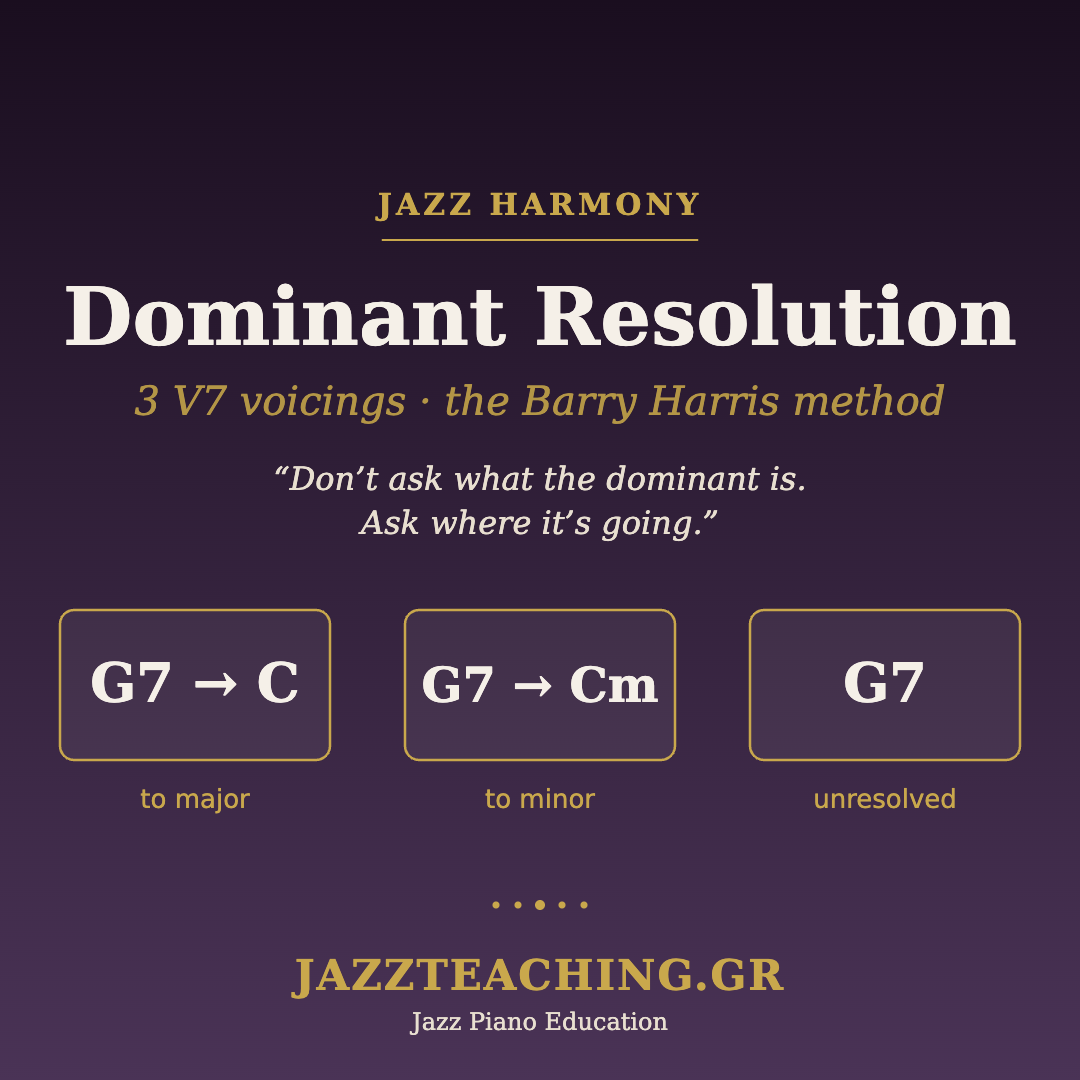
Jazz Harmony · Barry Harris
“Don’t ask what the dominant is. Ask where it’s going.”
When a student shows me a G7 on a lead sheet and asks “what do I play here?”, I answer with a question: “Where is it going?” That question is what dominant resolution is all about. Barry Harris didn’t choose a dominant voicing by looking at the dominant. He looked at the next chord. If the V7 resolves to major, it gets one color. If it resolves to minor, it gets another. If it doesn’t resolve at all, a third. In this article I’ll show you the three voicings, why each one works, and how to practice them until you find them without thinking.
Dominant resolution: the V7 looks ahead
The dominant (V7) is the chord of tension. It exists to lead somewhere, so where it resolves decides how it should sound. The same G7 before a Cmaj7 wants a bright bebop color; before a Cm6 it wants a dark, altered color. If you always play the same voicing on the V7, your harmony sounds correct but flat.
Barry Harris’s rule is simple and practical. You don’t think about alterations (♭9, ♭13, #9) one by one. You think of a 6th chord or a diminished chord in the right hand, and the alterations come out by themselves. If you haven’t seen the 6th-chord system yet, start with Barry Harris Voicing: Every Chord on Jazz Piano.
The left hand stays the same: root and 7th
In all three cases the left hand plays the same thing: the root and the minor 7th of the dominant. For G7, that’s G and F. The ear always knows which chord it is, and the right hand is free to give the color. Only the right hand changes.
1. Resolving to major: a diminished chord a minor 2nd up
When the dominant resolves to a major chord (ii–V–I in major), the right hand plays the diminished chord a half step above the root. For G7: A♭°7, that is A♭, B, D, F.
Over G in the bass, these four notes are the ♭9 (A♭), the 3rd (B), the 5th (D) and the ♭7 (F). You hear a G7♭9, the classic bebop sound, without having thought about the ♭9 at all.
This is the heart of the method. A♭°7 isn’t “foreign” to G7. It’s the diminished chord G7 is born from: lower the A♭ by a half step and you get G, B, D, F. That’s the logic of the brothers, which I explain in detail in Barry Harris Reharmonization: The 4 Brothers of V7. When you play the diminished chord over the dominant, you are playing its “mother”.
2. Resolving to minor: a minor 6th a minor 2nd up
When the dominant resolves to minor (ii–V–i in minor), the right hand plays the minor 6th chord a half step above the root. For G7 going to Cm: A♭m6, that is A♭, C♭, E♭, F. On the keyboard, C♭ is the B key.
Over G, the notes are the ♭9 (A♭), the 3rd (B), the ♭13 (E♭) and the ♭7 (F). Compared with the diminished chord, only one note changed: the 5th (D) became the ♭13 (E♭). That one note brings all the dark color of minor.
There’s also a very practical reason it fits. A♭, B, E♭ and F all belong to the scale Barry used over a minor ii–V: the B♭ dominant scale with 1♯, that is, the dominant of the relative major (E♭) with a sharp on the first degree. Those are the same notes as C harmonic minor, the chord you’re going to.
3. Not resolving: a minor 6th on the 5th
Some dominants don’t lead anywhere. They stay. The most common case is the blues: the F7 in the first bar of a blues in F isn’t the V7 of another chord, it’s home. The same goes for a dominant that lasts for several bars, as in a vamp.
Here Barry Harris played the minor 6th chord built on the perfect 5th of the dominant. For G7: Dm6, that is D, F, A, B. Over G you hear the 5th, the ♭7, the 9th and the 3rd: an open, calm sound with no tension asking for resolution. It’s also the basic dominant voicing in the 6th-chord table.
The map in one table
| What the V7 does | Right hand | Example with G7 | What you hear |
|---|---|---|---|
| Resolves to major | Diminished, a minor 2nd above the root | A♭°7 (A♭ B D F) | ♭9, 3, 5, ♭7 |
| Resolves to minor | Minor 6th, a minor 2nd above the root | A♭m6 (A♭ C♭ E♭ F) | ♭9, 3, ♭13, ♭7 |
| Does not resolve | Minor 6th on the perfect 5th | Dm6 (D F A B) | 5, ♭7, 9, 3 |
All three options on six dominants you’ll meet constantly in standards. I write the notes the way you find them on the keys:
| V7 | → Major | → Minor | No resolution |
|---|---|---|---|
| C7 | D♭°7 (D♭ E G B♭) | D♭m6 (D♭ E A♭ B♭) | Gm6 (G B♭ D E) |
| F7 | G♭°7 (G♭ A C E♭) | G♭m6 (G♭ A D♭ E♭) | Cm6 (C E♭ G A) |
| B♭7 | B°7 (B D F A♭) | Bm6 (B D F♯ G♯) | Fm6 (F A♭ C D) |
| E♭7 | E°7 (E G B♭ D♭) | Em6 (E G B C♯) | B♭m6 (B♭ D♭ F G) |
| G7 | A♭°7 (A♭ B D F) | A♭m6 (A♭ B E♭ F) | Dm6 (D F A B) |
| D7 | E♭°7 (E♭ F♯ A C) | E♭m6 (E♭ G♭ B♭ C) | Am6 (A C E F♯) |
In practice: Autumn Leaves
Take Autumn Leaves in G minor, the way I work on it with my students. The tune is basically two ii–Vs: one resolving to major and one resolving to minor. Our whole map in eight bars.
| Bars | Chords | The V7 goes | Right hand on the V7 |
|---|---|---|---|
| 1–3 | Cm7 · F7 · B♭maj7 | to major (B♭) | G♭°7 (G♭ A C E♭) |
| 5–7 | Am7♭5 · D7 · Gm6 | to minor (Gm) | E♭m6 (E♭ G♭ B♭ C) |
Notice something on lead sheets: the second dominant is often written D7(♭13) or D7(♭9). Those symbols simply describe the sound E♭m6 already gives you. You don’t need to translate them note by note. You see where the dominant goes, and you know what to play.
How to practice it
Practice in four steps
- One dominant, three colors. Left hand G and F. Right hand A♭°7, then A♭m6, then Dm6. Listen to the difference. Which one asks for resolution? Which one doesn’t?
- With the resolution. Play Dm7 · G7 (A♭°7) · Cmaj7, then Dm7♭5 · G7 (A♭m6) · Cm6. Sing the top note of the right hand as it resolves.
- Around the cycle of 5ths. One color at a time: for a week only “to major” in all keys, the next week only “to minor”. Slowly, with the metronome on 2 and 4.
- In a standard. Take a tune you know, mark “M”, “m” or “–” above every V7, and play it using only the right voicings.
Don’t try to learn all three at once in twelve keys. One color, many repetitions, until your hands find it before you think about it.
Play it: “Where Does the V7 Go?”
In the Practice Lab, Swingo shows you a progression and you choose the right-hand voicing. You hear right away whether it fits. Free, no sign-up.
Open the gameThree mistakes I see often
The same voicing everywhere. A student learns Dm6 over G7 and plays it on every dominant. The notes aren’t wrong, but the pull toward the resolution is gone.
Looking at the dominant instead of the resolution. The information isn’t in the G7. It’s in the chord that follows. Train your eye to read one bar ahead.
Losing the root. The diminished chord and A♭m6 don’t contain G. If the left hand doesn’t play G and F, the ear no longer hears a dominant. The left hand is the anchor.
Conclusion
Three voicings, one question: where does the dominant go? To major, a diminished chord a minor 2nd up. To minor, a minor 6th a minor 2nd up. Nowhere, a minor 6th on the 5th. You don’t need lists of alterations. You need an ear that hears where the harmony pulls, and hands that find the 6th chord without delay. The next step is to do the same with scales: to know, before you improvise, which scale goes over each part of the harmony. I show that in Map Out: Which Scale to Play Over Each Chord.
One-on-one jazz piano lessons, online
I teach private lessons on Zoom, starting from wherever you are right now. Your first lesson is a free 60-minute trial, so we can get to know each other and see if it’s a good fit.
About the lessonsJazz Piano Newsletter
The next article, in your inbox
About once a month: new articles, practice ideas and free material on jazz piano and the Barry Harris method. No spam, one-click unsubscribe.
SubscribeChristos Mastrogiannidis
Jazz pianist and educator · Berklee College of Music, Kunstuniversität Graz · Barry Harris Method · 30 years of teaching





2 Comments