Barry Harris Inversions: Major 6 & Minor 6 Study
Barry Harris Inversions: How to Study Major 6 & Minor 6 for the Voicing System
Before you enter the Barry Harris voicing system, there is a step most players skip: the inversions. Without them there is no system — just theory without application.
JazzTeaching.gr · Piano · Intermediate
In the previous articles of the Barry Harris series we saw the theory — how every chord corresponds to a Major 6 or Minor 6 and how the “See → Think” system changes the way you sit at the piano. But theory alone isn’t enough. The question my students always ask is: “How exactly do I practise these chords?”
This article is the answer. We won’t talk theory — we’ll talk practical study: which exercises you do, in which order, and why.
Why Barry Harris Inversions Are the Key
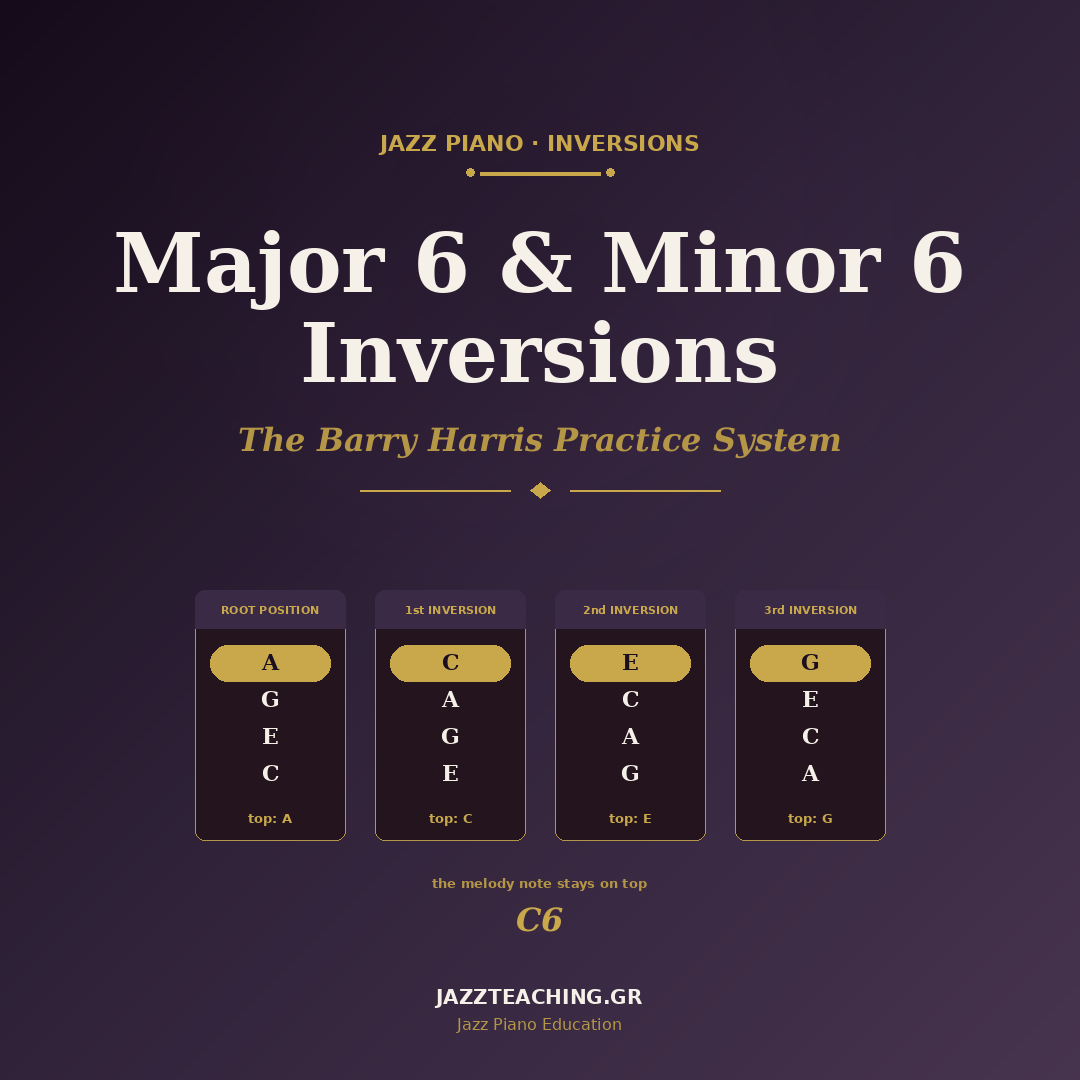
C6 (C · E · G · A) is a chord. But in practice, the melody doesn’t always sit on the A — it could be on C, on E, or on G. That means you need all 4 inversions to bring any melody note to the top of the chord.
The 4 Inversions of C6
Root Position
C · E · G · A
top note: A
1st Inversion
E · G · A · C
top note: C
2nd Inversion
G · A · C · E
top note: E
3rd Inversion
A · C · E · G
top note: G
The goal of practice is to be able to play any inversion instantly — without thinking. When you see E in the melody over C6, your hand should go automatically to the 2nd inversion of C6 (G · A · C · E). That doesn’t come from theory — it comes from systematic practice.
The Logic of the Exercises — Chromatic Movement
The most efficient way to learn the inversions is not to study them one key at a time (C, F, B♭ etc.) — but chromatically: C6 → C#6 → D6 → E♭6 and so on. Why?
- You cover all 12 keys in every single exercise
- The voice leading is minimal — each note moves only a semitone
- Your ear hears the relationship between the chords
- Muscle memory builds much faster
Barry Harris always taught that movement should be minimal — not leaps, but steps. The chromatic system follows exactly this philosophy.
The 16 Exercises — A Complete Practice Guide
The exercises are organised into 4 groups of 4 — one group per inversion. Each group has 4 movement variations:
Free Download
Get the Practice Workbook as a PDF
All 16 exercises for Major 6 and Minor 6 inversions — ready to print, keep on your piano, and work through week by week.
↓ Download the PDFExercise 1 — Ascending
C6 → C#6 → D6 → E♭6 → …
You go up chromatically, keeping the same inversion at each step. Start in root position.
Exercise 2 — Descending
C6 → D♭6 → D6 → E♭6 → …
You go up chromatically, same inversion, but play the notes of each chord from top to bottom: C6 → A-G-E-C, D♭6 → B♭-A♭-F-D♭, … Very important — direction changes muscle memory.
Exercise 3 — Ascending / Descending
You play one chord ascending, then the next chord descending. Combines both directions into a continuous flow.
Exercise 4 — Descending / Ascending
You start with a chord descending and then play the next chord ascending. The hardest one — this is where you test whether you’ve really automated the inversion.
The same structure (exercises 1-4) repeats for the 1st inversion (exercises 5-8), the 2nd inversion (exercises 9-12), and the 3rd inversion (exercises 13-16). Total: 16 exercises that cover every possible position.
Practical Tips for Effective Study
1. Slowly and cleanly — always
Start with a metronome at 50-60 bpm. Every chord must sound clean and complete before you move to the next one. There is no value in fast but muddy chords — the brain records the mistakes.
2. Listen and say out loud
Every time you play an inversion, say the notes out loud or in your head. “C6, 2nd inversion: G · A · C · E.” This combination of hearing + verbal confirmation builds knowledge much faster than muscle memory alone.
3. One inversion at a time
Don’t try to learn all the inversions at once. Focus on one inversion per week:
4-Week Program
- 📅 Week 1: Root position — exercises 1-4 (Major 6)
- 📅 Week 2: 1st inversion — exercises 5-8
- 📅 Week 3: 2nd inversion — exercises 9-12
- 📅 Week 4: 3rd inversion — exercises 13-16
Then: repeat the same program for Minor 6.
4. Swing feel from the start
Even in technical exercises — play with a swing feel. Not straight time. This makes a huge difference later, when you apply the inversions to jazz standards — your hand will already be in a jazz groove.
5. Both hands together
The exercises are played with the right hand only at the start. Once you feel confident, add the left hand with a shell voicing: root (bottom) + top of the 6th chord (top). This is exactly how you’ll use them in practice.
From Exercises to Practice — The Next Step
Once you learn the inversions of the Major 6, the system starts to “click”. Suddenly, when you see Cmaj7 on the lead sheet, you don’t think “G6” — your hand goes automatically to the correct inversion depending on the melody note. That is the ultimate goal.
Connection to the Voicing System
Remember: in Barry Harris’s system, every chord corresponds to a 6th chord. Now that you know all the inversions, you can apply the “See → Think” map with ease:
- Gmaj7 → D6 → which inversion? The one with the melody note on top.
- Am7 → C6 → which inversion? The one with the melody note on top.
Without knowing the inversions, this calculation is impossible in real tempo.
Minor 6 — The Next Phase
Once you complete the Major 6, the same program follows for Minor 6. The logic is identical — 4 inversions, chromatic, ascending and descending. Minor 6 covers the minor, dominant and altered chords in the Barry Harris system.
The 4 Inversions of Cm6
Root
C · E♭ · G · A
1st
E♭ · G · A · C
2nd
G · A · C · E♭
3rd
A · C · E♭ · G
Common Mistakes Students Make
- Playing fast without listening. The exercises are not technical gymnastics — they are ear training. If you don’t hear what you’re playing, you’re not learning anything.
- Practising only ascending. Descending exercises are equally important — in practice the melody moves in both directions.
- Skipping inversions. “I don’t need all 4 inversions” — wrong. The melody note decides which inversion you play, not you.
- Not connecting to standards. Every week you finish an exercise set, try one inversion on 2-3 bars of a standard. That closes the loop.
Conclusion
The Major 6 and Minor 6 chords with their inversions are not just a technical exercise — they are the alphabet of the entire Barry Harris voicing system. Every chord melody, every comping voicing, every reharmonization we have seen in this series assumes that you know them by heart.
Start with the root position. Play slowly. Listen. And in 4 weeks you will have automated knowledge that will change the way you sit at the piano.
📚 The Barry Harris Series
Read the other articles in the series:
→ Barry Harris Theory: Family Chords & the Genesis of Jazz Harmony
→ Barry Harris Voicing: Every Chord on Jazz Piano
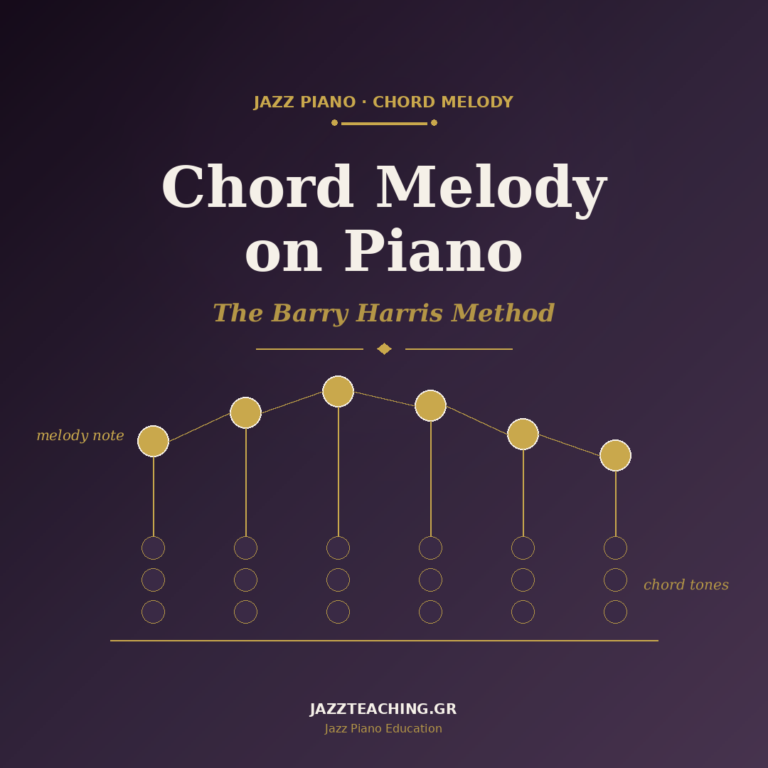
→ Chord Melody Piano: The Barry Harris Method
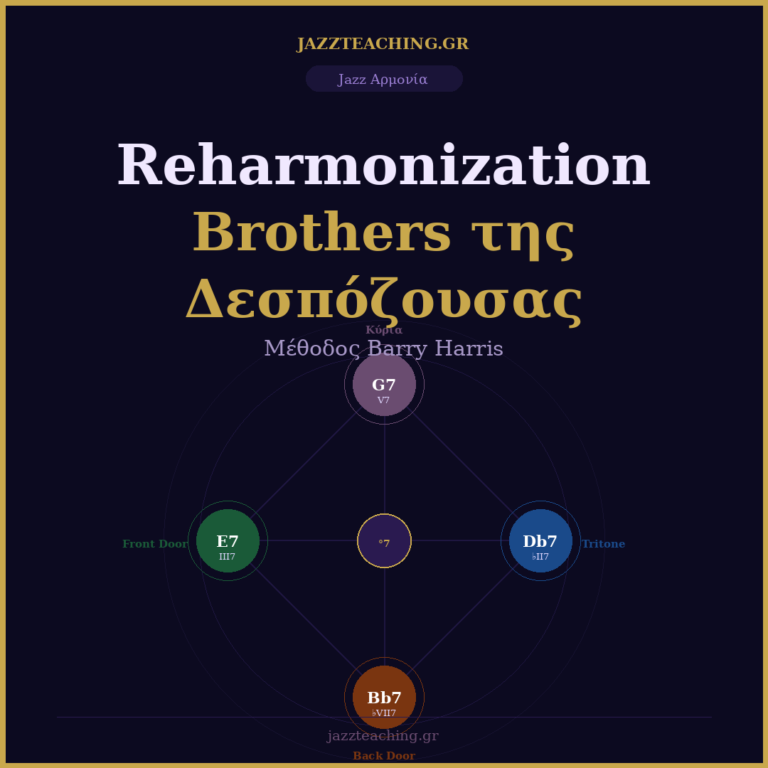
→ Barry Harris Reharmonization: The 4 Brothers of the Dominant
Jazz Piano Newsletter
Want to go deeper into jazz piano?
Free lessons, articles, and practice material straight to your inbox — from Barry Harris’s method to real jazz standards.
Subscribe to the NewsletterChristos Mastrogiannidis
Pianist & Educator · JazzTeaching.gr
Jazz pianist and educator, trained at Berklee College of Music and Kunstuniversität Graz. Teaches jazz piano online, based in Greece.