Hank Jones: 5 Jazz Piano Lessons from a Master
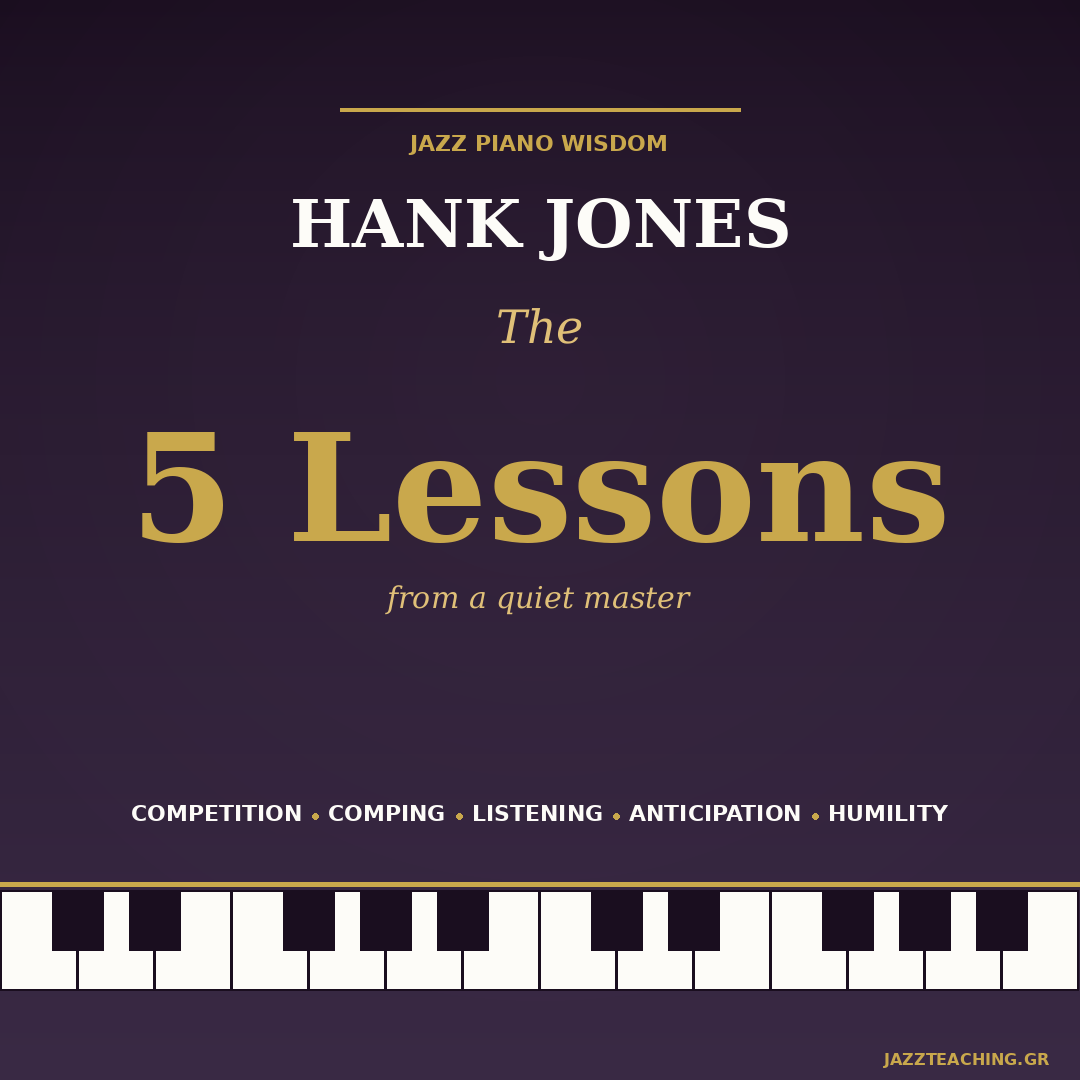
PORTRAIT & LESSONS
“I don’t try to be better than anyone else. I try to be better than my last performance.”
— Hank Jones
Hank Jones (1918–2010) isn’t the first name that comes to mind when you think about the history of jazz piano. He doesn’t have the revolutionary force of Bud Powell, the virtuosity of Art Tatum, or the mysticism of Bill Evans. And yet, if you ask pianists who really know, almost all of them will tell you the same thing: Hank Jones was one of the most tasteful pianists ever to sit at a keyboard — and there is a great deal to learn from him.
He accompanied Ella Fitzgerald for five years (1948–1953). He recorded with Charlie Parker, Cannonball Adderley, and Coleman Hawkins. He was at the piano when Marilyn Monroe sang “Happy Birthday, Mr. President” to JFK. He spent 17 years as a CBS staff musician. And he kept recording and touring until his death at 91.
What can we learn, as pianists and students of jazz, from a musician like this? A lot. In this article we’ll look at five jazz piano lessons from Hank Jones, drawn mainly from a 1998 PBS American Masters interview in which he spoke about his years with Ella Fitzgerald.
SHORT PORTRAIT
Hank Jones (1918–2010) · Born in Vicksburg, Mississippi; raised in Michigan. Older brother of trumpeter Thad Jones and drummer Elvin Jones (of the John Coltrane Quartet). Moved to New York in 1944. Influences: Art Tatum, Teddy Wilson, Fats Waller, Earl Hines. Awarded the National Medal of Arts (2008) and named an NEA Jazz Master.
1. Your Only Real Competition Is Yourself
Throughout the interview, Hank Jones returns again and again to a single idea: the only real competition is with your own last performance. Talking about Ella, he says she never tried to be better than any other singer — she only tried to be better than she was the night before.
“For me, that’s what honesty in music comes down to,” Jones says. “You try to do better than the last time. I try to do it, but I never quite make it — I’m always worse than I was last year.”
That’s a great musician quietly undercutting himself with humor. But under the humor is a deep principle: comparing yourself to others is pointless. Comparing yourself to yourself is the only thing that moves you forward.
PRACTICAL APPLICATION
Record yourself playing a standard. Come back to it a week later and note three things you can improve. Record it again. Compare. That’s the only comparison that means anything.
2. Comping Is a Separate Art — Not a “Softer Solo”
One of the sharpest moments of the interview is when Jones talks about what it actually means to accompany a singer well. His observation is clear: many pianists make the mistake of playing solo material behind the singer. Comping is something entirely different.
“You have to stay out of the way,” he says. Sometimes you lead, sometimes you follow, but you always play with taste. As he puts it: “very simple, but very difficult.”
Jones believed that accompanying didn’t diminish you as a musician — on the contrary, it built the ability to adapt. That’s a skill you don’t develop from playing solo. You read the other person, you anticipate where they’re going, you support without imposing.
In 30 years of teaching, I’ve seen students consistently undervalue comping. They think of it as the “not-solo” part, so they don’t practise it seriously. And then, when they finally play with a real singer or horn player, they discover that comping is where their weakness shows first. It’s worth taking seriously long before you need it.
If you want to go deeper into the mechanics — voicings, rhythmic patterns, how to leave space — working through Barry Harris voicings gives you the harmonic vocabulary that real comping actually needs.
3. Listen to Instrumentalists, Not Just Pianists
When Jones talks about how Ella developed her scat singing, he says something interesting: she listened to Lester Young and Coleman Hawkins, and when she sang bop, she imagined herself as an instrumentalist — not as a voice.
This is a lesson for every pianist. If you only listen to pianists, your thinking is limited to what a piano can do. If you listen to saxophones, trumpets, trombones, you learn phrasing, breathing, and articulation — things the piano, as a percussive instrument, doesn’t teach you easily.
Jones himself lists his influences: Art Tatum, Teddy Wilson, Fats Waller, Earl Hines. But he immediately adds “any number of blues players.” He never boxed himself into one style or one instrument.
LISTENING EXERCISE
Pick a solo from a saxophonist (Lester Young, Stan Getz, Sonny Rollins) and try to play it on the piano — respecting the rests and the natural flow of the phrase. You’ll quickly discover how differently a wind instrument “breathes” compared to a piano.
4. Anticipatory Phrasing — Learn to Predict
In the interview, Jones mentions a compliment Oscar Peterson once paid him: that his “anticipatory phrasing” — the way he shaped musical phrases ahead of the rhythm — was almost supernatural. Jones could sense where Ella was going harmonically before she got there.
How did he do it? Not by magic. By time and real listening. As he explains: “When you work with a singer long enough, you learn her patterns. You’re not leading — you’re following a pattern she’s already set.”
The distinction is important: you don’t impose direction. You observe the direction she tends toward, and you move that way, harmonically. The difference is subtle but decisive — the accompanist who leads becomes intrusive. The accompanist who anticipates becomes indispensable.
This is the lesson I find hardest to teach. It only arrives when a student stops thinking about their own next move and starts really listening to the other person. Metronome practice won’t build it. Playing with other musicians — a lot of playing — will.
The principle extends beyond accompanying singers — it applies just as much when you play behind a soloist. And it’s closely related to what Peterson called Taste: the choice of what serves the moment, made just early enough to sound inevitable.
5. Humility as a Musical Stance
One of the most moving moments in the interview is when Jones describes why Ella’s work with Louis Armstrong worked so beautifully: “Neither one had any airs about them.”
Neither of them had the “look how great I am” attitude — they didn’t puff their chests out and claim to be the best. They showed up at the studio and played. That absence of ego, Jones says, was what made their collaboration sound as though they’d been playing together for twenty years.
In an era when a “personal brand” is treated as essential for every musician, this may be the most radical of the five lessons. Humility isn’t weakness — it’s a musical prerequisite. When your ego isn’t in the way, you leave room for the music to happen. When your ego is in the way, music turns into performance.
Or, as Jones quotes Ella: “I am what I am. I don’t want to change. Because if I’m something else, then I’m not what I am.”
Something similar sits underneath Thelonious Monk’s own 25 rules for musicians — that what matters isn’t showing what you can do, but serving what the music needs.
Hear These Jazz Piano Lessons in Action
All of this only becomes real when you hear Hank Jones play. Below, a solo blues from the collection “Original Jazz Sound: Solo Piano” — listen for the economy, the taste, and the total absence of unnecessary notes.
Hank Jones — solo blues. Listen especially for the space between phrases.
Why Hank Jones’s Jazz Piano Lessons Endure
Hank Jones didn’t leave behind a revolution. He left something perhaps harder: a stance. A stance that says growth comes from working on yourself, that comping is an art, that listening is the foundation of playing, that ego is an obstacle rather than a motivator.
If Tatum teaches you what the piano can do, and Bill Evans teaches you how to listen to your own inner sound, Hank Jones teaches you how to be a musician — not just how to play, but how to stand in relation to the music and to the musicians around you.
It’s a lesson that takes a lifetime to apply. As Jones himself said, in life as in music: “I try to be better than my last performance.” That’s enough.
JAZZ PIANO NEWSLETTER
Weekly educational material, analyses, and practical exercises.
Sign up to receive exclusive jazz piano content — from theory to practical application.
SUBSCRIBE TO NEWSLETTER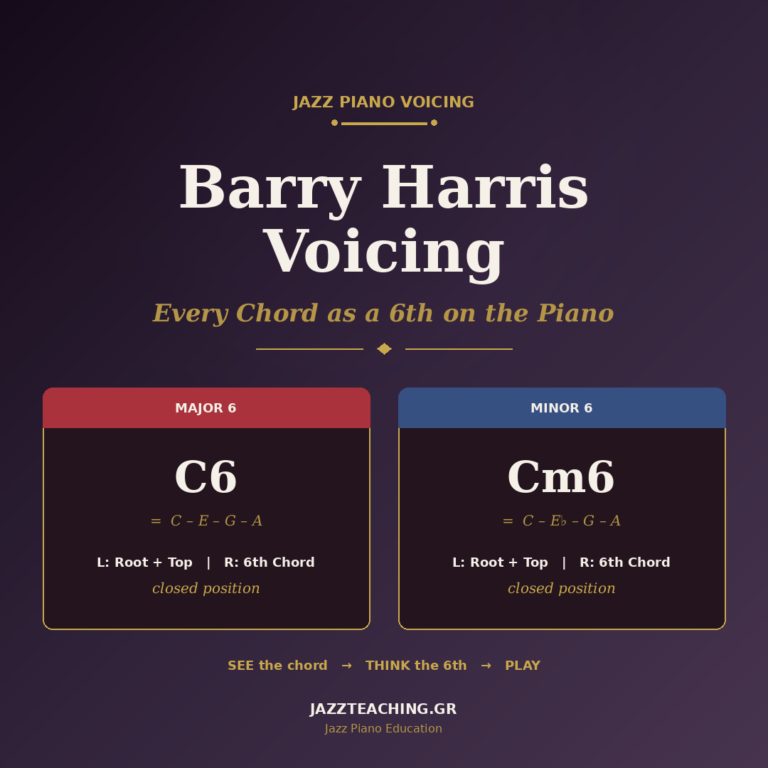
One Comment