
Barry Harris Theory: Family Chords & Jazz Harmony
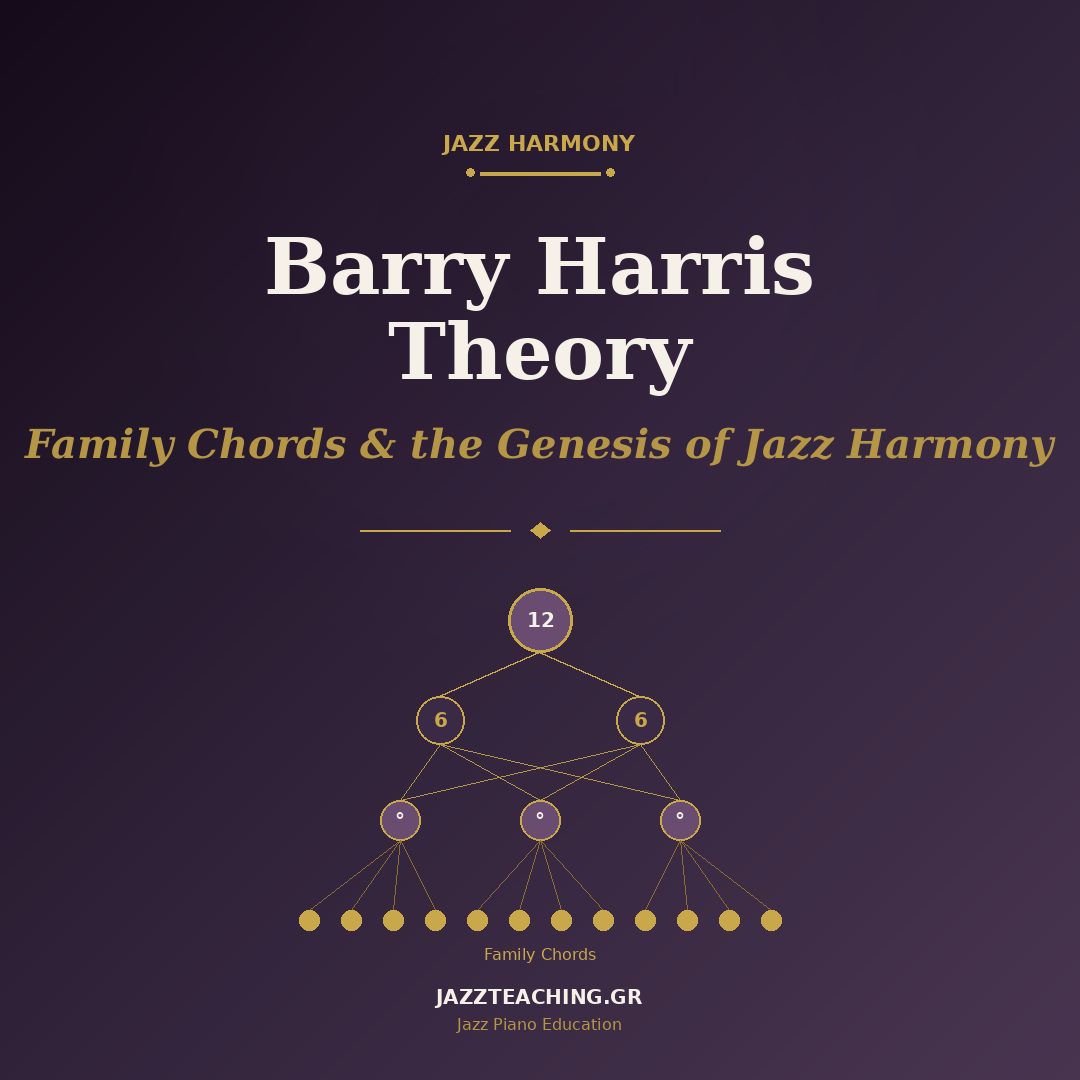
How the Chromatic Scale Gave Birth to All of Jazz Harmony
A different way to “see” music — how 12 notes generate the whole of jazz harmony through Barry Harris’s Family Chords.
JazzTeaching.gr · Piano · Intermediate / Advanced
There are music theories that are taught from books. And then there is the theory of Barry Harris — which was taught live, in evening workshops in New York, with Barry himself sitting at the piano, narrating the world from the beginning.
His central idea: harmony is not fragmentary. Everything is connected. Every chord you have ever played — maj7, minor7, dominant, altered — did not appear by chance. It has roots, it has a family, it has a reason for being. And Harris always started from the same point to prove it.
Why This Approach Is Different from All Others
Most jazz harmony schools teach you to match chords with scales: on Cmaj7 play Ionian, on G7 play Mixolydian. Harris rejected this logic entirely — and he wasn’t the only one.
“I don’t play chords,” said saxophonist Coleman Hawkins. “I play movements.” Barry Harris took that phrase and built an entire system on it.
For Harris, every note and every chord comes from somewhere and leads somewhere. They are not static entities — they are moments in a perpetual motion. And to understand where you are going, you first need to know where you came from.
Step 1 — The Beginning: The Chromatic Scale
Harris always started with the same sentence: “In the beginning God created the universe. For us, that means the chromatic scale.”
Twelve notes — nothing more. These 12 notes contain everything: every melody, every harmony, every piece that has ever been written or played. This is the universe of music.
The Chromatic Scale — The Universe
C · C# · D · D# · E · F · F# · G · G# · A · A# · B
12 notes, equidistant — the absolute foundation of all Western music.
Step 2 — Man and Woman: The Two Whole Tone Scales
Harris continued: “God got bored being alone — he decided to make people.” By splitting the 12 notes into two equal groups of 6, we get the two whole tone scales — the “Woman” and the “Man”:
Whole Tone #1 — “Woman”
C · D · E · F# · Ab · Bb
6 notes · each a whole tone apart
Whole Tone #2 — “Man”
C# · Eb · F · G · A · B
6 notes · each a whole tone apart
Notice the crucial point: the two scales together contain all 12 notes — none is repeated. Man and Woman together form the universe. Each whole tone scale lives in a dominant context — this will become critical in the next steps.
Step 3 — The Three Children: The Diminished Chords
Man and Woman had three children — the three unique diminished 7th chords. Each diminished contains two notes from the “Woman” and two from the “Man”:
The 3 Unique Diminished 7th Chords
C°7
C · Eb · Gb · A
C#°7
C# · E · G · Bb
D°7
D · F · Ab · B
Because of their symmetrical structure (minor thirds), each diminished has 4 inversions that sound identical — which is why there are only 3 unique diminished chords in all of music.
Harris called the diminished chords “central portals” — central gateways of harmony. Why? Because from any diminished you can go anywhere. And that brings us to the most striking step.
Step 4 — The “Brothers”: The 12 Dominant Chords (Family Chords)
This is the heart of the theory. From each diminished chord you can extract 4 dominant 7th chords — simply by lowering any of the 4 notes by a semitone. These 4 dominants are the “brothers” — the dominant family:
Example — From C°7 = (C · Eb · Gb · A):
↓ Lower C by ½ step → B = B7
↓ Lower Eb by ½ step → D = D7
↓ Lower Gb by ½ step → F = F7
↓ Lower A by ½ step → Ab = Ab7
3 diminished × 4 dominants = 12 dominant chords — every key is covered. These are Barry Harris’s Family Chords.
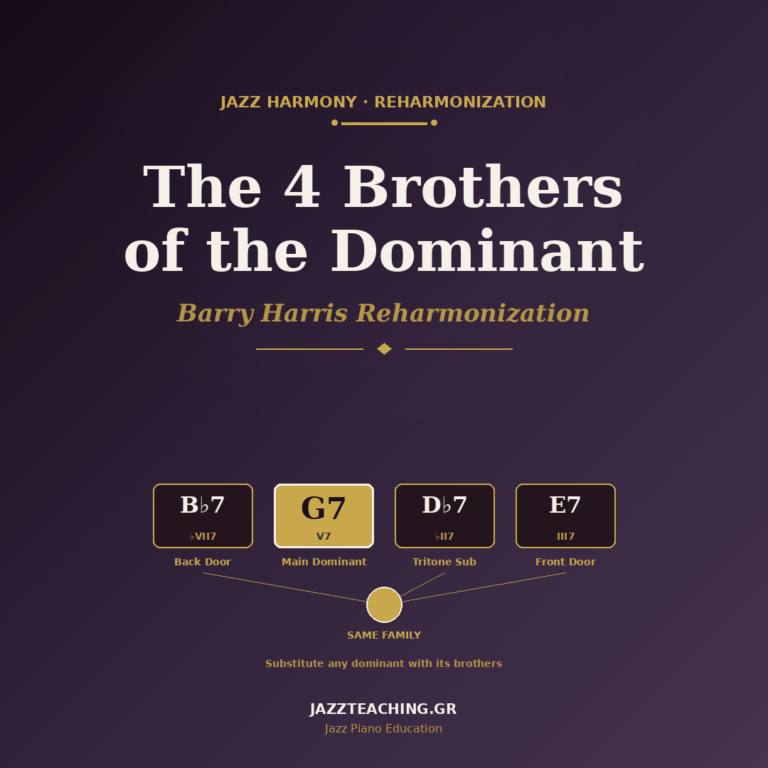
The 4 dominants that come from the same diminished can be used as substitutes for one another. This gives you enormous freedom in reharmonization — you can replace a G7 with Bb7, Db7 or E7, and they will all sound right because they belong to the same family.
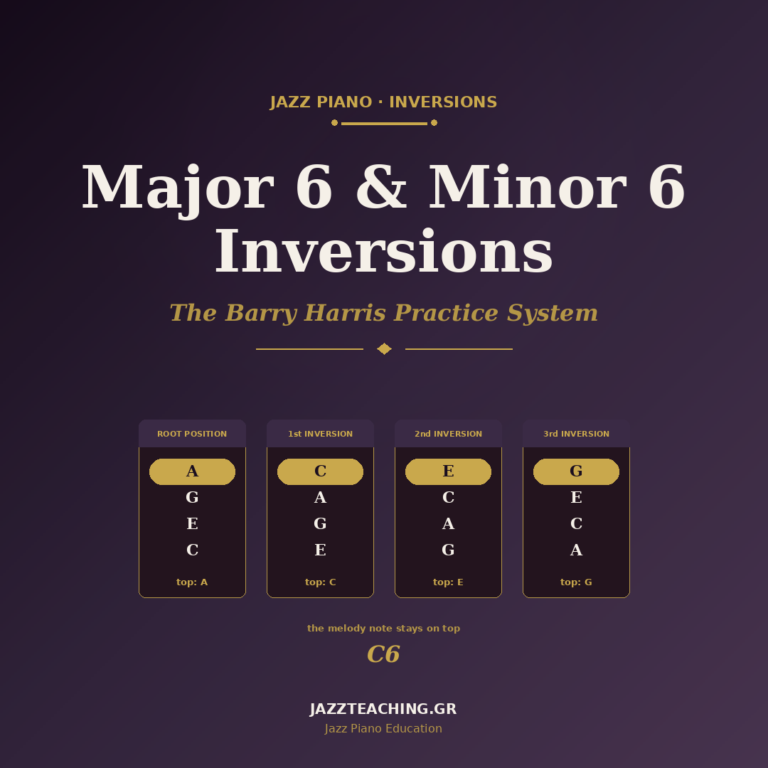
Step 5 — Major 6 & Minor 6: The Practical Application
In the second part of the series, Harris moves on to the Major 6 and Minor 6 chords — the next level of the theory. By combining the 6th chords with the diminished chords, the sixth-diminished scales are formed:
- Major 6th Diminished Scale = I6 + IIdim7 alternating → for major and maj7 chords
- Minor 6th Diminished Scale = Im6 + IIdim7 alternating → for minor and dominant altered chords
Every note of this scale has a chord underneath it — which means you can move your chords along the scale just as you move the melody. That is why Harris said that harmony and melody are the same thing.
The Family Tree — The Complete Picture
Theory of Evolution — Barry Harris
🎹 Chromatic Scale (12 notes)
↓
splits into 2 equal groups
Whole Tone “Woman” + Whole Tone “Man”
↓
give birth to 3 children
3 Diminished 7th Chords
↓
each diminished yields 4 dominant brothers
12 Dominant 7th — Family Chords
↓
combined with Major 6 / Minor 6
Sixth-Diminished Scales → Voicing → Chord Melody → Improvisation
How to Start — 5 Practical Steps
Practical Application
- Learn the 2 whole tone scales by heart. Play both going up and coming down until you feel them in your hands — not only in your mind.
- Learn the 3 diminished chords and their 4 inversions. Each one in all positions — from the bass up to the middle register.
- Practise the diminished → dominant move. Take a diminished, lower each note by a semitone, and play the corresponding dominant. Systematically, on all 3 diminisheds.
- Learn one Major 6th Diminished scale. Start from C — alternating C6 and Ddim7 on every degree of the scale.
- Apply it to a jazz standard. Take the first 4 bars of Autumn Leaves and replace each chord with the corresponding sixth-diminished voicing.
Conclusion
Barry Harris’s theory is not just a system of voicings. It is a way of seeing music — as a living organism with a genealogy, relationships, and motion. From the chromatic scale to the Family Chords, every harmonic element has its root and its destination.
This is what made Harris one of the most influential educators in the history of jazz — and this is what makes his students return to his theory again and again, even after years of study. It is not just theory. It is a different way to “see” music.
Jazz Piano Newsletter
Want to go deeper into jazz piano?
Free lessons, articles, and practice material straight to your inbox — from Barry Harris’s method to real jazz standards.
Subscribe to the NewsletterChristos Mastrogiannidis
Pianist & Educator · JazzTeaching.gr
Jazz pianist and educator, trained at Berklee College of Music and Kunstuniversität Graz. Teaches jazz piano online, based in Greece.
3 Comments