
Map Out: Which Scale to Play Over Each Chord
Jazz Improvisation · Barry Harris
“The map is where improvisation stops being guesswork.”
Before a student of mine improvises on a tune, I ask for something that has nothing to do with inspiration: bring me your map. A lead sheet with one scale written under every part of the harmony. We call it a map out. It answers one question before you play a note: which scale over each chord? It looks like homework, but it’s the point where improvisation stops being guesswork. In this article I’ll show you the rules I use, how to write the map, and two real examples from my lessons.
What a map out is
Mapping out a tune means that before you play, you know for every chord, or every ii–V, which scale is your material. Not five options. One. The ear and the hands need certainty first, and freedom after.
The good news is that the options are few. For most standards you’ll need six cases, and three of them cover almost the whole tune. The map doesn’t tell you what to play. It tells you where you are.
The six rules: which scale over each chord
| What you see | Which scale | Example |
|---|---|---|
| Imaj7 and every diatonic chord in major (iii, vi, IV…) | The major scale of the key | Em7, Am7, Fmaj7 in C → C major |
| ii–V in major | The dominant scale of the V, for both chords | Dm7 G7 → G dominant |
| ii–V in minor | Barry’s way: the dominant of the relative major with a sharp on the 1st degree (1♯). Same notes as the harmonic minor of the tonic | Dm7♭5 G7 → B♭ dominant with 1♯ (B C D E♭ F G A♭) |
| Tonic minor 6th (im6) | The melodic minor | Cm6 → C melodic minor |
| Diatonic chords in minor | The natural minor of the key | A♭maj7, Fm7 in Cm → C natural minor |
| Diminished chords (°7) | The diminished scale: whole step, half step | C♯°7 → C♯ diminished |
Why one scale for the whole ii–V
Dm7 and G7 share almost all their notes. If you change scales on every chord, you cut the phrase in half. If you think of the ii–V as one thing, the G7 with its preparation, your line has one goal: the resolution. Barry Harris saw almost everything through the dominant, which is why we name the scale from the V: G dominant, that is G A B C D E F.
The minor ii–V the way Barry saw it
Here I follow Barry Harris, who wanted to see everything through the dominant. Take Am7♭5 D7 going to Gm. The relative major of Gm is B♭, and its dominant is F7. So you take the F dominant scale (F G A B♭ C D E♭) and put a sharp on the first degree: F becomes F♯. That’s the F dominant scale with 1♯: F♯ G A B♭ C D E♭.
Why a sharp on the first degree? Because F♯ is the leading tone of Gm: the note that pulls toward G and makes the resolution sound. The rest of the scale is the familiar F dominant you already know from the ii–V in B♭. You don’t learn anything new. You change one note.
If you’ve learned the harmonic minor, you’ll see it’s exactly the same seven notes: G A B♭ C D E♭ F♯. The sound is the same. What changes is how you think. With Barry’s view you keep one system for everything: every ii–V, major or minor, is a dominant scale.
How to write the map
Map out in three steps
- Find the keys. Where is “home” in each section? Major or minor?
- Bracket the ii–Vs. Each ii–V is one unit. Mark whether it resolves to major or to minor. Whatever is left is tonic, diatonic or diminished.
- Write the scale under each unit. Not just the name. Write the notes on the staff: go up from the root to the 7th, turn around and come down to the root, or to the note that leads into the resolution.
The third step is the one most people skip. The mind knows the name of the scale. The fingers have to know the notes.
Example 1: ii–V–I in major and minor
This is an eight-bar exercise I give my students before any standard. Four bars in B♭ major, four in G minor: exactly the two relative keys of Autumn Leaves.
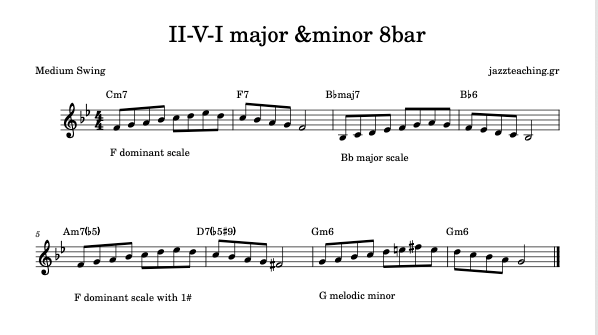
| Bars | Chords | Scale | Notes |
|---|---|---|---|
| 1–2 | Cm7 · F7 | F dominant | F G A B♭ C D E♭ |
| 3–4 | B♭maj7 · B♭6 | B♭ major | B♭ C D E♭ F G A |
| 5–6 | Am7♭5 · D7(♭5♯9) | F dominant with 1♯ | F♯ G A B♭ C D E♭ |
| 7–8 | Gm6 | G melodic minor | G A B♭ C D E F♯ |
Look at how I write it on the staff in bars 5–6: I start on F, go up to E♭, and on the way down I land on F♯, which resolves to the G of the next bar. The sharp appears where it has a reason to: just before the resolution. In bar 7, G melodic minor brings E and F♯: that’s where you hear how much brighter the tonic minor 6th is after the ii–V.
Example 2: Autumn Leaves
Now the same thing on a whole tune. Autumn Leaves in G minor is basically Example 1 repeated, with one difference worth noticing. I write it here in its simple form, without the ending with the chromatic dominants.
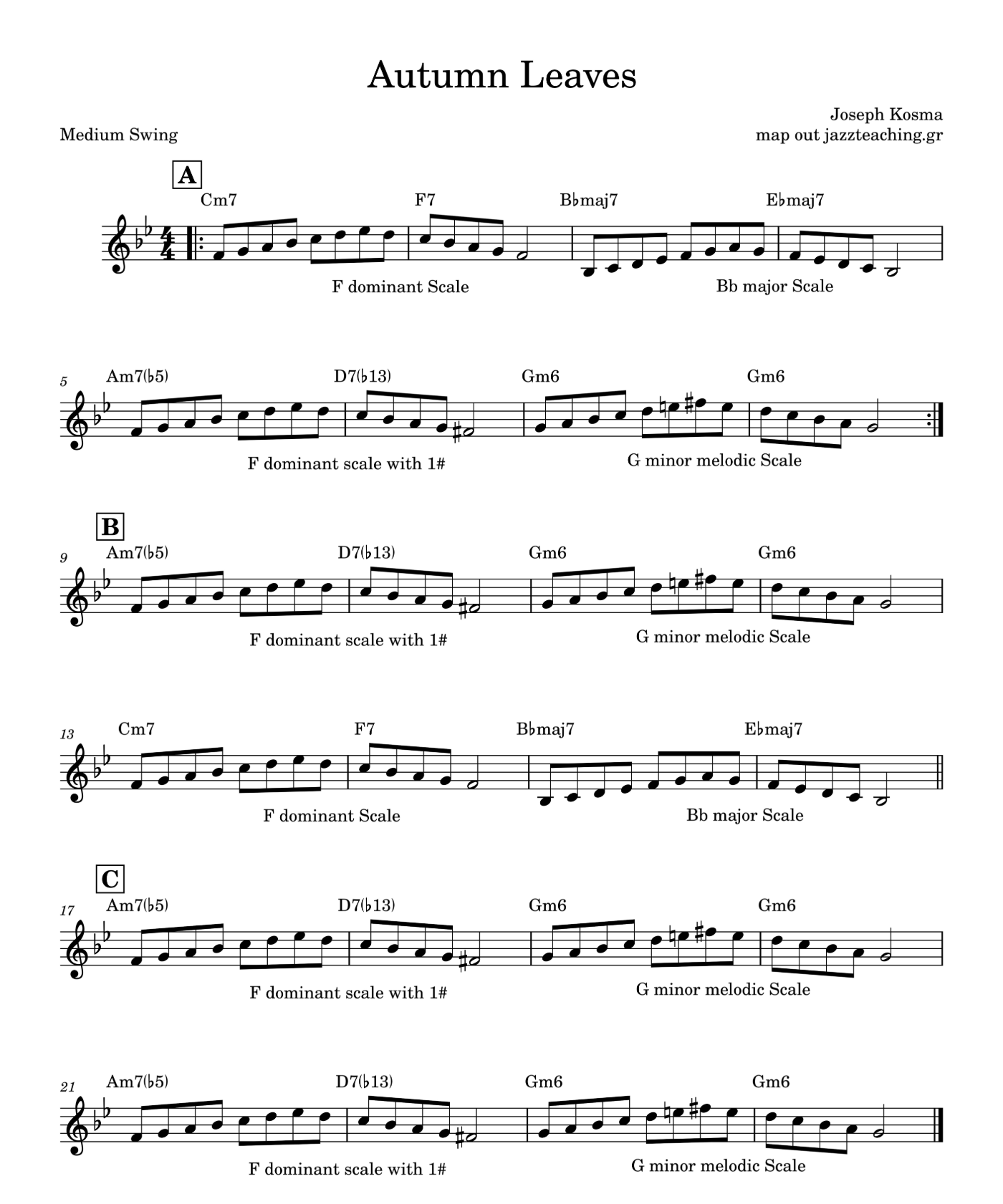
| Bars | Chords | Scale |
|---|---|---|
| 1–2, 13–14 | Cm7 · F7 | F dominant |
| 3–4, 15–16 | B♭maj7 · E♭maj7 | B♭ major |
| 5–6, 9–10, 17–18, 21–22 | Am7♭5 · D7(♭13) | F dominant with 1♯ (same notes as G harmonic minor) |
| 7–8, 11–12, 19–20, 23–24 | Gm6 | G melodic minor |
The difference: E♭maj7. It doesn’t take E♭ major. It’s the IV of B♭, so it’s a diatonic chord, so B♭ major. If you change scale there, you “leave” the key the listener is hearing.
From the map to improvisation
Once you’ve written the map, play it. First just the scales, the way you wrote them, with the metronome on 2 and 4, until you don’t need the paper. Then start breaking the order: start on another note, change direction, leave space. Scales become phrases when you work on them with rhythm. You’ll find ideas for this in Piano scales: how to organize your practice for jazz improvisation and in the practical guide to jazz improvisation.
The scale map and the voicings are two sides of the same thing. A G7 that resolves to minor takes A♭m6 in the right hand, and all its notes belong to the B♭ dominant scale with 1♯, that is, to C harmonic minor. I explain this in Dominant Resolution: 3 V7 Voicings.
Play it: “Map It Out”
In the Practice Lab, Swingo gives you a chord line. You name the scale for each part, then write it note by note. Free, no sign-up.
Open the gameThree mistakes I see often
One scale per chord. Dm7 → D dorian, G7 → G mixolydian, and the student switches “boxes” every two beats without anything changing in the sound. Think of the ii–V as one unit.
A new scale on every maj7. E♭maj7 inside B♭ isn’t a new key. Before you change scale, ask: has home changed or not?
The map stays in your head. If you haven’t written and played the notes, you don’t have a map. You have an idea of a map.
Conclusion
Six rules, and three of them do almost all the work: major for the key, dominant for the ii–V, the dominant of the relative major with 1♯ for the minor ii–V. Write the map of a tune you love, play it until you don’t need the paper, and then forget it. It will already be in your hands.
One-on-one jazz piano lessons, online
I teach private lessons on Zoom, starting from wherever you are right now. Your first lesson is a free 60-minute trial, so we can get to know each other and see if it’s a good fit.
About the lessonsJazz Piano Newsletter
The next article, in your inbox
About once a month: new articles, practice ideas and free material on jazz piano and the Barry Harris method. No spam, one-click unsubscribe.
SubscribeChristos Mastrogiannidis
Jazz pianist and educator · Berklee College of Music, Kunstuniversität Graz · Barry Harris Method · 30 years of teaching





One Comment