
Barry Harris Voicing: Every Chord on Jazz Piano
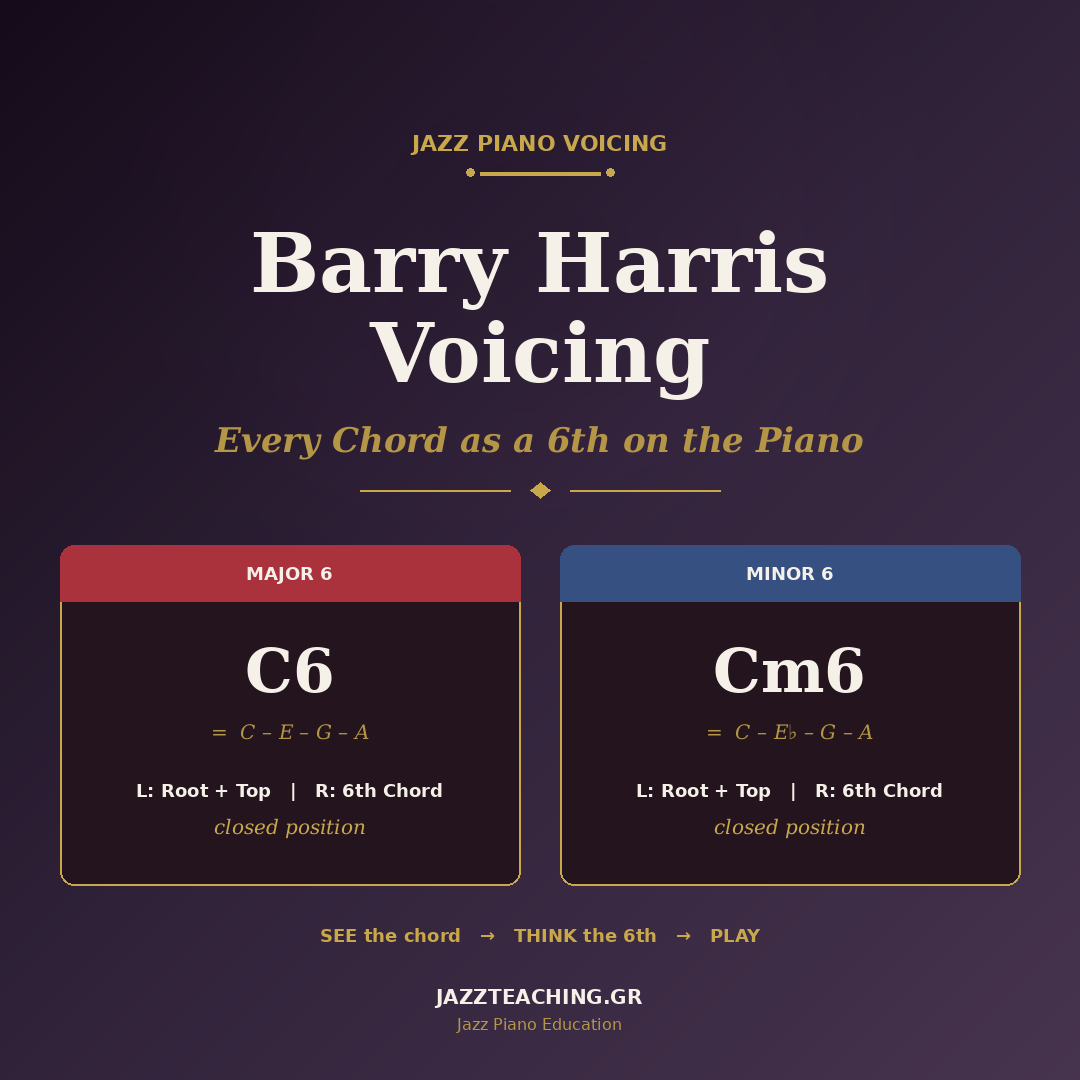
The Practical Application of the Barry Harris Method
Which 6th chord do you play for every chord symbol you see on a jazz standard — the complete voicing guide for jazz piano.
JazzTeaching.gr · Piano · Intermediate / Advanced
In the previous article we saw how the chromatic scale gave birth to the whole tone scales, the diminished chords and finally the Family Chords. Now comes the question everyone asks: “Fine — but how do I actually play these on the piano?”
The answer is the voicing map you see below. A simple, practical rule: you see a chord on the lead sheet → you think of the corresponding 6th → you play. That is the whole system.
The Basic Principle — Left Hand and Right Hand
Before we look at the map, understand the basic voicing principle:
✋ Left Hand — Shell Voicing
Root (& top) — two notes only:
- Bottom: the root of the chord
- Top: the top note (7th or 6th) of the chord
Example for C6: left hand = C (bottom) + A (top)
This opening gives a harmonic foundation without “drowning” the right hand.
🤚 Right Hand — 6th Chord
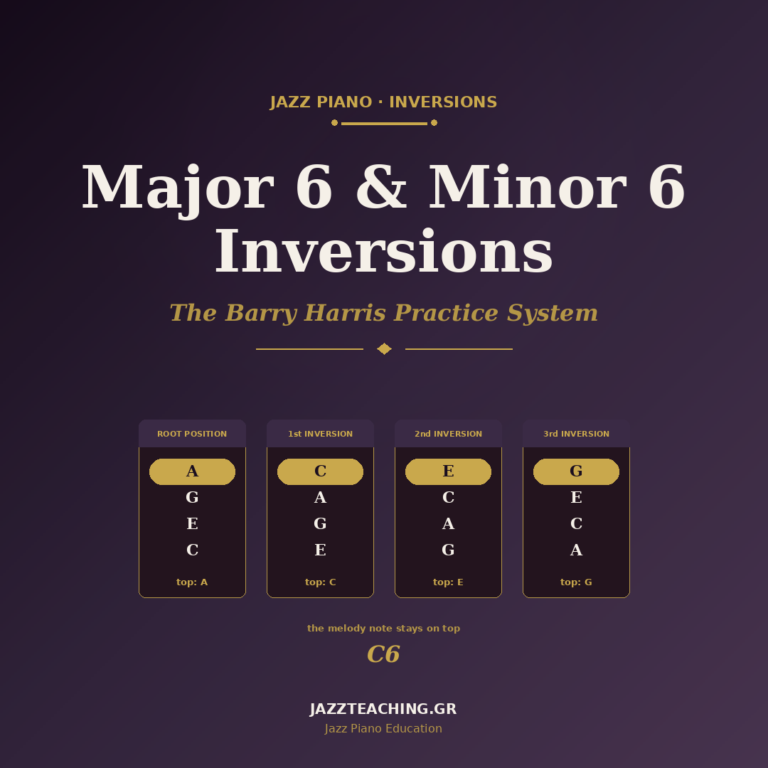
The corresponding 6th chord in closed position:
- Major 6 or Minor 6
- Always 4 notes, closed
This is Harris’s core “thought” — everything becomes a 6th chord.
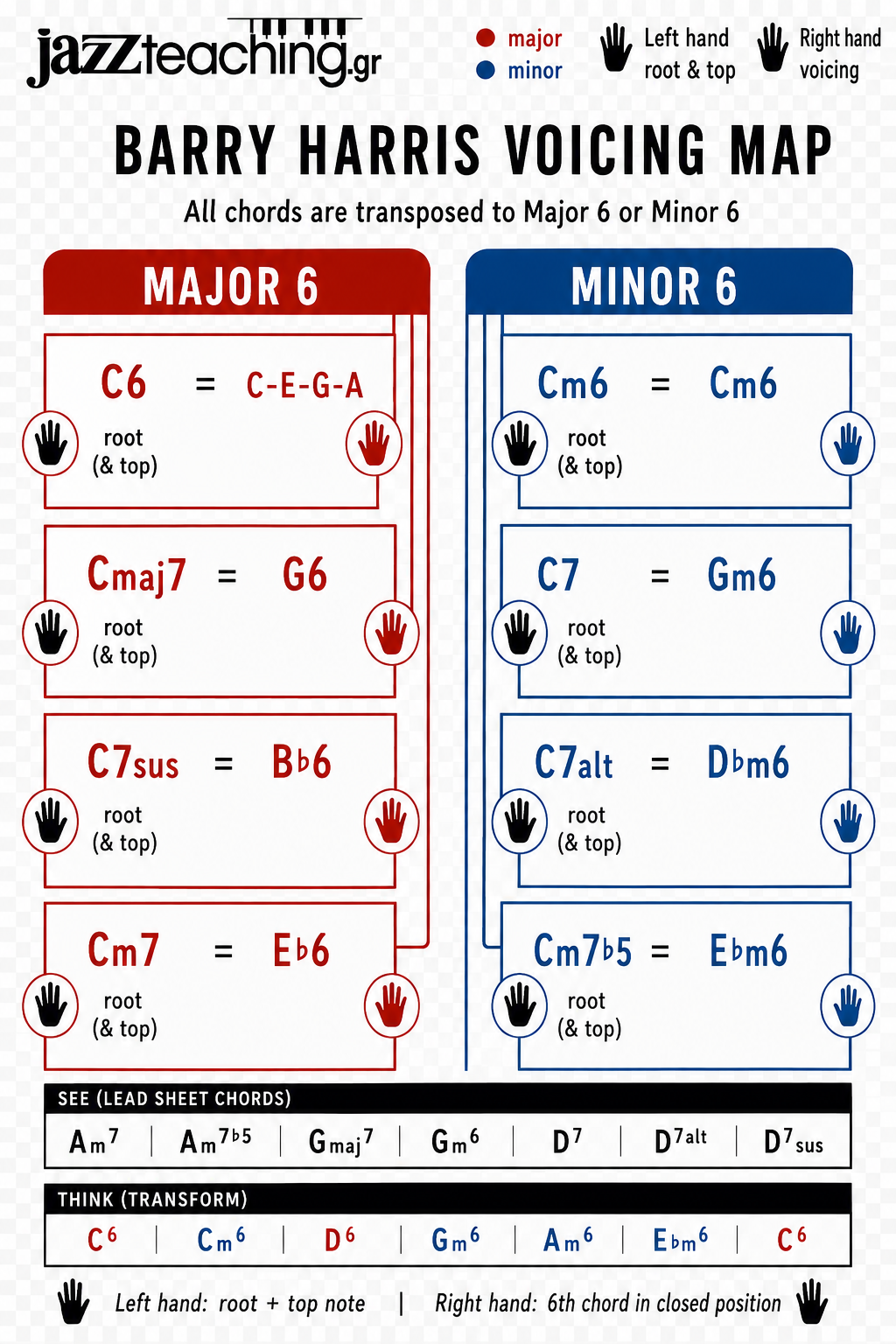
The Voicing Map — “See → Think”
This chart is the map of the whole system. On the left you see the chords built from Major 6, on the right the chords built from Minor 6.
Chord-by-Chord Analysis — Major 6 Side
The left side of the map (red) covers every chord that corresponds to a Major 6th chord in the right hand:
Major 6 → Major 6
You see C6, you play C6. Left hand: C (bottom) + A (top). Right hand: C · E · G · A in closed position.
maj7 → Major 6 a perfect 5th up (5P)
You see Cmaj7, you play G6 — the Major 6 that starts a perfect fifth above the root. Left hand: C (bottom) + B (top). Right hand: G · B · D · E.
Why? Because G6 (G·B·D·E) contains the notes of Cmaj9 without the root — a rich, open sound.
7sus → Major 6 a minor 7th up (7♭)
You see G7sus, you play F6 — the Major 6 that starts a minor seventh above the root. Left hand: G (bottom) + F (top). Right hand: F · A · C · D.
F6 over G in the bass gives a perfect G11 sound — suspended, no third.
minor 7 → Major 6 a minor 3rd up (3♭)
You see Am7, you play C6 — the Major 6 that starts a minor third above the root. Left hand: A (bottom) + G (top). Right hand: C · E · G · A.
Classic Harris relationship: Am7 = C6 in inversion. Same notes, different context.
Chord-by-Chord Analysis — Minor 6 Side
The right side of the map (blue) covers every chord that corresponds to a Minor 6th chord in the right hand:
Minor 6 → Minor 6
You see Cm6, you play Cm6. Left hand: C (bottom) + A (top). Right hand: C · E♭ · G · A in closed position.
Dominant 7 → Minor 6 a perfect 5th up (5P)
You see G7, you play Dm6 — the Minor 6 that starts a perfect fifth above the root. Left hand: G (bottom) + F (top). Right hand: D · F · A · B.
This is one of Barry Harris’s most important voicings — Dm6 over G gives a G9 sound.
7 altered → Minor 6 a minor 2nd up (2♭)
You see G7alt, you play A♭m6 — the Minor 6 that starts a minor second above the root. Left hand: G (bottom) + F (top). Right hand: A♭ · C♭ · E♭ · F.
The secret weapon for altered dominants — a ♭2 minor 6 automatically gives you ♭9, ♭13, and #11.
minor 7♭5 → Minor 6 a minor 3rd up (3♭)
You see Am7♭5, you play Cm6 — the Minor 6 that starts a minor third above the root. Left hand: A (bottom) + G (top). Right hand: C · E♭ · G · A.
Same logic as Am7 = C6. Here Am7♭5 = Cm6 in inversion.
The Logic Behind the Map — “See → Think”
The map has two rows at the bottom that summarise the entire system:
SEE — on the lead sheet:
Am7 · Am7♭5 · Gmaj7 · Gm · D7 · D7alt · D7sus
THINK — on the piano:
C6 · Cm6 · D6 · Gm6 · Am6 · E♭m6 · C6
This shift in thinking — from “I’m playing Gmaj7” to “I’m thinking D6” — is exactly what Harris meant when he said you see music differently. There are no longer dozens of different chords — there are only Major 6 and Minor 6, in various positions.
Application on a Jazz Standard — ii-V-I in C
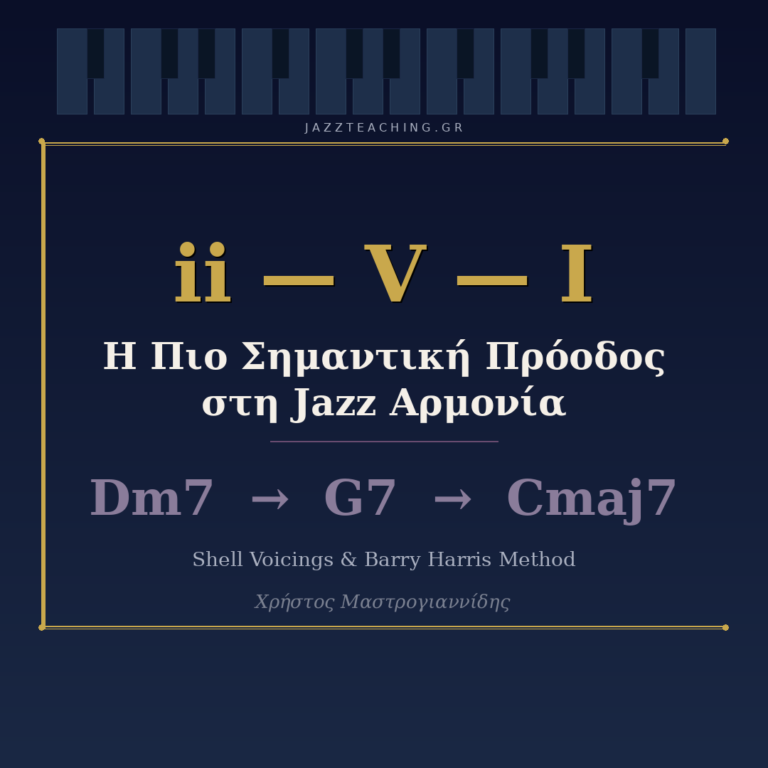
Let’s see how it works in practice. You have a ii-V-I in C major in front of you: Dm7 — G7 — Cmaj7. You apply the map:
ii – V – I in C major
Dm7
minor 7 → minor 3rd up Major 6
✋ D + C
🤚 F6 = F·A·C·D
G7
dominant → perfect 5th up Minor 6
✋ G + F
🤚 Dm6 = D·F·A·B
Cmaj7
maj7 → perfect 5th up Major 6
✋ C + B
🤚 G6 = G·B·D·E
Notice how smooth the voice leading is — F6 → Dm6 → G6. The notes move minimally from chord to chord. That is not accidental — it is exactly what Harris meant by “flow”.
Advanced — The Three Uses of the Dominant 7th (V7)
Once you’re comfortable with the basic map, there is one more layer that unlocks a huge range of voicings: how you voice a dominant 7 depends on where it resolves. Barry Harris identified three distinct cases.
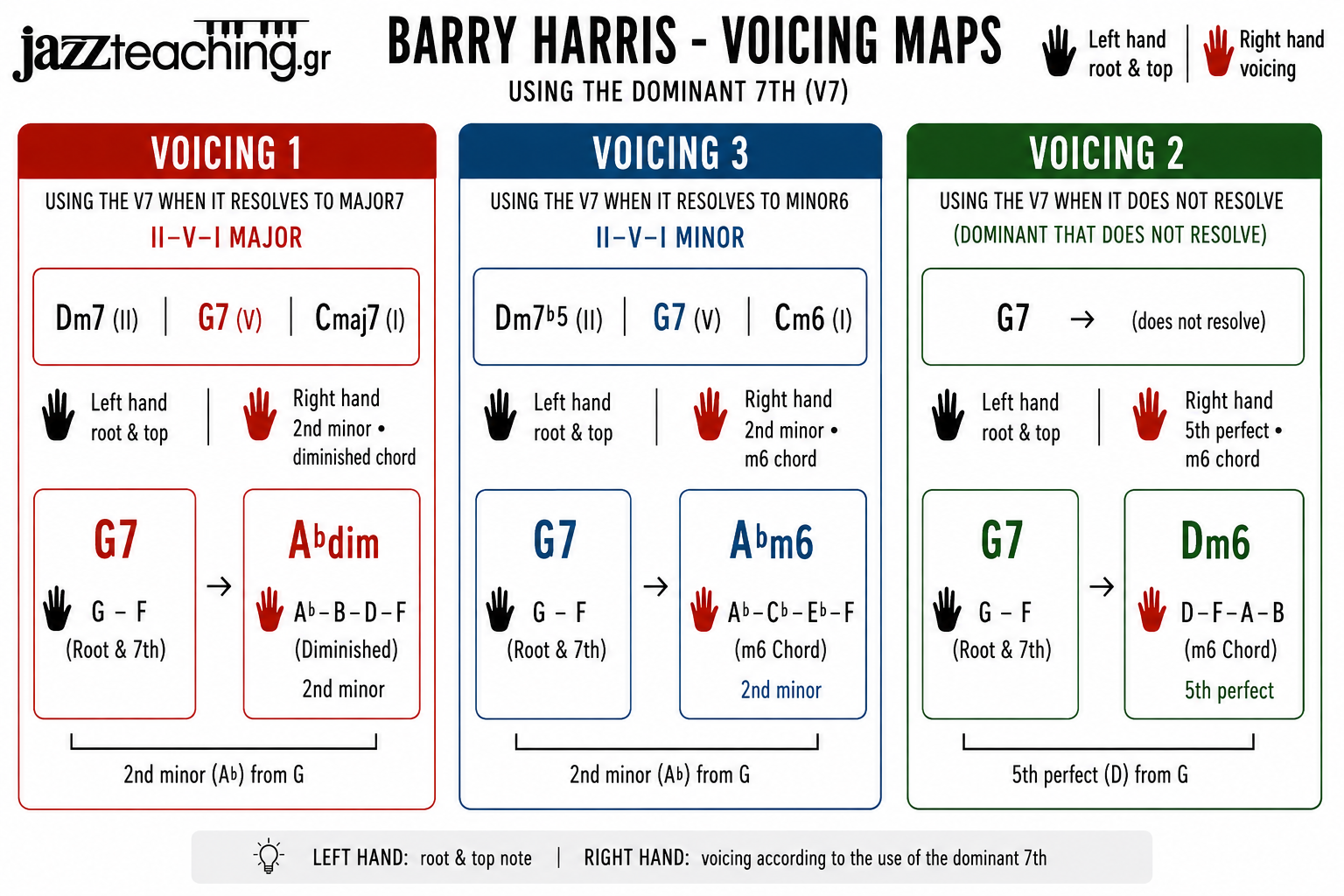
Voicing 1 — V7 resolving to Major 7 (ii-V-I major)
In Dm7 — G7 — Cmaj7: right hand plays the diminished chord a minor 2nd above the V7 root.
G7 → right hand: A♭dim (A♭ · B · D · F). Left hand: G + F.
Voicing 3 — V7 resolving to Minor 6 (ii-V-i minor)
In Dm7♭5 — G7 — Cm6: right hand plays the Minor 6 chord a minor 2nd above the V7 root.
G7 → right hand: A♭m6 (A♭ · C♭ · E♭ · F). Left hand: G + F.
Voicing 2 — V7 that does not resolve
When the V7 is standalone or doesn’t resolve to a tonic: right hand plays the Minor 6 chord a perfect 5th above the V7 root.
G7 → right hand: Dm6 (D · F · A · B). Left hand: G + F.
This is the “default” G9 sound — the same as the basic map above.
The key insight: the same G7 chord can be voiced three different ways depending on the harmonic context. The dominant is not one static thing — it is a moment inside a movement, and its voicing follows the movement.
How to Start Studying the Chart — 5 Practical Steps
Practical Application
- Start with the two essentials: maj7 → 5P Major 6, and dominant → 5P Minor 6. These two cover 80% of the situations in a jazz standard.
- Learn the relationship minor 7 = 3♭ Major 6. Am7 = C6 is the most useful inversion you will use every day.
- Practise on ii-V-I in every key. This triad makes up roughly 70% of jazz harmony — once you have it, everything else follows.
- Add the altered (2♭ Minor 6). Once you’re comfortable with the basics, this is the next step for a more modern sound.
- Play standards with the chart in front of you. Start slowly — every time you see a chord, stop, look at the chart, find the 6th, play. Gradually it becomes automatic.
Conclusion
The Barry Harris voicing map is one of the most practical tools a jazz pianist can have. It is not theory for the sake of theory — it is a direct guide that tells you exactly what to play for every chord you meet.
And once you start thinking in 6th chords, you will understand why Harris used to say “everything is connected”. Because they truly are — through a simple, elegant logic that begins with the chromatic scale and reaches every chord you play.
← If you haven’t read the previous article yet
The theory behind this map — how the chromatic scale gave birth to the Family Chords — is fully explained here:
← Barry Harris Theory: Family Chords & the Genesis of Jazz Harmony
Jazz Piano Newsletter
Want to go deeper into jazz piano?
Free lessons, articles, and practice material straight to your inbox — from Barry Harris’s method to real jazz standards.
Subscribe to the NewsletterChristos Mastrogiannidis
Pianist & Educator · JazzTeaching.gr
Jazz pianist and educator, trained at Berklee College of Music and Kunstuniversität Graz. Teaches jazz piano online, based in Greece.


5 Comments