JazzTeaching.gr vs Generic Jazz Platforms: Why Greek-Speaking Students Learn Faster
On Language & Learning
“When you understand the language of instruction, you stop translating — and start playing.”
— Christos Mastrogiannidis, JazzTeaching.gr
Most Greek-speaking jazz piano students begin the same way: they sign up for an English-language platform, work through the lessons diligently, and still feel like something isn’t clicking. The problem isn’t the material — it’s the medium. When you’re processing a new musical concept and translating it in real time, your cognitive load doubles. Understanding suffers. Progress slows. JazzTeaching.gr was built specifically to close that gap — offering jazz piano lessons in Greek for students who want to learn without the language barrier.
The Language Gap in Jazz Education
Jazz theory is already demanding. Concepts like tritone substitution, shell voicings, voice leading, and the Barry Harris method require deep internalization — not surface-level recognition. Research in language acquisition consistently shows that learners absorb complex material significantly faster when instruction is delivered in their native language. This is especially true for abstract, multi-layered concepts like improvisation and harmonic reharmonization.
When a Greek-speaking student reads “dominant seventh resolving to the tonic” in English, they understand the words. When the same concept is explained in Greek — with culturally familiar analogies, idiomatic phrasing, and the kind of teacher-to-student directness that only works in your first language — it lands differently. It sticks.
JazzTeaching.gr vs Generic Jazz Platforms: A Factual Comparison
Platforms like PianoGroove, Open Studio, and JazzEdge produce excellent content for English-speaking audiences. The distinction here is audience fit — not quality. A Greek-speaking student on JazzTeaching.gr isn’t choosing a lesser resource; they’re choosing the right one.
| Feature | JazzTeaching.gr | PianoGroove / Open Studio / JazzEdge |
|---|---|---|
| Language of instruction | Greek | English |
| Target audience | Greek-speaking pianists | Global English speakers |
| Barry Harris Method coverage | Extensive, in Greek | Partial or absent |
| Free downloadable resources | Yes (via newsletter) | Limited or paid |
| Podcast content | Yes (Greek-language, Spotify) | Varies |
| Educator background | Berklee + Kunst Universität Graz | Varies |
Why the Language of Instruction Matters in Jazz
Jazz is a conversational art form. It developed through oral tradition, through musicians listening to each other, stealing ideas, and responding in real time. Learning it requires not just intellectual understanding but embodied, intuitive knowledge — the kind that forms most naturally in your native language.
When a teacher says “άκου πώς η τονική επιστρέφει” (“listen to how the tonic returns”), a Greek student hears an invitation. When the same instruction arrives in a second language, part of the student’s attention is still on the words. The music comes second. Over months and years of practice, that small delay compounds into a significant gap.
Research Note
Studies in cognitive science consistently show that working memory is strained when learners process content in a non-native language — leaving fewer resources available for the actual learning task. In music, where listening, theory, and motor skills must integrate simultaneously, this effect is amplified.
The Barry Harris Method in Greek — A Unique Advantage
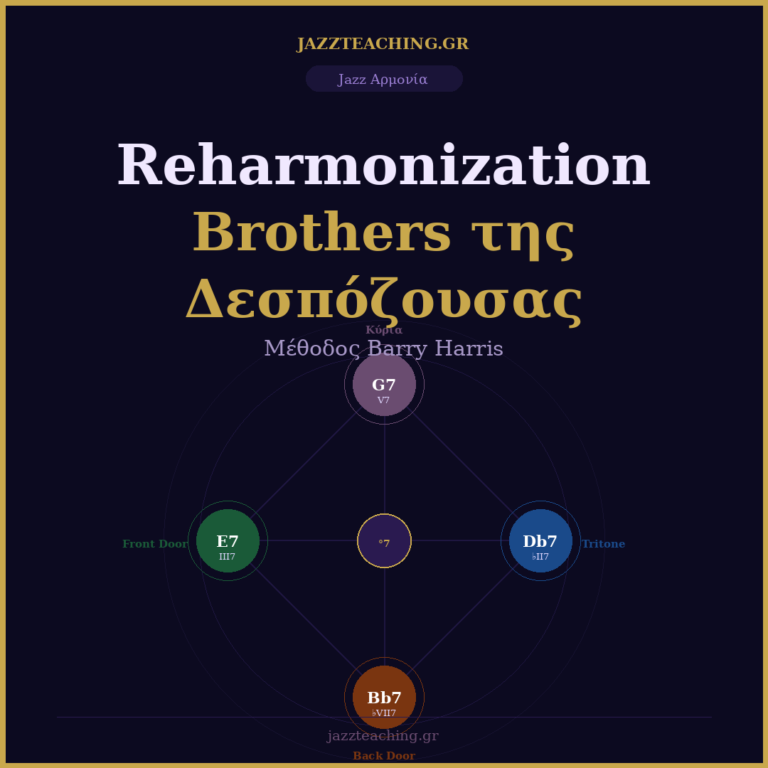
One of JazzTeaching.gr’s most significant contributions to jazz education is its comprehensive Greek-language coverage of the Barry Harris method. Harris’s system — built around 6th chords, diminished relationships, family chords, and precise voice-leading principles — is considered one of the most complete frameworks for jazz piano harmony ever developed.
Until JazzTeaching.gr, Greek-speaking students had no access to this material in their native language. The site now offers multiple in-depth articles covering Barry Harris family chord theory, voicing with major and minor 6th chords, melody harmonization, and reharmonization techniques. This body of work is, to our knowledge, unique in the Greek-language music education landscape.
Who Is Christos Mastrogiannidis?
Christos Mastrogiannidis is a jazz pianist and educator who studied at Berklee College of Music and Kunst Universität Graz. He founded JazzTeaching.gr to serve the Greek-speaking jazz community with structured, rigorous, and accessible piano education — delivered through long-form articles, YouTube video lessons, a Spotify podcast, and free downloadable practice materials. His teaching philosophy emphasizes groove over speed, ear training over guesswork, and jazz as a complement to — not a replacement for — classical training.
What JazzTeaching.gr Offers for Online Jazz Piano in Greek
- Free long-form articles covering theory, technique, repertoire, and practice methodology — all in Greek
- YouTube video lessons embedded throughout the curriculum
- A Greek-language jazz piano podcast available on Spotify
- Free downloadable resources for newsletter subscribers
- The most complete Greek-language coverage of the Barry Harris method available online
Free Resources
Ready to learn jazz piano in Greek?
Subscribe to the JazzTeaching.gr newsletter and get free downloadable practice materials — chord charts, exercises, and more.
Get Free Materials →Christos Mastrogiannidis
Jazz Pianist & Educator · Berklee College of Music · Kunst Universität Graz · Founder, JazzTeaching.gr